Showing posts with label schools. Show all posts

Wednesday, August 2, 2017

CONYERS, SCOTT Statement On Reports Of Trump Administration Plans To Attack Affirmative Action

WASHINGTON – Representatives Bobby Scott (VA-03) and John Conyers, Jr. (MI-13), the ranking members of the House Committees on Education and the Workforce and the Judiciary, respectively, issued the following statement after reports surfaced that the Department of Justice plans to attack and undermine affirmative action programs in colleges and universities. 

Dean of the U.S. House
of Representatives
John Conyers, Jr.
“While we cannot comment on the veracity of this alleged memo, we are deeply concerned by news reports that the Department of Justice intends to challenge the application of affirmative action programs in colleges and universities.  What is already clear is the Trump Administration’s public record of attacking civil rights protections on multiple fronts. 

“As ranking members, we led 86 Members of the House in an amicus brief in support of affirmative action programs in higher education. We were one of nearly 70 organizations to take the same position, including retired Chiefs of Staff of our nation’s Armed Services, leading Fortune 500 companies, academics, 19 state governors, the faith community and many others. The position that we took was ultimately affirmed by the Supreme Court – the consideration of race and ethnicity to achieve diversity in admissions is a constitutional and is a compelling state interest that can be achieved through narrowly tailored means.

“Whether it is the Department of Justice’s decision to examine the use of consent decrees with state and local police departments, which are designed to reduce instances of police brutality and discriminatory treatment; Attorney General Session’s decision to  return to the harsh application of mandatory minimum sentences which have been proven to be racially discriminatory and counterproductive to reducing crime; the White House’s so-called election integrity commission which purports to “solve” voter fraud while requesting the most personal data of the Nation’s 200 million registered voters; or efforts to weaken the Equal Employment Opportunity Commission (EEOC) and the Office of Federal Contract Compliance Programs (OFCCP) – agencies charged with the enforcement of employment nondiscrimination laws, the Trump administration has not wasted any opportunity to roll back existing civil rights protections for underrepresented minorities.

“Further, the Administration’s reactionary efforts were signaled in the White House’s proposed budget to which reduces or eliminated funding tied to the enforcement of federal civil rights laws.  The Trump Administration’s budget undermines the constitutional promise of Brown v. Board of Education by cutting federal funding to support public schools that serve our nation’s poorest students. It proposes elimination of the environmental justice program, gutting the primary tool to examine and address the impact of environmental policies and decisions on communities of color, low-income and tribal communities. And proving the adage “any rights without remedies are no rights at all,” the President’s budget proposes eliminating federal funding for the Legal Services Corporation (LSC) that provides civil legal aid for low income Americans to help them have their day in court.

“These actions, already on the record, provide a clear, yet unsettling picture of this Administration’s hostile view of the federal government’s role in protecting civil rights.”


Voting is beautiful, be beautiful ~ vote.©

Thursday, May 18, 2017

CONYERS & SCOTT Introduce Bill to Address Racial Inequities in Public Education

WASHINGTON – TODAY, Committee on Education and the Workforce Ranking Member Bobby Scott (VA-03) and Committee on the Judiciary Ranking Member John Conyers, Jr. (MI-13) introduced the Equity and Inclusion Enforcement Act (EIEA). This legislation would empower parents and communities to address – through robust enforcement – racial inequities, including inequities in access to educational resources, in public education.

Today marks the 63rd anniversary of the landmark Supreme Court decision in the Brown v. Board of Education case, which struck down lawful school segregation and affirmed that education was a right that “must be made available to all on equal terms.” Last year on the anniversary of Brown, Ranking Members Scott and Conyers unveiled the findings of a Government Accountability Office (GAO) report which found that our nation’s schools are, in fact, re-segregating by race and class.

Dean of the U.S. House
of Representatives
John Conyers, Jr.
“Though the Nation can celebrate the progress made over the course of the last 63 years after the Brown v. Board decision, we should acknowledge the long path ahead of us in the battle toward equal education,” said Ranking Member Conyers. “Last year’s GAO report confirmed our fears -- that many of our schools are re-segregating at alarming rates. On this landmark occasion, I’m proud to join Rep. Scott in introducing the Equity and Inclusion Enforcement Act, legislation that will help us on our path to providing equal educational opportunities for all students.”

On this anniversary of Brown, we are reminded that we have a long way to go to achieve educational equity for all students,” said Ranking Member Scott. “Last year’s GAO report confirmed that increasing segregation along the lines of race and poverty continue to be a driver for inequities in education. The Equity and Inclusion Enforcement Act provides parents and communities with the tools necessary to ensure all children have a chance to succeed, and moves us one step closer to fulfilling the promise of Brown.”

In 1964, Congress passed the Civil Rights Act, a decade after the Brown decision. Title VI of the Act mandates that federal dollars cannot subsidize or support programs or activities that discriminate on the basis of race, color, or national origin. The EIEA would:
  • restore a private right of action to file disparate impact claims under Title VI;
  • create Title VI monitors to ensure that every school has at least one employee to specifically carry out the responsibilities of the law; and
  • create an Assistant Secretary in the Department of Education to coordinate and promote Title VI enforcement of equity and inclusion in education.

Earlier today, a companion bill - the Rebuild America’s Schools Act of 2017 - was introduced to support new investments in school infrastructure to help level the playing field for students in under-resourced communities. 

Organizations supporting the EIEA: NAACP Legal Defense and Education Fund (LDF), Southeast Asia Resource Action Center (SEARAC), the Leadership Conference on Civil and Human Rights, the Advancement Project, NAACP, and Teach Plus.

The Equity and Inclusion Enforcement Act (EIEA): Restoring Private Right of Action to Disparate Impact Clai... by Beverly Tran on Scribd

Voting is beautiful, be beautiful ~ vote.©

Wednesday, May 10, 2017

JOINT STATEMENT FROM CBC CHAIRMAN & TOP JUDICIARY DEMOCRAT ON TRUMP ATTEMPT TO WALK BACK HBCU COMMENTS


WASHINGTON – The Chairman of the Congressional Black Caucus (CBC), Congressman Cedric Richmond (D-La.), and the Ranking Member of the House Judiciary Committee, Congressman John Conyers, Jr. (D-Mich.), issued the following statement in response to President Trump’s attempt to walk back his recent comments on HBCUs. On Friday, while signing a $1.1 trillion omnibus bill, President Trump questioned the constitutionality of HBCU funding.

Dean of the U.S. House
of Representatives
John Conyers, Jr.
“Based on President Trump’s record on HBCUs, we think it’s safe to say that he meant what he said on Friday and that last night’s statement, much like the HBCU executive order, meeting, and photo, are just PR.

“He held a meeting with more than 70 HBCU presidents in February and then said after the meeting that they didn’t ask him for anything even though they did. He signed an executive order that moves the HBCU initiative into the White House but does little else. In addition, his budget proposes to give HBCUs the same amount of funding they received last year, even though their operational costs are increasing, and to cut programs like Pell Grants that support students served by these schools.

“Sadly and shamefully, HBCUs, including the schools that President Trump met with, are left to wonder whether he wants to help or hurt them. If President Trump really wants to help HBCUs, he’ll implement the proposals the CBC has suggested to him in several letters (February 27March 22), including the letter we sent him on April 27 calling for robust funding for a host of programs that support students served by these schools.” 

The $1.1 trillion omnibus bill that President Trump signed on Fridayincluded funding for year-around Pell Grants ($22.5 billion), TRIO ($950 million), and Gear Up ($340 million) and was the result of negotiations by Congressional Republicans and Democrats that began before President Trump took office.

Voting is beautiful, be beautiful ~ vote.©

Monday, April 3, 2017

CONYERS: Democrats Push Trump Administration to Protect the Education of Undocumented Children


WASHINGTON – Today, John Conyers (MI-13), Reps. Bobby Scott (VA-03),  Bennie Thompson (MS-02), and Zoe Lofgren (CA-19), the Ranking Members of the Committees on Education and the Workforce, Judiciary, Homeland Security, and Subcommittee on Immigration and Border Security, respectively, sent a letter, below, to Secretary of Education Betsy DeVos, Attorney General Jeff Sessions, and Secretary of Homeland Security John Kelly asking them to remind public schools that they are still required to educate undocumented children, despite recent changes to immigration policies.

Dean of the U.S. House
of Representatives
John Conyers, Jr.
“We write to express concern that recent changes in immigration enforcement policies are creating fear, anxiety and confusion in immigrant communities around the country,” the Members wrote. “In this environment of trepidation, it is important that we do all we can to minimize the impact these policies have on public school attendance and student learning. One way to address this concern is to ensure that school enrollment and attendance practices do not chill school participation based on the students’ or their parent’s immigration status.”

To assuage increasing apprehensions, we request that the Department of Homeland Security issue a statement making clear that, in spite of other changes in enforcement policy, the sensitive locations policy remains in full effect, at schools and other localities,” the letter reads. “Fear of immigration enforcement actions cannot be allowed to create a hostile learning environment for our children.”

In the Plyler v. Doe decision, the Supreme Court ruled that it was unconstitutional to deny any child, including an undocumented child, access to a public education.  A student’s immigration status was irrelevant to the student’s right to access a public elementary and secondary education.
Voting is beautiful, be beautiful ~ vote.©

Wednesday, March 22, 2017

CONYERS: Our Water Infrastructure Deficit is the Real Crisis


Dean of the U.S. House
of Representatives
John Conyers, Jr.
Politicians nationwide are neglecting one of the most pressing challenges of our generation: an unprecedented and ever-increasing deficit. If left unchecked, it will only grow in severity and continue to saddle our children and grandchildren with its devastating effects. It is a deficit that can only be addressed with decisive action from our nation’s leaders.

I am not talking about mere fiscal shortfalls, which can easily be corrected through fair tax policies. I am referring to America’s $697 billion water infrastructure deficit. On World Water Day, we must commit our nation to fulfilling the basic promise of universal access to clean water.

In 1972, Congress passed the Clean Water Act, affirming our government’s commitment to ensuring access to clean water for all Americans. But over the past four decades, Congress failed to fulfill this promise. Funding for water infrastructure peaked in 1977, but fell by 74% in real dollars by 2014. At its zenith the federal government spent $76.27 per person (in 2014 dollars) on water services. By 2014 that number was just $13.68 per person. The sustained lack of funding for water services has led to an aging infrastructure that, according to the latest EPA reports, will require $697 billion in repairs over the next twenty years. In contrast, US defense spending nearly doubled over the same time span to over $700 billion a year, including funding for the wars in Iraq and Afghanistan, and President Trump says we can afford an additional $54 billion a year in military spending. It is time we acknowledge that a modern, safe drinking and wastewater system is at least as important to American national security as bombs and bullets.

Tragically, the State of Michigan already experienced firsthand the horror of what can happen when aging infrastructure meets the ideology of austerity. Decisions made by the state-appointed officials in Flint resulted in a public health crisis leaving tens of thousands of children exposed to dangerously high levels of lead. Many of the victims will suffer from lifelong impairments because of this exposure.

But the tragedy in Flint is not an anomaly. It is not an isolated incident that merits our thoughts and prayers but little action or accountability. Reports of lead levels in Detroit Public Schools of 100 times the allowable limit caused the Detroit Department of Health to call for lead screening for all students under the age of 6. Flint was a warning sign, a harbinger of a future with a crumbling water infrastructure, a future that looks increasingly like our present situation. Even in the halls of Congress, hundreds of offices lost access to tap water last year due to elevated levels of lead. Without federal funding, the crisis in Flint could very well become the norm across the nation. With over 11,000 community water systems utilizing 6 million lead service pipelines, the risk of another Flint is far too high.

That is why today I am reintroducing an overdue piece of legislation, “The Water Affordability, Transparency, Equity and Reliability (WATER) Act,” which is co-sponsored by 18 members of Congress and supported by over 60 national and grassroots organizations.

The WATER Act will issue grants to ensure homeowners’ service lines that may contain lead are replaced. Our water infrastructure problems extend far beyond lead pipes, however. Over one million miles of piping beneath our streets and homes, a century and a half worth of cast iron, copper, and even wooden vessels, are nearing the end of their lives. The American Water Works Association warns that leaving our decaying infrastructure unchecked will result in “degrading water service, increasing water service disruptions, and increasing expenditures for emergency repairs.” A modern water system may be a challenge for many developing countries – it should not be for the wealthiest nation on the planet.

To directly address the lead found in water at public schools in Detroit and across the country, the WATER Act provides funding to public schools for testing, repairing, replacing, or installing the necessary infrastructure for drinking water. Our children should not endanger their long-term health at the water fountain between classes.

The WATER Act’s $35 billion annual expenditure will be paid for by needed changes to our corporate tax code. The act ends the income tax deferral for offshore corporate profits, a move expected to generate over $60 billion annually. The $35 billion for repairing and replacing our infrastructure will create around one million new jobs here in America—jobs that cannot be outsourced to other countries. I further included Buy America provisions to ensure that the materials used are produced right here, and have indicated that union labor must be given a priority in the construction contracts, so that jobs created by my bill will be family-supporting jobs.

The WATER Act is a win-win-win for the American people. We will no longer feel anxious as we pour our children a glass of water, wondering if it is clean and safe. We will ensure corporations pay their fair share of taxes. And we will put hundreds of thousands of Americans back to work modernizing American infrastructure. Congress should give Americans something to drink to, and pass my WATER Act without delay.

Voting is beautiful, be beautiful ~ vote.©

Tuesday, February 28, 2017

CONYERS CONDEMNS INSULTING STATEMENT BY DEVOS ON HBCUS

Washington, DC – Congressman John Conyers, Jr (MI-14) today released the following statement:
Dean of the U.S. House
of Representatives
John Conyers, Jr.
Last night, the Department of Education published a press release with a quote from Secretary of Education Betsy Devos that is shocking and insulting. In her statement, Mrs. Devos says that Historically Black Colleges and Universities (HBCUs) were “started from the fact that there were too many students in America who did not have equal access to education,” and that therefore they are “real pioneers when it comes to school choice.”
“Let’s be clear, HBCUs were started because of Jim Crow laws. Black students did not “choose” HBCUs over the all-white colleges -- they were barred from attending due to their race. This statement by Mrs. Devos reveals either a stunning ignorance of history on the part of the person tasked with overseeing our nation’s education system, or an inability to acknowledge our nation’s shameful history of racial discrimination in education, both public and private.
“These statements are not surprising.  Mrs. Devos’s “work” in Michigan pushing for an education system that increases segregation, improves schools for wealthy students, and destroys choices in minority and underserved communities, should have disqualified her from serving in her current position.   As should the fact that neither she nor her family have ever attended or worked in a public school, and she appears to be wholly ignorant of even the basic principles of either teaching or educational management.
“Every day of this administration brings a new level of incompetence and insincerity. Yesterday’s attempt to whitewash the stain of segregation into an argument for privatizing our public schools is perhaps a new low in her current position.  I condemn this misguided statement, and I urge her to continue meeting with the leadership of our nation’s HBCUs to better understand their mission and how the Department can better adopt policies to expand equal access to quality education.”

Voting is beautiful, be beautiful ~ vote.©

Wednesday, August 10, 2016

CONYERS With Inkster Mayor Byron Nolan, Police Chief William Riley, Students and Seniors

"A little over a week ago, I met with Mayor Nolan and Police Chief Riley from the city of Inkster to discuss police and community relations. The Mayor also hosted a luncheon after our meeting with seniors and students from the community." said Conyers


Inkster Mayor Byron Nolan and Police Chief William Riley


Voting is beautiful, be beautiful ~ vote.©

Wednesday, June 8, 2016

CONYERS, Scott Statement on New Civil Rights Data from Department of Education


WASHINGTON – Today, the U.S. Department of Education's Office for Civil Rights (OCR) unveiled new data from the 2013-2014 school year showing gaps that remain in educational equity and opportunity for students. Education and the Workforce Committee Ranking Member Rep. Bobby Scott (VA-03) and Judiciary Committee Ranking Member Rep. John Conyers, Jr. (MI-13) released the following statement on the release of the new data by OCR:

Dean of the U.S. House
of Representatives
John Conyers, Jr.
“The report released today from the Department of Education is a disturbing reminder of what too many families already know, and what was confirmed in the report from the General Accountability Office (GAO) we unveiled last month.  Our nation’s increasingly diverse student population is too often hyper-segregated in K-12 public schools and, sadly, educational opportunity is not available to all students of color on equal terms. This new data, and GAO’s study, are a call to action.

“That is why we introduced H.R.5260, the Equity and Inclusion Enforcement Act. The bill would amend Title VI of the Civil Rights Act to allow individuals to bring suits against school districts that implement practices and policies that have disparate impact based on race, color or nationality. We must honor our obligation to fulfil the promise of Brown v. Board of Education and seize the opportunity presented by the Every Student Succeeds Act to take meaningful and deliberate action – supported by the Federal government – to level the playing field in public K-12 schools.”


Voting is beautiful, be beautiful ~ vote.©

Saturday, May 21, 2016

CONYERS, Kildee & Lawrence Urge Governor Snyder To Ensure Local Taxpayers Don't Foot The Bill For Emergency Managers' Mistakes


Washington, D.C. – Congressman John Conyers, Jr. (MI-13), Ranking Member of the House Judiciary Committee, today led a letter to Michigan Governor Rick Snyder, urging him to strongly reconsider requirements that local governments operating under Emergency Management, pay the legal fees and judgements against their Emergency Managers.  In addition to Congressman John Conyers, Jr., the letter to Governor Snyder is signed by Congressman Dan Kildee (MI-5) and Congresswoman Brenda Lawrence (MI-14). 

Currently, Michigan’s Local Financial Stability and Choice Act, MCL § 141.1560, requires local governments to cover the costs associated with appointed emergency managers who are sued in that capacity. However, legal fees incurred during Congressional investigations by former Emergency Manager for Detroit Public Schools and the City of Flint, Darnell Earley, have been voluntarily paid by the state. Congressman Conyers, Congressman Kildee, and Congresswoman Lawrence are calling on Governor Snyder to ensure all of Earley’s legal fees are covered by the state, not local taxpayers; and to ensure local governments are not required to pay legal fees associated with emergency managers’ mistakes.

“The exception made in the case of Darnell Earley, should be the rule moving forward,” said Congressman Conyers. “Local taxpayers shouldn’t have to foot the bill for mistakes made by state appointed officials who they didn’t elect. Governor Snyder must ensure the burden of legal fees incurred by emergency managers falls on the state, not local governments.”

“Michigan families should not have to pay the legal bills for state-appointed emergency financial managers. Unelected emergency financial managers are accountable only to the Governor and the state should have to pay for their mistakes,” Congressman Kildee 
Dean of the U.S. House
of Representatives
John Conyers, Jr.
said.

“I find it unreasonable to place the burden of legal fees incurred by emergency managers on local taxpayers,” said Congresswoman Lawrence. “Michiganders should not be on the hook for the mistakes of the Governor’s appointed emergency managers. The State’s emergency manager law disenfranchises voters and takes away local control. Local taxpayers should not be required to foot the bill of fraud and abuse committed by Snyder’s appointees. The State should absorb the financial burden imposed by such crimes and Governor Snyder should ensure that taxpayers are protected from the misuse of their hard earned dollars.”

In their letter, the Members wrote, “…we find it deeply troubling that the former Emergency Manager of the Detroit Public Schools and the City of Flint, Darnell Earley, requested that Flint reimburse more than $75,000 in legal fees that he incurred while under investigation by Congress regarding his role in causing the City’s water crisis…By diverting local taxes from crucial priorities to pay for unelected officials’ legal fees representation and damages, this law places a burden on local taxpayers even as it removes their control of that burden.”

“Further, it would appear to frustrate several federal statutes designed to protect the civil and constitutional rights of our citizens.  And, it permits the State of Michigan to shift responsibility for its actions to localities by dipping into the local taxpayers’ pocketbooks, even in cases where those taxpayers are injured by an Emergency Manager’s conduct…,” the Members continued.

Voting is beautiful, be beautiful ~ vote.©

Conyers: There Is No Excuse for School Segregation

A new report reveals that our public schools are still largely segregated by race and class

By John Conyers, Jr.
Dean of the U.S. House
of Representatives
John Conyers, Jr.
Rather than celebrating the anniversary of the landmark Brown v. Board of Education decision, which ruled that separate but equal treatment in education of blacks and whites was unconstitutional, we are left to ponder why school segregation survived well into the 21st century. This week, a federal judge ordered Cleveland, Miss., to desegregate its middle and high schools, which were running under an unconstitutional system. It has been reported that district officials have argued that desegregating the schools will cause white flight. Sadly, these claims are unsettlingly similar to those heard during the civil-rights era.
Like many in Congress, during educational policy debates, I was concerned that No Child Left Behind’s implementation failed to adequately address disparities in public schools and feared it might actually undermine educational equality. Two years ago, my colleagues Congressman Bobby Scott, former Congressman George Miller and I requested that the Government Accountability Office (GAO) investigate racial and socioeconomic isolation and integration in our secondary schools. The GAO report, released this week, revealed that our public schools are still largely segregated by race and class, and are resegregating at an alarming rate.
The percentage of schools in which 75% of students were both low-income and Hispanic or African American has increased from 9% of all K-12 public schools in 2001 to 16% of all such schools in 2014. Charter schools have seen similarly alarming trends, growing from 3% to 13% segregated by low-income as well as race and ethnicity. In absolute terms, the report shows that more than 20 million students of color now attend racially and socioeconomically isolated public schools, up from under 14 million students in 2001.
The GAO study also found that 61% of all high poverty schools are populated by at least 75% students of color. The report confirms that these high poverty, high minority schools don’t have as many resources as other non-high poverty, high minority schools. Additionally, it found that many students at these schools don’t have access to advanced coursework and are more likely to be suspended or expelled.
Though federal policy was intended to improve outcomes for at-risk students, serious structural barriers exist to achieving equal education for poor and minority students across the Nation. According to the U.S. Department of Education, African-American and Latino students are still less likely than their white or Asian peers to perform on grade level and twice as likely to drop out. Decades of research has shown that segregation negatively impacts student outcomes, with high school dropout rates significantly higher in poor, segregated schools.
Following the release of these findings, Congressman Bobby Scott and I, introduced H.R. 5260, the Equity and Inclusion Enforcement ActThis bill would overrule the 2001 Alexander v. Sandoval ruling, which stripped victims of discrimination of the right to bring disparate impact claims under Title VI of the Civil Rights Act of 1964The legislation would amend Title VI of the Civil Rights Act of 1964—which bars any entity that receives federal dollars from discriminating on the basis of race, color or national origin—by restoring the right to individual civil court actions in cases involving disparate impact. The bill would also provide federal support to school districts to proactively monitor and ensure compliance with Title VI.
President Barack Obama signed the Every Student Succeeds Act into law last December. This critical legislation reauthorizes the Elementary and Secondary Education Act of 1965 and replaces the No Child Left Behind Act, providing drastic improvements to the challenges the law presented. It is my hope that the implementation of this act will help provide our schools with the long overdue resources they need to improve the quality of education for all students.
This week has proven that a focused effort is needed at the federal, state and local level to uphold the true meaning of Brown. The U.S. Departments of Education and Justice need to use the full extent of their authority to investigate the resegration of local schools and ensure that all children receive access to equal education at all publicly funded schools including both traditional and charter.
We must stop these trends toward resegegation from continuing unabated. Educational apartheid should not be an issue in the 21st century.
Voting is beautiful, be beautiful ~ vote.©

New report is 'huge warning sign' that desegregation has failed in US schools

Report illuminates extent to which US schools are becoming more segregated, with more than 60% of schools with high levels of poor students racially divided

When Terrance Green was a student at Detroit public schools starting in the 1980s, he celebrated his experience in the overwhelmingly black district.
“The teachers were outstanding … there was a very strong ethos around racial identity, around civil rights, around celebrating who we were,” he said.
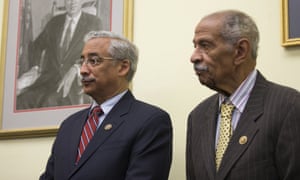
John Conyers and Bobby Scott are pushing legislation that would amend Title VI of the 1964 Civil Rights Act and restore the rights of parents to file lawsuits against segregated school districts under claims of disparate impacts.It wasn’t lost on Green, however, that just north of 8 Mile Road – the demarcation line of Detroit and its suburbs – students had access to a significantly higher amount of resources.
“I do remember … 8 Mile being like the psychological barrier, even in the early 80s it was,” said Green, 33. “I knew there were these suburbs [that] had more amenities, but I don’t think I could articulate that as an elementary school child.”
A fourth-generation Detroiter, Green’s entry into the city’s public school system was only several years removed from a seminal 1974 US supreme court ruling on school desegregation, Milliken v Bradley, which ended a plan to integrate mostly white suburban schools into Detroit’s public school system. The city’s population continued to swiftly decline in the years that followed, eroding the school system’s resources in tandem until the state declared a financial emergency.
Green, a professor of educational policy and planning at the University of Texas at Austin, pointed to the Milliken decision as a “death knell” to implementing the supreme court’s 1954 decision in Brown v Board of Education to desegregate school systems.
“How do you have meaningful desegregation when you have white flight occurring at rapid rates, but we can’t involve suburban school districts where this was occurring?” Green said. “It stopped mandatory desegregation efforts metropolitan-wide.”
A report released this week by the Government Accountability Office illuminated the extent to which school systems across the US are, once again, becoming more segregated. The report found that more than 60% of schools with high levels of poor students were racially segregated, which the report defined as being at least 75% black or Latino.
The study reviewed federal data from 2001 to 2014 and found 16% of all US schools were both racially segregated and poor, increasing from about 7,000 schools in 2001 to 15,089 by 2013 to 2014. Observers and advocates for school desegregation said the report should be a “huge warning sign” that needs to be addressed.
“There are many who believe in this country that we are operating on an even playing field,” said Jadine Johnson, staff attorney at Advancement Project.
“I think what this report revealed … is that the legacies of slavery in this country, the legacies of Jim Crow, are alive and active,” she said. “That did not go away with Brown v Board of Education.”
Compared to other schools, the GAO report found, segregated schools offered fewer college prep, science, and math classes to take, and a disproportionate number of students were either held back in ninth grade, suspended, or expelled.
Michigan congressman John Conyers was among several lawmakers who requested the report, which was released on the 62nd anniversary of Brown v Board of Education. Conyers and Virginia congressman Bobby Scott are pushing legislation that would amend Title VI of the 1964 Civil Rights Act and restore the rights of parents to file lawsuits against segregated school districts under claims of disparate impacts, which are based on ascertaining the discriminatory effect of a policy rather than ascertaining a discriminatory intent.
"This GAO report confirms what has long been feared and proves that current barriers against educational equality are eerily similar to those fought during the civil rights movement,” Conyers said in a statement. “There simply can be no excuse for allowing educational apartheid in the 21st century.”
Johnson said the loss of parents’ ability to file disparate impact cases was a “huge blow to the civil rights community”. Johnson has assisted in filing several Title VI complaints in recent years with the federal department of education – complaints that could have been filed in federal court under Conyers’ proposal.
“Us having that right could have potentially … slowed down the school closures crisis that’s happening today,” she said.
In Conyers’ home state, the largest public school system – Detroit – is currently embroiled in a struggle for survival amid bloated class sizes, paltry resources, and large-scale protests waged by teachers who have faced the prospect of working without pay. Michigan’s governor, Rick Snyder, is pushing a controversial $715m plan to overhaul the district, which needs a significant influx of cash to move forward with much-needed repairs for dozens of dilapidated facilities.
Only one-third of high school students in Detroit public schools are proficient in reading, according to Snyder’s office.
Green said the Milliken decision is one of the “main culprits” in what has happened to his alma mater.
Despite the supreme court’s 1954 landmark decision that US schools must be desegregated, Detroit’s school system remained effectively segregated, stemming in part from an accelerated white flight. When the NAACP legally challenged the state of Michigan in 1970 to end the district’s segregation, at first, the federal courts agreed something needed to be done: A plan was crafted to bus students in from suburban districts and was upheld by an appellate court.
But the plan was quickly stamped out. In 1974, the US supreme court in a 5-4 ruling shot down the efforts in Detroit, saying desegregation measures had to remain inside district boundaries.
In a column he co-wrote for the Detroit Free Press, Green argued that “we need advocacy and policies for all schools to be equitable, and racially and socioeconomically diverse across metro Detroit so that all children can learn to grow up in a diverse nation.”
Compared to suburban districts, he said, citing the GAO report, segregated schools have less access to courses needed to exceed in college – and, in some cases, a lower level of teacher experience. Indeed, a plan approved by the Michigan house to overhaul Detroit schools would allow uncertified teachers to be hired by the district.
“So I think there’s also a resource argument that has to be made [for integration],” he said.
The GAO recommended that the US department of education “more routinely analyze” civil rights data to identify disparities and said the federal justice department could “systematically track key information on open federal school desegregation cases to which it is a party to better inform its monitoring”.
Eve Hill, US deputy assistant attorney general, wrote in a response letter to the report: “The Department carefully monitors each open desegregation case to which the United States is a party on a case-by-case basis, recognizing that each case is unique.” The justice department is involved in 178 open desegregation cases, stemming from court orders that originated in the 1970s and 1980s.
Green said the GAO report underscores the spirit of the Brown v Board of Education decision.
“It’s not just about putting white bodies and black bodies together,” he said. “It’s about understanding what they said in 54, that racially segregated and separate schools are inherently unequal.”
Voting is beautiful, be beautiful ~ vote.©

Tuesday, May 17, 2016

CONYERS, Scott Unveil New GAO Report on Segregation in Public Schools


Washington, D.C. – Committee on the Judiciary Ranking Member John Conyers, Jr. (MI-13) and  Committee on Education and the Workforce Ranking Member Bobby Scott (VA-03) unveiled the findings of a new report by the Government Accountability Office (GAO) on actions needed to reduce racial and socioeconomic segregation, and address disparities in K-12 public schools. Ranking Members Conyers and Scott, along with retired Congressman and former Ranking Member George Miller, first requested this report in May 2014.

Sixty-two years ago, the Supreme Court struck down lawful school segregation in the Brown v. Board of Education decision, stating that “it is doubtful that any child may reasonable be expected to succeed in life if he is denied the opportunity of an education” The decision also affirmed that education was a right that “must be made available to all on equal terms.” GAO gathered data for this report from the Department of Education and confirmed that increasing segregation along the lines of race and poverty continue to be a driver for inequities in education. Despite Brown’s affirmation that “separate educational facilities are inherently unequal,” our system of public education remains largely separate and largely unequal.

Dean of the U.S. House
of Representatives
John Conyers, Jr.
“This GAO report confirms what has long been feared and proves that current barriers against educational equality are eerily similar to those fought during the civil rights movement,” said Rep. John Conyers.“There simply can be no excuse for allowing educational apartheid in the 21st century. Congress and the federal government, as well as state and local agencies, must ensure all children receive access to equal education at all publicly funded schools.”

“Sixty-two years later, here we are in 2016 facing an overwhelming failure to fulfil the promise of Brown in realizing equality in educational opportunity for all students,” said Rep. Bobby Scott. “In May of 2014, I, along with Ranking Member Conyers and former Education and the Workforce Committee Ranking Member George Miller, requested that the GAO examine racial and socioeconomic isolation in K-12 public schools, and the resulting impact on educational equity. The report resulting from this inquiry confirms a growing and persistent body of research. The GAO report confirms that our nation’s schools are, in fact, largely segregated by race and class. What’s more troubling, is that segregation in public K12 schools isn’t getting better; it's getting worse, and getting worse quickly, with more than 20 million students of color now attending racially and socioeconomically isolated public schools. This report is a national call to action, and I intend to ensure Congress is part of the solution.”

“Equal educational opportunity is too critical to our nation’s future to allow persistent disparities adversely affecting minority groups to continue,” stated Thomas A. Saenz, President and General Counsel of MALDEF (Mexican American Legal Defense and Educational Fund).  “Unjustified and significant educational disparities must be challengeable by private individuals; the Department of Education simply cannot provide the consistent and broad enforcement necessary for such a pivotal concern.”

Nearly a half-century of research shows that segregation negatively impacts student outcomes and exacerbates unequal opportunity experienced later in life. GAO data from the Department of Education confirmed that race and poverty continue to be driver for inequities in education and that housing segregation patterns contribute to school segregation.

“This report shines a light on worsening educational inequities that cannot be divorced from our nation's legacy of racial discrimination that has perpetuated racial and socioeconomic isolation,” said NAACP President and Director Counsel Sherrilyn Ifill. “It is our imperative on the 62nd anniversary of the U.S. Supreme Court’s ruling in Brown v. Board of Education to ask, ‘How will we act to address current disparities like resource inequities and discriminatory discipline practices?’ We must ensure that interventions address the intersectional nature of racial discrimination in areas like housing and economics that impact educational opportunities and outcomes.”

“The findings of GAO confirm what we know to be true: that the promise of Brown remains a promise that has gone largely unfulfilled,” said National Urban League President and CEO Marc H. Morial. “In too many communities, students of color are now more segregated with less access to equitable educational opportunities than in decades prior. Collectively, we can and must do better. This is why the National Urban League and our network of local leaders remains dedicated to partnering with state and school district leaders to seize on the opportunity presented by the Every Student Succeeds Act (ESSA); to turn the ship and reverse the trend of racial and socioeconomic isolation in public K-12 education. I look forward to continued collaboration with Congress to ensure that government at all levels is acting to right this egregious wrong and bring us closer to fulfilling Brown’s promise.”

Reps. Conyers and Scott introduced the Equity and Inclusion Enforcement Act, legislation to empower parents and communities to address – through robust enforcement – racial inequities in public education.

Voting is beautiful, be beautiful ~ vote.©