Showing posts with label Bobby Scott. Show all posts

Sunday, September 10, 2017

CONYERS: Members Hold Forum On Affirmative Action, Racial Climate On College Campuses


Image may contain: 1 person, sittingWASHINGTON – On FRIDAYSeptember 8th, Members of the U.S. House of Representatives held a forum entitled “Affirmative Action, Inclusion, and Racial Climate on America’s Campuses.” Amidst national conversations on white supremacy, xenophobia, and racial inequality, reports surfaced suggesting that the Trump Administration has plans to reexamine the values of racial diversity on campuses.

Image may contain: 3 peopleThis forum convened student officers, representatives from institutions of higher education, and key legal experts to discuss the role of Title VI of the Civil Rights Act in ensuring that students are welcomed to a safe, inclusive learning environment free of harassment and intimidation on the basis of race, color, or national origin.
 Image may contain: 4 people, people sitting
         
  • Congressman Bobby Scott (VA-03), Ranking Member, Committee on Education & the Workforce
  • Congressman John Conyers, Jr. (MI-13), Ranking Member, Committee on the Judiciary
  • Congresswoman Sheila Jackson Lee (TX-18)
  • Congressman Hank Johnson, Jr. (GA-04)
  • Additional Members of Congress
  • Sherrilyn Ifill, President and Director-Counsel, NAACP Legal Defense and Educational Fund
  • Richard Cohen, Executive Director, Southern Poverty Law Center
  • Theresa Sullivan, President, University of Virginia
  • Dr. Benjamin Reese, Vice President of the Office for Institutional Equity, Duke University
  • Roger Worthington, Chief Diversity Officer, University of Maryland
  • Taylor Dumpson, Student President, American University
  • Weston “Wes” Gobar, President, Black Student Alliance, University of Virginia
  • Payton Head, Former Student Body President, University of Missouri

Voting is beautiful, be beautiful ~ vote.©

Friday, September 1, 2017

House, Senate Democratic Leaders Push Trump Administration for Answers on Affirmative Action


Amid national conversation on race and white supremacy, new efforts from the Trump Administration to reexamine the values of racial diversity on campus are deeply troubling

Democrats: “This is the latest effort by [Trump]Administration to step away from enforcing the protections provided under the Civil Rights Act and instead promote policies that undermine civil rights protections”

Congressman Bobby Scott (D-VA), ranking member of the House Committee on Education and the Workforce, Congressman John Conyers  (D-MI), ranking member of the House Committee on Judiciary, Congressman Hakeem Jeffries (D-NY), Senator Patty Murray (D-WA), ranking member of the Senate Committee on Health, Education, Labor, and Pensions, and Senator Dianne Feinstein (D-CA), ranking member of the Senate Committee on Judiciary, sent a letter, below, to Attorney General Jeff Sessions and Secretary of Education Betsy DeVos about a recent memo that showed intent of the Departments of Justice (DOJ)  and Education (ED) to reexamine the process by which the federal government ensures racial diversity on college campuses.

“Recently, an internal hiring posting from DOJ citing ‘investigations and possible litigation related to intentional race-based discrimination in college and university admissions’ caused public concerns as to whether DOJ and ED are launching a new effort to reexamine the values of racial diversity on campus,” the Members wrote. “This is the latest effort by this Administration to step away from enforcing the protections provided under the Civil Rights Act and instead promote policies that undermine civil rights protections and your Departments’ Civil Rights Offices. The Supreme Court has made it clear that racial diversity is a compelling state interest and that it is in our national interest that talented students from a variety of backgrounds get a close look and a fair chance at overcoming obstacles to higher education.” 

The Members also highlighted that this memo follows a disturbing pattern of the Trump Administration’s hostile view of the federal government’s role in protecting civil rights.

“This action is especially suspect given this Administration’s lack of attention to civil rights issues in our education system thus far,” the letter continues. “For example, neither DOJ nor ED have publically addressed the spate of racially charged incidents on college campuses nor the rise in white supremacist recruiting efforts and incidents on college campuses which the Anti-Defamation League (ADL) describes as unprecedented.   Such incidents include the stabbing of an African American student commissioned as a second lieutenant in the U.S. Army by a fan of white supremacist websites, or bananas hanging from nooses labeled ‘Harambe bait.’”
Voting is beautiful, be beautiful ~ vote.©

Wednesday, August 2, 2017

CONYERS, SCOTT Statement On Reports Of Trump Administration Plans To Attack Affirmative Action

WASHINGTON – Representatives Bobby Scott (VA-03) and John Conyers, Jr. (MI-13), the ranking members of the House Committees on Education and the Workforce and the Judiciary, respectively, issued the following statement after reports surfaced that the Department of Justice plans to attack and undermine affirmative action programs in colleges and universities. 

Dean of the U.S. House
of Representatives
John Conyers, Jr.
“While we cannot comment on the veracity of this alleged memo, we are deeply concerned by news reports that the Department of Justice intends to challenge the application of affirmative action programs in colleges and universities.  What is already clear is the Trump Administration’s public record of attacking civil rights protections on multiple fronts. 

“As ranking members, we led 86 Members of the House in an amicus brief in support of affirmative action programs in higher education. We were one of nearly 70 organizations to take the same position, including retired Chiefs of Staff of our nation’s Armed Services, leading Fortune 500 companies, academics, 19 state governors, the faith community and many others. The position that we took was ultimately affirmed by the Supreme Court – the consideration of race and ethnicity to achieve diversity in admissions is a constitutional and is a compelling state interest that can be achieved through narrowly tailored means.

“Whether it is the Department of Justice’s decision to examine the use of consent decrees with state and local police departments, which are designed to reduce instances of police brutality and discriminatory treatment; Attorney General Session’s decision to  return to the harsh application of mandatory minimum sentences which have been proven to be racially discriminatory and counterproductive to reducing crime; the White House’s so-called election integrity commission which purports to “solve” voter fraud while requesting the most personal data of the Nation’s 200 million registered voters; or efforts to weaken the Equal Employment Opportunity Commission (EEOC) and the Office of Federal Contract Compliance Programs (OFCCP) – agencies charged with the enforcement of employment nondiscrimination laws, the Trump administration has not wasted any opportunity to roll back existing civil rights protections for underrepresented minorities.

“Further, the Administration’s reactionary efforts were signaled in the White House’s proposed budget to which reduces or eliminated funding tied to the enforcement of federal civil rights laws.  The Trump Administration’s budget undermines the constitutional promise of Brown v. Board of Education by cutting federal funding to support public schools that serve our nation’s poorest students. It proposes elimination of the environmental justice program, gutting the primary tool to examine and address the impact of environmental policies and decisions on communities of color, low-income and tribal communities. And proving the adage “any rights without remedies are no rights at all,” the President’s budget proposes eliminating federal funding for the Legal Services Corporation (LSC) that provides civil legal aid for low income Americans to help them have their day in court.

“These actions, already on the record, provide a clear, yet unsettling picture of this Administration’s hostile view of the federal government’s role in protecting civil rights.”


Voting is beautiful, be beautiful ~ vote.©

Thursday, May 18, 2017

CONYERS & SCOTT Introduce Bill to Address Racial Inequities in Public Education

WASHINGTON – TODAY, Committee on Education and the Workforce Ranking Member Bobby Scott (VA-03) and Committee on the Judiciary Ranking Member John Conyers, Jr. (MI-13) introduced the Equity and Inclusion Enforcement Act (EIEA). This legislation would empower parents and communities to address – through robust enforcement – racial inequities, including inequities in access to educational resources, in public education.

Today marks the 63rd anniversary of the landmark Supreme Court decision in the Brown v. Board of Education case, which struck down lawful school segregation and affirmed that education was a right that “must be made available to all on equal terms.” Last year on the anniversary of Brown, Ranking Members Scott and Conyers unveiled the findings of a Government Accountability Office (GAO) report which found that our nation’s schools are, in fact, re-segregating by race and class.

Dean of the U.S. House
of Representatives
John Conyers, Jr.
“Though the Nation can celebrate the progress made over the course of the last 63 years after the Brown v. Board decision, we should acknowledge the long path ahead of us in the battle toward equal education,” said Ranking Member Conyers. “Last year’s GAO report confirmed our fears -- that many of our schools are re-segregating at alarming rates. On this landmark occasion, I’m proud to join Rep. Scott in introducing the Equity and Inclusion Enforcement Act, legislation that will help us on our path to providing equal educational opportunities for all students.”

On this anniversary of Brown, we are reminded that we have a long way to go to achieve educational equity for all students,” said Ranking Member Scott. “Last year’s GAO report confirmed that increasing segregation along the lines of race and poverty continue to be a driver for inequities in education. The Equity and Inclusion Enforcement Act provides parents and communities with the tools necessary to ensure all children have a chance to succeed, and moves us one step closer to fulfilling the promise of Brown.”

In 1964, Congress passed the Civil Rights Act, a decade after the Brown decision. Title VI of the Act mandates that federal dollars cannot subsidize or support programs or activities that discriminate on the basis of race, color, or national origin. The EIEA would:
  • restore a private right of action to file disparate impact claims under Title VI;
  • create Title VI monitors to ensure that every school has at least one employee to specifically carry out the responsibilities of the law; and
  • create an Assistant Secretary in the Department of Education to coordinate and promote Title VI enforcement of equity and inclusion in education.

Earlier today, a companion bill - the Rebuild America’s Schools Act of 2017 - was introduced to support new investments in school infrastructure to help level the playing field for students in under-resourced communities. 

Organizations supporting the EIEA: NAACP Legal Defense and Education Fund (LDF), Southeast Asia Resource Action Center (SEARAC), the Leadership Conference on Civil and Human Rights, the Advancement Project, NAACP, and Teach Plus.

The Equity and Inclusion Enforcement Act (EIEA): Restoring Private Right of Action to Disparate Impact Clai... by Beverly Tran on Scribd

Voting is beautiful, be beautiful ~ vote.©

Thursday, April 6, 2017

CONYERS: Members Hold Forum On Civil Rights Under The Trump Administration


Washington, D.C. – Today, April 6, 2017 at 10:30 AM, Members of the U.S. House of Representatives held a forum entitled, “Civil Rights Under the Trump Administration-The First 100 Days.” 

The 2016 presidential campaign was the most polarizing and divisive in memory, particularly from a civil rights perspective.  Though the Obama administration made notable legislative and enforcement gains in civil rights, with the rise in hate violence, police shootings and legislative backlash at the state and local level, minority communities have been justifiably concerned about the continuing role of the Federal government in protecting their civil rights.  This forum will examine the appointments, polices and orders undertaken in the first 100 days of the Trump administration in order to help foster an agenda for the protection of civil rights.   

WHO:            Members of Congress
·         House Judiciary Committee Ranking Member John Conyers, Jr. (D-MI)
·         House Committee on Education and the Workforce Ranking Member Bobby Scott (D-VA)
·         Rep. Cedric Richmond (D-LA), Chair of the Congressional Black Caucus
·         House Committee on Science, Space and Technology Ranking Member Eddie Bernice Johnson (D-TX)
·         Rep. G. K. Butterfield (D-NC)
·         Rep. Sheila Jackson Lee (D-TX)
·         Rep. Hank Johnson Jr. (D-GA)
·         Rep. David N. Cicilline (D-RI)
·         Rep. Donald McEachin (D-VA)
·         Additional Members of Congress

Panelists
·         Gavin Grimm, plaintiff in transgender rights case,G.G. v. Gloucester County School Board

·         Chief Hassan Aden, Steering Committee, Law Enforcement Leaders to Reduce Crime and Incarceration and former Chief of Police of the Greenville Police Department

·         Catherine Lhamon, Chair of the U.S. Commission on Civil Rights, former Assistant Secretary for Civil Rights at the U.S. Department of Education

·         Ron Davis, former director of the Office of Community Oriented Policing Services at the Department of Justice

·         Chiraag Bains, Senior Fellow at Harvard Law School Criminal Justice Policy Program, former Senior Counsel to the Assistant Attorney General for Civil Rights

·         Roy Austin, former director of the White House Office of Urban Affairs, Justice, and Opportunity

·         Joe Rich, Co-Director, Fair Housing & Community Development Project, Lawyers’ Committee for Civil Rights Under Law


Voting is beautiful, be beautiful ~ vote.©

Monday, April 3, 2017

CONYERS: Democrats Push Trump Administration to Protect the Education of Undocumented Children


WASHINGTON – Today, John Conyers (MI-13), Reps. Bobby Scott (VA-03),  Bennie Thompson (MS-02), and Zoe Lofgren (CA-19), the Ranking Members of the Committees on Education and the Workforce, Judiciary, Homeland Security, and Subcommittee on Immigration and Border Security, respectively, sent a letter, below, to Secretary of Education Betsy DeVos, Attorney General Jeff Sessions, and Secretary of Homeland Security John Kelly asking them to remind public schools that they are still required to educate undocumented children, despite recent changes to immigration policies.

Dean of the U.S. House
of Representatives
John Conyers, Jr.
“We write to express concern that recent changes in immigration enforcement policies are creating fear, anxiety and confusion in immigrant communities around the country,” the Members wrote. “In this environment of trepidation, it is important that we do all we can to minimize the impact these policies have on public school attendance and student learning. One way to address this concern is to ensure that school enrollment and attendance practices do not chill school participation based on the students’ or their parent’s immigration status.”

To assuage increasing apprehensions, we request that the Department of Homeland Security issue a statement making clear that, in spite of other changes in enforcement policy, the sensitive locations policy remains in full effect, at schools and other localities,” the letter reads. “Fear of immigration enforcement actions cannot be allowed to create a hostile learning environment for our children.”

In the Plyler v. Doe decision, the Supreme Court ruled that it was unconstitutional to deny any child, including an undocumented child, access to a public education.  A student’s immigration status was irrelevant to the student’s right to access a public elementary and secondary education.
Voting is beautiful, be beautiful ~ vote.©

Wednesday, June 8, 2016

CONYERS, Scott Statement on New Civil Rights Data from Department of Education


WASHINGTON – Today, the U.S. Department of Education's Office for Civil Rights (OCR) unveiled new data from the 2013-2014 school year showing gaps that remain in educational equity and opportunity for students. Education and the Workforce Committee Ranking Member Rep. Bobby Scott (VA-03) and Judiciary Committee Ranking Member Rep. John Conyers, Jr. (MI-13) released the following statement on the release of the new data by OCR:

Dean of the U.S. House
of Representatives
John Conyers, Jr.
“The report released today from the Department of Education is a disturbing reminder of what too many families already know, and what was confirmed in the report from the General Accountability Office (GAO) we unveiled last month.  Our nation’s increasingly diverse student population is too often hyper-segregated in K-12 public schools and, sadly, educational opportunity is not available to all students of color on equal terms. This new data, and GAO’s study, are a call to action.

“That is why we introduced H.R.5260, the Equity and Inclusion Enforcement Act. The bill would amend Title VI of the Civil Rights Act to allow individuals to bring suits against school districts that implement practices and policies that have disparate impact based on race, color or nationality. We must honor our obligation to fulfil the promise of Brown v. Board of Education and seize the opportunity presented by the Every Student Succeeds Act to take meaningful and deliberate action – supported by the Federal government – to level the playing field in public K-12 schools.”


Voting is beautiful, be beautiful ~ vote.©

Saturday, May 21, 2016

New report is 'huge warning sign' that desegregation has failed in US schools

Report illuminates extent to which US schools are becoming more segregated, with more than 60% of schools with high levels of poor students racially divided

When Terrance Green was a student at Detroit public schools starting in the 1980s, he celebrated his experience in the overwhelmingly black district.
“The teachers were outstanding … there was a very strong ethos around racial identity, around civil rights, around celebrating who we were,” he said.
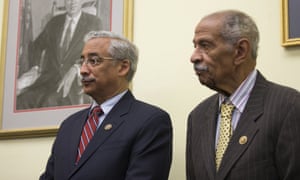
John Conyers and Bobby Scott are pushing legislation that would amend Title VI of the 1964 Civil Rights Act and restore the rights of parents to file lawsuits against segregated school districts under claims of disparate impacts.It wasn’t lost on Green, however, that just north of 8 Mile Road – the demarcation line of Detroit and its suburbs – students had access to a significantly higher amount of resources.
“I do remember … 8 Mile being like the psychological barrier, even in the early 80s it was,” said Green, 33. “I knew there were these suburbs [that] had more amenities, but I don’t think I could articulate that as an elementary school child.”
A fourth-generation Detroiter, Green’s entry into the city’s public school system was only several years removed from a seminal 1974 US supreme court ruling on school desegregation, Milliken v Bradley, which ended a plan to integrate mostly white suburban schools into Detroit’s public school system. The city’s population continued to swiftly decline in the years that followed, eroding the school system’s resources in tandem until the state declared a financial emergency.
Green, a professor of educational policy and planning at the University of Texas at Austin, pointed to the Milliken decision as a “death knell” to implementing the supreme court’s 1954 decision in Brown v Board of Education to desegregate school systems.
“How do you have meaningful desegregation when you have white flight occurring at rapid rates, but we can’t involve suburban school districts where this was occurring?” Green said. “It stopped mandatory desegregation efforts metropolitan-wide.”
A report released this week by the Government Accountability Office illuminated the extent to which school systems across the US are, once again, becoming more segregated. The report found that more than 60% of schools with high levels of poor students were racially segregated, which the report defined as being at least 75% black or Latino.
The study reviewed federal data from 2001 to 2014 and found 16% of all US schools were both racially segregated and poor, increasing from about 7,000 schools in 2001 to 15,089 by 2013 to 2014. Observers and advocates for school desegregation said the report should be a “huge warning sign” that needs to be addressed.
“There are many who believe in this country that we are operating on an even playing field,” said Jadine Johnson, staff attorney at Advancement Project.
“I think what this report revealed … is that the legacies of slavery in this country, the legacies of Jim Crow, are alive and active,” she said. “That did not go away with Brown v Board of Education.”
Compared to other schools, the GAO report found, segregated schools offered fewer college prep, science, and math classes to take, and a disproportionate number of students were either held back in ninth grade, suspended, or expelled.
Michigan congressman John Conyers was among several lawmakers who requested the report, which was released on the 62nd anniversary of Brown v Board of Education. Conyers and Virginia congressman Bobby Scott are pushing legislation that would amend Title VI of the 1964 Civil Rights Act and restore the rights of parents to file lawsuits against segregated school districts under claims of disparate impacts, which are based on ascertaining the discriminatory effect of a policy rather than ascertaining a discriminatory intent.
"This GAO report confirms what has long been feared and proves that current barriers against educational equality are eerily similar to those fought during the civil rights movement,” Conyers said in a statement. “There simply can be no excuse for allowing educational apartheid in the 21st century.”
Johnson said the loss of parents’ ability to file disparate impact cases was a “huge blow to the civil rights community”. Johnson has assisted in filing several Title VI complaints in recent years with the federal department of education – complaints that could have been filed in federal court under Conyers’ proposal.
“Us having that right could have potentially … slowed down the school closures crisis that’s happening today,” she said.
In Conyers’ home state, the largest public school system – Detroit – is currently embroiled in a struggle for survival amid bloated class sizes, paltry resources, and large-scale protests waged by teachers who have faced the prospect of working without pay. Michigan’s governor, Rick Snyder, is pushing a controversial $715m plan to overhaul the district, which needs a significant influx of cash to move forward with much-needed repairs for dozens of dilapidated facilities.
Only one-third of high school students in Detroit public schools are proficient in reading, according to Snyder’s office.
Green said the Milliken decision is one of the “main culprits” in what has happened to his alma mater.
Despite the supreme court’s 1954 landmark decision that US schools must be desegregated, Detroit’s school system remained effectively segregated, stemming in part from an accelerated white flight. When the NAACP legally challenged the state of Michigan in 1970 to end the district’s segregation, at first, the federal courts agreed something needed to be done: A plan was crafted to bus students in from suburban districts and was upheld by an appellate court.
But the plan was quickly stamped out. In 1974, the US supreme court in a 5-4 ruling shot down the efforts in Detroit, saying desegregation measures had to remain inside district boundaries.
In a column he co-wrote for the Detroit Free Press, Green argued that “we need advocacy and policies for all schools to be equitable, and racially and socioeconomically diverse across metro Detroit so that all children can learn to grow up in a diverse nation.”
Compared to suburban districts, he said, citing the GAO report, segregated schools have less access to courses needed to exceed in college – and, in some cases, a lower level of teacher experience. Indeed, a plan approved by the Michigan house to overhaul Detroit schools would allow uncertified teachers to be hired by the district.
“So I think there’s also a resource argument that has to be made [for integration],” he said.
The GAO recommended that the US department of education “more routinely analyze” civil rights data to identify disparities and said the federal justice department could “systematically track key information on open federal school desegregation cases to which it is a party to better inform its monitoring”.
Eve Hill, US deputy assistant attorney general, wrote in a response letter to the report: “The Department carefully monitors each open desegregation case to which the United States is a party on a case-by-case basis, recognizing that each case is unique.” The justice department is involved in 178 open desegregation cases, stemming from court orders that originated in the 1970s and 1980s.
Green said the GAO report underscores the spirit of the Brown v Board of Education decision.
“It’s not just about putting white bodies and black bodies together,” he said. “It’s about understanding what they said in 54, that racially segregated and separate schools are inherently unequal.”
Voting is beautiful, be beautiful ~ vote.©

Tuesday, May 17, 2016

CONYERS, Scott Unveil New GAO Report on Segregation in Public Schools


Washington, D.C. – Committee on the Judiciary Ranking Member John Conyers, Jr. (MI-13) and  Committee on Education and the Workforce Ranking Member Bobby Scott (VA-03) unveiled the findings of a new report by the Government Accountability Office (GAO) on actions needed to reduce racial and socioeconomic segregation, and address disparities in K-12 public schools. Ranking Members Conyers and Scott, along with retired Congressman and former Ranking Member George Miller, first requested this report in May 2014.

Sixty-two years ago, the Supreme Court struck down lawful school segregation in the Brown v. Board of Education decision, stating that “it is doubtful that any child may reasonable be expected to succeed in life if he is denied the opportunity of an education” The decision also affirmed that education was a right that “must be made available to all on equal terms.” GAO gathered data for this report from the Department of Education and confirmed that increasing segregation along the lines of race and poverty continue to be a driver for inequities in education. Despite Brown’s affirmation that “separate educational facilities are inherently unequal,” our system of public education remains largely separate and largely unequal.

Dean of the U.S. House
of Representatives
John Conyers, Jr.
“This GAO report confirms what has long been feared and proves that current barriers against educational equality are eerily similar to those fought during the civil rights movement,” said Rep. John Conyers.“There simply can be no excuse for allowing educational apartheid in the 21st century. Congress and the federal government, as well as state and local agencies, must ensure all children receive access to equal education at all publicly funded schools.”

“Sixty-two years later, here we are in 2016 facing an overwhelming failure to fulfil the promise of Brown in realizing equality in educational opportunity for all students,” said Rep. Bobby Scott. “In May of 2014, I, along with Ranking Member Conyers and former Education and the Workforce Committee Ranking Member George Miller, requested that the GAO examine racial and socioeconomic isolation in K-12 public schools, and the resulting impact on educational equity. The report resulting from this inquiry confirms a growing and persistent body of research. The GAO report confirms that our nation’s schools are, in fact, largely segregated by race and class. What’s more troubling, is that segregation in public K12 schools isn’t getting better; it's getting worse, and getting worse quickly, with more than 20 million students of color now attending racially and socioeconomically isolated public schools. This report is a national call to action, and I intend to ensure Congress is part of the solution.”

“Equal educational opportunity is too critical to our nation’s future to allow persistent disparities adversely affecting minority groups to continue,” stated Thomas A. Saenz, President and General Counsel of MALDEF (Mexican American Legal Defense and Educational Fund).  “Unjustified and significant educational disparities must be challengeable by private individuals; the Department of Education simply cannot provide the consistent and broad enforcement necessary for such a pivotal concern.”

Nearly a half-century of research shows that segregation negatively impacts student outcomes and exacerbates unequal opportunity experienced later in life. GAO data from the Department of Education confirmed that race and poverty continue to be driver for inequities in education and that housing segregation patterns contribute to school segregation.

“This report shines a light on worsening educational inequities that cannot be divorced from our nation's legacy of racial discrimination that has perpetuated racial and socioeconomic isolation,” said NAACP President and Director Counsel Sherrilyn Ifill. “It is our imperative on the 62nd anniversary of the U.S. Supreme Court’s ruling in Brown v. Board of Education to ask, ‘How will we act to address current disparities like resource inequities and discriminatory discipline practices?’ We must ensure that interventions address the intersectional nature of racial discrimination in areas like housing and economics that impact educational opportunities and outcomes.”

“The findings of GAO confirm what we know to be true: that the promise of Brown remains a promise that has gone largely unfulfilled,” said National Urban League President and CEO Marc H. Morial. “In too many communities, students of color are now more segregated with less access to equitable educational opportunities than in decades prior. Collectively, we can and must do better. This is why the National Urban League and our network of local leaders remains dedicated to partnering with state and school district leaders to seize on the opportunity presented by the Every Student Succeeds Act (ESSA); to turn the ship and reverse the trend of racial and socioeconomic isolation in public K-12 education. I look forward to continued collaboration with Congress to ensure that government at all levels is acting to right this egregious wrong and bring us closer to fulfilling Brown’s promise.”

Reps. Conyers and Scott introduced the Equity and Inclusion Enforcement Act, legislation to empower parents and communities to address – through robust enforcement – racial inequities in public education.

Voting is beautiful, be beautiful ~ vote.©

Monday, May 16, 2016

CONYERS, Scott to Unveil New GAO Report on Segregation in Public Schools

TOMORROW: CONYERS, SCOTT TO UNVEIL NEW GAO REPORT ON SEGREGATION IN PUBLIC SCHOOLS

**For an embargoed copy of the report, email Shadawn.reddick-smith@mail.house.gov . All materials related to this report are embargoed until 1:30 p.m./EDT on Tuesday, May 17, 2016.**

Washington, D.C. – On Tuesday, May 17th at 1:30PM, Committee on the Judiciary Ranking Member John Conyers, Jr. (MI-13) and Committee on Education and the Workforce Ranking Member Bobby Scott (VA-03) will host a press conference to unveil the findings of a new report by the Government Accountability Office (GAO) on actions needed to reduce racial and socioeconomic segregation, and address disparities in K-12 public schools. Ranking Members Conyers and Scott along with retired Congressman and former Ranking Member George Miller, first requested this report in May 2014.

Dean of the U.S. House
of Representatives
John Conyers, Jr.
Sixty-two years ago, the Supreme Court struck down lawful school segregation in the Brown v. Board of Education decision, stating that education was “perhaps the most important function of state and local government.” The decision also affirmed that education was a right that “must be made available to all on equal terms.” GAO gathered data for this report from the Department of Education and confirmed that race and poverty continue to be a driver for inequities in education, and that housing segregation patterns contribute to school segregation.

WHO:  Ranking Member John Conyers, Jr. (MI-13), Committee on the Judiciary; Ranking Member Robert C. “Bobby” Scott (VA-03), Committee on Education and the Workforce; Representative G.K. Butterfield (NC-01), Chair, Congressional Black Caucus; Marc Morial, President and CEO, National Urban League; Nancy Zirkin, Executive Vice President, The Leadership Conference on Civil and Human Rights
                                                                                                            
WHAT:  Press conference releasing new GAO report on actions needed to reduce racial and socioeconomic segregation, and address disparities in public schools.
                       
                        WHEN:  Tuesday, May 17, 2016, 1:30 – 2:15 p.m.

WHERE:  421 Cannon House Office Building (CHOB), Washington, DC

RSVP:      Media interested in attending Tuesday’s press conference should RSVP toShadawn.Reddick-Smith@mail.house.gov.

Voting is beautiful, be beautiful ~ vote.©