Showing posts with label medicaid. Show all posts

Sunday, July 30, 2017

50 Years Ago, LBJ Signs Medicare & Medicaid Into Law

50 years ago, President Johnson signed into law, Medicare & Medicaid to provide health care to old, the young, the sick and the veterans who have served this nation.

50 years later, our elected officials want to "unsign" the health care law.

President Lyndon B. Johnson signed the Medicare bill and dedicated it to Harry S. Truman, the former president who "planted the seeds of compassion".


No longer will older Americans be denied the healing miracle of modern medicine. No longer will illness crush and destroy the savings that they have so carefully put away over a lifetime so that they might enjoy dignity in their later years. No longer will young families see their own incomes, and their own hopes, eaten away simply because they are carrying out their deep moral obligations to their parents, and to their uncles, and their aunts.

And no longer will this Nation refuse the hand of justice to those who have given a lifetime of service and wisdom and labor to the progress of this progressive country.


Dean of the U.S. House of Representatives, John Conyers, Jr. has introduced Medicare For All.


Voting is beautiful, be beautiful ~ vote.©

Thursday, May 4, 2017

CONYERS on House passage of TrumpCare

Washington, D.C  – Congressman John Conyers, Jr., the Dean of the House of Representatives, released the following statement after Republicans passed TrumpCare on a party-line vote:

Dean of the U.S. House of Representatives
John Conyers, Jr.
“I’ve served in Congress for 52 years and it’s hard for me to recall a time when we’ve voted on something so obviously and intentionally harmful to seniors and working people in this country.

This legislation strips healthcare from 24 million people. It requires seniors to pay 100% or more of their income in premiums. This legislation dramatically cuts Medicaid, directly contradicting Mr. Trump’s claim not to.

Every policy expert who has looked at the Upton amendment has said it is grossly inadequate to fund high risk pools for people with pre-existing conditions.

In Michigan, almost one million children, nearly half of all children in the state, rely on Medicaid. In my district alone, 56,000 people will lose coverage, including 16,000 children and 3,500 elderly.

If this bill becomes law, people will die. Children, seniors, and working people will suffer and many will die, all so that wealthy people can get a tax cut.

Healthcare is a right, not a privilege. That’s why I have a bill to create a single-payer, Medicare-for-All plan. Most of the Democratic party has joined me in cosponsoring that bill. Democrats will be in the majority again—given today’s vote that may happen very soon. When it does, I will do everything in my power to make sure a national, universal, government-funded system is our agenda.”


Voting is beautiful, be beautiful ~ vote.©

Friday, March 24, 2017

CONYERS, SLAUGHTER, CROWLEY, NADLER & JEFFRIES: GOP Bill To Single Out New Yorkers Represents Worst of Washington


Members Release Legal Analysis Pointing to Provision’s Unconstitutionality

Washington, D.C. – Today, House Judiciary Committee Ranking Member John Conyers, Jr. (D-MI), House Rules Committee Ranking Member Louise Slaughter (D-NY), Democratic Caucus Chairman Joe Crowley (D-NY), and House Judiciary Committee Members Reps. Jerrold Nadler (D-NY) and Hakeem Jeffries (D-NY) released a legal analysis, below, prepared by the House Judiciary Committee Democratic staff demonstrating the unconstitutionality of the ongoing Republican plans to single out New York State for sharing Medicaid costs with its counties. The Members  released the following joint statement:

Dean of the U.S. House
of Representatives
John Conyers, Jr.
“House Republicans’ Trumpcare bill is nothing more than a tax cut for the wealthy masquerading as a 'healthcare bill.' If this bill were to become law, 24 million Americans would lose their insurance coverage, and seniors would face skyrocketing premiums. Even worse, to appease the extreme conservatives of the House Republican Freedom Caucus, the newly adopted manager’s amendment includes provisions eliminating Essential Health Benefits requirements such as maternity care, prescription drug and emergency coverage – essentially erasing protections for Americans with pre-existing conditions.

“In a desperate attempt to pass this unconscionable bill, Speaker Ryan and the House Republican leadership have offered to include the Faso-Collins amendment in order to gain the support of vulnerable New York Republican members. This blatant vote buying represents the worst side of Washington politics. In fact, many Republican Attorneys General called a similar provision in 2009 ‘constitutionally flawed’ and ‘violating the most basic and universally held notions of what is fair and just.’  

“By singling out New York State – even though 15 other states have similar systems for sharing Medicaid costs -- and forcing New York to give up its core sovereign power to decide how it will raise funds for its own share of Medicaid, this measure is unconstitutional. This is why we believe New York State would be well within its rights to challenge the provision in court, as Governor Cuomo has suggested.

“The irony of this buyout is that the payment supposedly being delivered in exchange for votes is the legislative equivalent of a check on a closed bank account. It will never deliver the promised benefit. 

“Finally, it is also important to note that House Republican Leadership’s reckless attempt to cram Trumpcare through Congress is that according to the most recent CBO report, the Faso-Collins amendment has no or only incidental impact on the federal budget.  It should therefore be struck under reconciliation rules if this bill even reaches the Senate.” 

Background

For the last 51 years, New York State has chosen to fund a portion of its share of the Medicaid Program by using funds from county property taxes.  Fifteen other states structure Medicaid funding through a similar legally authorized system.

The Faso-Collins amendment, being incorporated into the Manager’s amendment to H.R. 1628, the “American Healthcare Act of 2017,”  specifies that any State that had an allotment of Disproportionate Share Hospital (DSH) funds that was more than 6 times the national average, and that requires subdivisions with populations of less than 5,000,000 to contribute toward Medicaid costs, shall have its reimbursement reduced by the amount of contributions by such subdivisions. This effectively limits the application to New York State, and carves out New York City. Under the amendment, New York State is at risk of losing $2.3 billion of its $32 billion in Federal Medicaid funds.

The amendment would implicate Constitutional limits on the Federal Spending Power, the Due Process and Equal Protection Clauses and the Tenth Amendment (reserving all undelegated powers to the States) because it is not related to a legitimate Federal interest; no rational Federal purpose has been proffered for the provision which singles out New York for discrimination; and it severely intrudes on traditional state prerogatives, such as structuring taxing and spending authorities.  Under a series of Supreme Court cases these provisions would exceed Congress’s spending authority, violate the Equal Protection and Due Process Clauses, and violate Tenth Amendment principles. 


Voting is beautiful, be beautiful ~ vote.©

Wednesday, March 22, 2017

CONYERS: For Once, I Agree With Governor Snyder!


Washington, D.C. – Today, Michigan Governor Rick Snyder sent a letter to the entire Michigan Congressional Delegation informing them of his opposition to the American Health Care Act, the House Speaker Paul Ryan and President Donald Trump backed plan to sharply cut Medicaid and reduce taxes for the wealthiest Americans. In his letter, Governor Snyder points out that the bill “shifts significant financial risk and cost from the federal government to states without providing sufficient flexibility to manage this additional responsibility,” and that it “reduces federal resources that our state relies on to assist 2.4 million Michiganders enrolled in traditional Medicaid and the Healthy Michigan Plan …”

In response, Congressman John Conyers, Jr. (MI-13) released the following statement:

Dean of the U.S, House
of Representatives
John Conyers Jr.
“For once, I agree with Governor Snyder’s views on the Republican healthcare bill — or as I call it, wealth care bill. As Snyder points out, about half of all children in Michigan are served by Medicaid, and those children will suffer if Donald Trump and Paul Ryan pass this massive tax cut for the wealthy.

“The bill is a massive transfer of wealth that takes money from those most in need and gives it to the rich. Under this bill, the 400 wealthiest families in America get a tax break worth $7 million per year. The bill undoes protections that the Affordable Care Act provides by allowing insurance companies to discriminate against cancer survivors or people with disabilities by charging them higher rates, or denying them coverage altogether. This Trump/Ryan backed bill also allows insurance companies to charge seniors five times more than what others pay for the same plan.

“Governor Snyder is right to be concerned about the additional costs this bad bill will shift to the state of Michigan. Because I believe that healthcare is a right for all, not a privilege for those who can afford it, I have long championed a single-payer, Medicare-for-All approach to healthcare that would finally establish truly universal care. If Governor Snyder is serious about reducing the strain on state resources, I call on him to join me in supporting Medicare-for-All, which would virtually eliminate state spending to subsidize care.”

Voting is beautiful, be beautiful ~ vote.©

Saturday, September 24, 2016

Statement of the Honorable John Conyers, Jr. for the Hearing on “Treating the Opioid Epidemic: The State of Competition in the Markets for Addiction Medicine” Before the Subcommittee on Regulatory Reform, Commercial and Antitrust Law


Dean of the U.S. House
of Representatives
John Conyers, Jt.
Sudden and sharp increases in the cost of life-saving prescription medications have caused much public outcry, most recently regarding the substantial spike in the price of EpiPen, which is used to treat life-threatening allergic reactions. 

Although today’s hearing focuses on competition in the markets for a particular set of life-saving drugs -- namely, those that treat opioid addiction -- I hope that there are some broader lessons that we can draw from our discussion today. 

To that end, I would like our witnesses to address the following issues. 

To begin with, the witnesses should discuss the real-life consequences of the opioid addiction epidemic and the impact of rising prices for medications that treat opioid addiction.

According to the Centers for Disease Control and Prevention, there were more than 28,000 deaths in 2014 resulting from opioid overdoses.   In fact, 6 out of 10 drug overdose deaths that year resulted from opioid overdoses.

Medications like Naloxone revive an opioid overdose victim in the critical moments after he or she has stopped breathing as a result of an overdose.

Yet the price of this drug, in both its generic and branded forms, has skyrocketed in recent years, according to public health and police officials. 

Prices for the drug have increased by 50% or more, according to some reports.  As a result, the ability of emergency responders and individuals to purchase this critical life-saving medication is being jeopardizes.

Other generic and branded medicines that are designed to gradually wean addicts from their opioid use have also seen similar price increases.

As the statistics demonstrate, addressing the consequences of these price increases is no mere academic matter.  It is beyond dispute that such price increases have had a devastating impact on patients, their families, insurers, first responders, and health care providers.

In addition, I would like the witnesses to consider whether current law strikes a proper balance between incentivizing investment in new pharmaceutical products and ensuring vigorous competition.

Under both our patent and regulatory systems, manufacturers of brand-name drugs are entitled to temporary exclusivity periods for their products during which other firms are prevented from offering competing products.

These exclusivity periods are designed to provide an economic incentive for manufacturers to invest in developing new products, but the result is that prices for brand-name drugs remain high.

After the exclusivity periods end, competition in the form of the introduction of generic versions of the brand-name drug, is supposed to lead to decreases in drug prices.

Indeed, the availability of generics is the primary means of ensuring competition and lower prices in pharmaceutical markets.

Nevertheless, there is a concern that some brand-name manufacturers have manipulated the current patent and regulatory regimes to extend what are supposed to be their time-limited monopolies.

We should explore whether there should be a better balance.

Finally, the witnesses should address the factors responsible for the skyrocketing cost of generic opioid addiction drugs and the actions that Congress should take in response.

Prices for almost all opioid addiction medicines have risen, not just those for brand-name products.

This situation undermines the competition-based rationale for encouraging generics to enter the market in the first place.

We in Congress need to focus on constructive ways to respond to this problem.

So, I accordingly look forward to hearing any thoughtful suggestions from our witnesses today and I thank them for their participation.

Voting is beautiful, be beautiful ~ vote.©

Friday, September 23, 2016

Statement of the Honorable John Conyers, Jr. for Hearing on “The Ultimate Civil Right: Examining the Hyde Amendment and the Born Alive Infants Protection Act” Before the Subcommittee on the Constitution and Civil Justice


Dean of the U.S. House
of Representatives
John Conyers, Jr.
In Roe v. Wade, the Supreme Court recognized a woman’s constitutional right to make what is perhaps the most profoundly personal of healthcare decisions –when to start a family – free from undue government interference.

Unfortunately, since 1976, Congress has sought to undermine this important constitutional right by attaching the so-called “Hyde Amendment” to annual appropriations measures funding the Department of Health and Human Services.

The Hyde Amendment – named for its original sponsor, former Judiciary Committee Chairman Henry Hyde – prohibits the use of federal Medicaid funds to pay for an abortion except to protect the mother’s life or in cases of rape or incest.

There are many reasons why this restriction should be rescinded. 

To begin with, the Hyde Amendment is a blatant example of politicians inappropriately interfering in women’s health care decisions.

For more than 40 years, Roe v. Wade has been the law of the land.  Yet, it is clear that the Hyde Amendment’s purpose is to undermine the Roe’s constitutional guarantee of a right to choose to terminate a pregnancy by limiting low-income women’s access to safe, legal medical care.  
           
Politicians, most of whom are not doctors, have no business interfering in a woman’s constitutionally protected private healthcare decisions in order to impose their own moral views about women’s rights and healthcare. 

In addition, the Hyde Amendment has a disproportionately detrimental impact on the health of low-income women and the wellbeing of their families.

According to research by the Guttmacher Institute, many low-income women lacking medical coverage are forced to delay paying utility bills, rent, or grocery bills for themselves or their children; to seek out financial assistance from relatives or friends; or to sell personal belongings in order to pay for an abortion.
  
Moreover, women who cannot afford an abortion procedure may, in desperation, resort to self-inducing an abortion or turn to unsafe, untrained, or unlicensed practitioners – heightening the risk of injury or death from what is supposed to be a safe, legal medical procedure. 
           
Finally, the Hyde Amendment disproportionately affects women of color

Medicaid provides medical coverage to 20% of women of reproductive age. 

But, as a result of social and economic inequality tied to the persistence of racism in our society, 30% of African American women and 24% of Hispanic women of reproductive age are enrolled in Medicaid, compared to just 14% of white women of reproductive age.
           
Clearly, the consequences of the Hyde Amendment disproportionately fall on women of color.

While 15 states permit the use of their own funds to provide abortion coverage for Medicaid enrollees, 60% of women of reproductive age enrolled in Medicare live in states that only cover abortion in limited circumstances.

Rather than undermine the constitutional rights of low-income women and women of color, Congress should look to these states as an example and act to ensure that women -- regardless of their financial situation -- have access to quality, comprehensive reproductive health services.    

I thank the witnesses for participating in this hearing and I look forward to hearing their testimony. 

Voting is beautiful, be beautiful ~ vote.©

Wednesday, July 6, 2016

Statement of the Honorable John Conyers, Jr. for the Hearing on the “Federal Government on Autopilot: Mandatory Spending and the Entitlement Crisis”


Dean of the U.S. House
of Representatives
John Conyers, Jr.
Once again, in its 7th hearing to date, this Task Force is considering old wine in new bottles.

Unfortunately, today’s hearing is just the latest in a decades-old line of attack by conservatives on America’s longstanding commitments to aid the elderly and the poor. 

As we consider the arguments made today, we should keep a few points in mind.

To begin with, efforts to curb “mandatory spending” and stopping the so-called “entitlement crisis” are really intended to slash programs, such as Social Security, Medicare, and Medicaid.

These programs comprise the great majority of mandatory spending in the federal budget.

According to the Congressional Budget Office, Medicare and Medicaid alone made up 40 percent of all mandatory spending in fiscal year 2015.

And, Social Security, Medicare, and the federal share of Medicaid – the largest mandatory spending programs – comprised 50.6% of all federal spending.

The budget deficit and the future solvency of the trusts that fund Social Security and Medicare are important issues that merit discussion.

But instead of putting forth a serious proposal that would help raise revenue, the Majority proposes to funnel these and other important social safety net programs through the annual appropriations process, a process that often becomes mired in partisan division.

And while the Majority may protest that they would leave Social Security and Medicare alone, keep in mind that the other important social safety net programs such as Food Stamps (SNAP) and Temporary Assistance for Needy Families (TANF) only account for approximately 10 percent of mandatory spending.

If the Majority’s plan for reducing the federal deficit relies on cuts alone, you cannot do so simply by cutting funding for these other important social safety net programs through the appropriations process. 

Subjecting Social Security, Medicare, and Medicaid recipients to an annual appropriations process threatens to harm the basic economic well-being of seniors and working people in need.

According to the Center on Budget and Policy Priorities, without any government income assistance, either from safety net programs or programs like Social Security, the Nation’s poverty rate would have been 27% in 2014, almost double the recorded rate of 15%.

Imagine the harm it would do to the most vulnerable members of our society if the funding for these programs were held hostage to yearly budget negotiations or benefits were withheld because of a government shutdown.

Unfortunately, given the Majority’s track record, this scenario is entirely possible, if not likely.

Finally, Mandatory spending provisions are not an historical accident whereby Congress gave away too much power to the Executive.  Rather, they reflect Congress’ commitment to the American people to care for the elderly after a lifetime of hard work and to aid the working poor.

Mandatory spending for programs like Social Security and Medicare is based on the need to ensure stability in these and other vital programs so that the most vulnerable in our society can be assured of minimum income levels to meet their basic human needs.

Proposing to subject these and other programs to the annual appropriations process is not a serious proposal. 

It is merely another attempt to denigrate the working poor and the elderly as undeserving “takers,” something with which I will not abide. 

Nevertheless, I look forward to hearing from our witnesses today and I thank them for their participation.

Voting is beautiful, be beautiful ~ vote.©

Saturday, May 21, 2016

New report is 'huge warning sign' that desegregation has failed in US schools

Report illuminates extent to which US schools are becoming more segregated, with more than 60% of schools with high levels of poor students racially divided

When Terrance Green was a student at Detroit public schools starting in the 1980s, he celebrated his experience in the overwhelmingly black district.
“The teachers were outstanding … there was a very strong ethos around racial identity, around civil rights, around celebrating who we were,” he said.
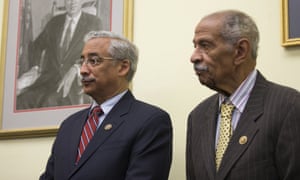
John Conyers and Bobby Scott are pushing legislation that would amend Title VI of the 1964 Civil Rights Act and restore the rights of parents to file lawsuits against segregated school districts under claims of disparate impacts.It wasn’t lost on Green, however, that just north of 8 Mile Road – the demarcation line of Detroit and its suburbs – students had access to a significantly higher amount of resources.
“I do remember … 8 Mile being like the psychological barrier, even in the early 80s it was,” said Green, 33. “I knew there were these suburbs [that] had more amenities, but I don’t think I could articulate that as an elementary school child.”
A fourth-generation Detroiter, Green’s entry into the city’s public school system was only several years removed from a seminal 1974 US supreme court ruling on school desegregation, Milliken v Bradley, which ended a plan to integrate mostly white suburban schools into Detroit’s public school system. The city’s population continued to swiftly decline in the years that followed, eroding the school system’s resources in tandem until the state declared a financial emergency.
Green, a professor of educational policy and planning at the University of Texas at Austin, pointed to the Milliken decision as a “death knell” to implementing the supreme court’s 1954 decision in Brown v Board of Education to desegregate school systems.
“How do you have meaningful desegregation when you have white flight occurring at rapid rates, but we can’t involve suburban school districts where this was occurring?” Green said. “It stopped mandatory desegregation efforts metropolitan-wide.”
A report released this week by the Government Accountability Office illuminated the extent to which school systems across the US are, once again, becoming more segregated. The report found that more than 60% of schools with high levels of poor students were racially segregated, which the report defined as being at least 75% black or Latino.
The study reviewed federal data from 2001 to 2014 and found 16% of all US schools were both racially segregated and poor, increasing from about 7,000 schools in 2001 to 15,089 by 2013 to 2014. Observers and advocates for school desegregation said the report should be a “huge warning sign” that needs to be addressed.
“There are many who believe in this country that we are operating on an even playing field,” said Jadine Johnson, staff attorney at Advancement Project.
“I think what this report revealed … is that the legacies of slavery in this country, the legacies of Jim Crow, are alive and active,” she said. “That did not go away with Brown v Board of Education.”
Compared to other schools, the GAO report found, segregated schools offered fewer college prep, science, and math classes to take, and a disproportionate number of students were either held back in ninth grade, suspended, or expelled.
Michigan congressman John Conyers was among several lawmakers who requested the report, which was released on the 62nd anniversary of Brown v Board of Education. Conyers and Virginia congressman Bobby Scott are pushing legislation that would amend Title VI of the 1964 Civil Rights Act and restore the rights of parents to file lawsuits against segregated school districts under claims of disparate impacts, which are based on ascertaining the discriminatory effect of a policy rather than ascertaining a discriminatory intent.
"This GAO report confirms what has long been feared and proves that current barriers against educational equality are eerily similar to those fought during the civil rights movement,” Conyers said in a statement. “There simply can be no excuse for allowing educational apartheid in the 21st century.”
Johnson said the loss of parents’ ability to file disparate impact cases was a “huge blow to the civil rights community”. Johnson has assisted in filing several Title VI complaints in recent years with the federal department of education – complaints that could have been filed in federal court under Conyers’ proposal.
“Us having that right could have potentially … slowed down the school closures crisis that’s happening today,” she said.
In Conyers’ home state, the largest public school system – Detroit – is currently embroiled in a struggle for survival amid bloated class sizes, paltry resources, and large-scale protests waged by teachers who have faced the prospect of working without pay. Michigan’s governor, Rick Snyder, is pushing a controversial $715m plan to overhaul the district, which needs a significant influx of cash to move forward with much-needed repairs for dozens of dilapidated facilities.
Only one-third of high school students in Detroit public schools are proficient in reading, according to Snyder’s office.
Green said the Milliken decision is one of the “main culprits” in what has happened to his alma mater.
Despite the supreme court’s 1954 landmark decision that US schools must be desegregated, Detroit’s school system remained effectively segregated, stemming in part from an accelerated white flight. When the NAACP legally challenged the state of Michigan in 1970 to end the district’s segregation, at first, the federal courts agreed something needed to be done: A plan was crafted to bus students in from suburban districts and was upheld by an appellate court.
But the plan was quickly stamped out. In 1974, the US supreme court in a 5-4 ruling shot down the efforts in Detroit, saying desegregation measures had to remain inside district boundaries.
In a column he co-wrote for the Detroit Free Press, Green argued that “we need advocacy and policies for all schools to be equitable, and racially and socioeconomically diverse across metro Detroit so that all children can learn to grow up in a diverse nation.”
Compared to suburban districts, he said, citing the GAO report, segregated schools have less access to courses needed to exceed in college – and, in some cases, a lower level of teacher experience. Indeed, a plan approved by the Michigan house to overhaul Detroit schools would allow uncertified teachers to be hired by the district.
“So I think there’s also a resource argument that has to be made [for integration],” he said.
The GAO recommended that the US department of education “more routinely analyze” civil rights data to identify disparities and said the federal justice department could “systematically track key information on open federal school desegregation cases to which it is a party to better inform its monitoring”.
Eve Hill, US deputy assistant attorney general, wrote in a response letter to the report: “The Department carefully monitors each open desegregation case to which the United States is a party on a case-by-case basis, recognizing that each case is unique.” The justice department is involved in 178 open desegregation cases, stemming from court orders that originated in the 1970s and 1980s.
Green said the GAO report underscores the spirit of the Brown v Board of Education decision.
“It’s not just about putting white bodies and black bodies together,” he said. “It’s about understanding what they said in 54, that racially segregated and separate schools are inherently unequal.”
Voting is beautiful, be beautiful ~ vote.©

Saturday, June 27, 2015

John Conyers Discusses His Healthcare Vote


John Conyers Discusses His Healthcare Vote by showerwaterpolo Voting is beautiful, be beautiful ~ vote.©

Friday, April 3, 2015

Conyers: “Doc Fix” Protects Seniors, Children, and Community Health Centers

WASHINGTON – Congressman John Conyers, Jr. (MI-13) released the following statement after voting in support of H.R. 2, The Medicare and CHIP Reauthorization Act of 2015, which passed the House overwhelmingly with a final vote of 392-37:

Dean of the U.S. House
of Representatives
John Conyers, Jr.
“This bipartisan agreement will provide much-needed stability for patients, doctors, and hospitals, while ensuring funding for essential children’s insurance programs and community health centers.  Had Congress failed to act, doctors would have faced steep cuts in Medicare reimbursements and, accordingly, seniors with health coverage would have been left without care. For years, Medicare’s payments to healthcare providers have failed to keep pace with inflation, leading doctors around the country to refuse seeing Medicare patients.  Crucially, this permanent “doc fix” legislation protects all current beneficiaries from cost increases.

“Equally important to fixing Medicare’s broken payment system, today’s bipartisan agreement safeguards health investments for children and struggling families. The legislation includes a two year extension of the Children’s Health Insurance Program (CHIP) while avoiding the GOP’s desired funding cuts.  The legislation also includes $7.2 billion in funding over two years for the Community Health Center Program created under the Affordable Care Act.  Detroit has seven Community Health Centers that serve nearly 100,000 patients per year, 70 percent of whom are low-income. Without this funding, Detroit’s Community Health Centers would have been forced to turn away patients or even close their doors.”

“Having served as a champion for Medicare since voting for its creation in 1965, I strongly reject any attempts to shift the costs of care to struggling and vulnerable beneficiaries.  I supported this legislation because it contains important safeguards to protect people in need, and because it will help ensure that Americans—both young and old—maintain their access to quality healthcare.”

Voting is beautiful, be beautiful ~ vote.©

Sunday, February 17, 2013

Majority of House Democrats Call on President Obama to Reject Benefit Cuts to Medicare, Medicaid, and Social Security Benefits


(WASHINGTON) - 107 House Democrats, a majority of Democrats in the House of Representatives, wrote President Obama today, urging him to reject any proposals to cut benefits millions of American families depend upon through Medicare, Medicaid and Social Security. The letter was led by Rep. Jan Schakowsky (D-IL),Congressional Progressive Caucus Co-Chairs Reps. Keith Ellison (D-MN) and Raúl M. Grijalva (D-AZ), Rep. John Conyers (D-MI), and Rep Donna Edwards (D-MD).
The Members specifically singled out “Chained CPI”—a proposal to reduce Social Security benefits by changing the way inflation is calculated—and raising the Medicare retirement age as policies they oppose.
“A commitment to keeping the middle-class strong and reducing poverty requires a commitment to keeping Social Security, Medicare and Medicaid strong,” the Members said in the letter. “We urge you to reject any proposals to cut benefits, and we look forward to working with you to enact approaches that instead rely on economic growth and more fair revenue-raising policies to solve our fiscal problems.”

You can read the full text of the letter below.

^^^^^^^^^^^^^^^^^

February 15, 2013

Dear President Obama:

We want to thank you for standing strong in the American Taxpayer Relief Act to protect Social Security, Medicare, and Medicaid from benefit cuts that would jeopardize the well-being of millions of Americans.
We write to affirm our vigorous opposition to cutting Social Security, Medicare, or Medicaid benefits in any final bill to replace sequestration.  Earned Social Security and Medicare benefits provide the financial and health protections necessary to keep individuals and families out of poverty.  Medicaid is not only a lifeline for low-income children, pregnant women, people with disabilities and families, it is the primary source of long-term care services and supports for 3.6 million individuals.  We cannot overstate their importance for our constituents and our country.

That is why we remain deeply opposed to proposals to reduce Social Security benefits through use of the chained CPI to calculate cost-of-living adjustments.  We remain committed to making the changes that will extend solvency for 75 years, but Social Security has not contributed to our current fiscal problems and it should not be on the bargaining table. 

Similarly, we oppose proposals to increase Medicare cost-sharing requirements or to raise the age of eligibility.  Half of all Medicare recipients live on less than $22,000 a year – yet they spend, on average, three times as much of those limited incomes on health care as other Americans.  Raising their already heavy cost-sharing burden or increasing the age of eligibility doesn’t lower health care costs, it just shifts them to those who can least afford more financial burdens – seniors, people with disabilities and their families. 
A commitment to keeping the middle-class strong and reducing poverty requires a commitment to keeping Social Security, Medicare and Medicaid strong.  We urge you to reject any proposals to cut benefits, and we look forward to working with you to enact approaches that instead rely on economic growth and more fair revenue-raising policies to solve our fiscal problems.

Sincerely,

Schakowsky, Jan
Ellison, Keith
Grijalva, Raúl M.
Conyers, John
Edwards, Donna
Barber, Ron
Bass, Karen
Bera, Ami
Bonamici, Suzanne
Brady, Robert
Braley, Bruce L.
Brown, Corrine
Brownley, Julia
Bustos, Cheri
Butterfield, G.K.
Capps, Lois
Cardenas, Tony
Cartwright, Matthew
Castor, Kathy
Christensen, Donna M.,
Chu, Judy
Cicilline, David
Clarke, Yvette D.
Clay Jr., William "Lacy"
Cleaver, Emanuel
Cohen, Steve
Conyers Jr., John
Courtney, Joe
Cummings, Elijah
Davis, Danny K.
DeFazio, Peter
DeLauro, Rosa L.
Deutch, Ted
Duckworth, Tammy
Edwards, Donna F.
Ellison, Keith
Eshoo, Anna G.
Faleomavaega, Eni F. H.
Farr, Sam
Fattah, Chaka
Frankel, Lois
Fudge, Marcia L.
Garamendi, John
Grayson, Alan
Green, Al
Green, Gene
Grijalva, Raul
Gutierrez, Luis
Hahn, Janice
Hastings, Alcee L.
Hinojosa, Rubén
Holt, Rush
Honda, Mike
Huffman, Jared
Jackson Lee, Sheila
Jeffries, Hakeem
Johnson, Eddie Bernice
Johnson, Henry C. "Hank" Jr.
Kaptur, Marcy
Kildee, Daniel
Kirkpatrick, Ann
Langevin, Jim
Lee, Barbara
Lewis, John
Loebsack, David
Lofgren, Zoe
Lowenthal, Alan
Lujan Grisham, Michelle
Lynch, Stephen F.
Maloney, Carolyn
Markey, Ed
Matsui, Doris O.
McDermott, Jim
McGovern, James
Meng, Grace
Michaud, Michael
Moore, Gwen
Nadler, Jerrold
Negrete McLeod, Gloria
Nolan, Rick
Norton, Eleanor Holmes
Pastor, Ed
Payne Jr., Donald
Pingree, Chellie
Pocan, Mark
Rangel, Charles B.
Roybal-Allard, Lucille
Rush, Bobby L.
Ryan, Tim
Sablan, Gregorio
Sanchez, Linda
Scott, Robert C.
Serrano, José E.
Shea-Porter, Carol
Sinema, Kyrsten
Sires, Albio
Slaughter, Louise
Speier, Jackie
Takano, Mark
Thompson, Bennie G.
Tierney, John
Titus, Dina
Tonko, Paul D.
Vargas, Juan
Veasey, Marc
Velázquez, Nydia M.
Waters, Maxine
Watt, Mel
Waxman, Henry
Welch, Peter
Wilson, Frederica

cc:  Speaker John Boehner
House Minority Leader Pelosi
Senate Majority Leader Reid
Senate Minority Leader McConnell

Voting is beautiful, be beautiful ~ vote.©