Showing posts with label privatization. Show all posts

Friday, June 1, 2018

CONYERS Retired, Resigned Or Is It A Federal Investigation?: Michael Gilmore Wants A Special Election


He is going to do the dramatic Hollywood style ceremonial "filing of the complaint" on the courthouse steps.

I am excited to see the video and what he is going to do with it for his campaign, because you know he is going to use the federal litigation for his campaign.

Well, the days of the political drama have been, oh, let us just say, have been placed under the lens of the cyber community, so all eyes shall be watching this case, in real time.

To begin, let us exam the reason why Michael is filing this lawsuit.

On second thought, that would be a waste of time so I am just going to identify his motivation to file the lawsuit in the title of the article, below.

He is filing to launch his campaign, and not for the greater good of society.

I say this because a congressional seat does not belong to a man nor is it an American title of nobility; it belongs to all people of the 13th Congressional District of Michigan, not just a targeted population of Detroit.

Can one use federal resources, in this case, the federal court, for a political campaign, particularly if the suit of law is for the seat you are attempting to sway to public to win?

This is a questionable way to kick off a political campaign.

This is also the part that where I defenestrate my reservations and remain consistent.

There is a formal process for a Member of Congress to resign and it is my belief that process was executed in a fraudulent manner.

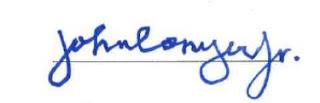
The following is copy of the Congressional Letter of "retirement" of John Conyers, Jr. which was found published with media outlets.


That does not look like his signature to me and I should know.

How could he sign a letter dated December 5, 2017 and enter it into public record when it was reported that he was hospitalized, medically incapacitated, November 30, 2017 in Detroit?

Hmmmmm....

According to media reports, Conyers' "retirement" was lobbied by a non-governmental, unlicensed attorney, and other Members of Congress, despite the fact that Arnold Reed was retained to represent Mr. Conyers.

Hmmmmm....
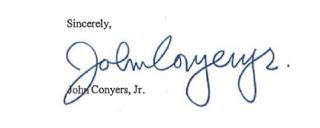
Date of signature: December 5, 2017

Date of signature: July 7, 2007


Date of signature: November 18, 2017

Date of signature: December 16, 2016


Only one of these signatures from United States Congressional Letters, is the real signature of John Conyers, Jr.

Can you guess which one is his?


Mother Superior Augustine would have had a heart attack if she bared witness to the reading of this letter with just about every sentence commencing with first person pronoun, "I", giving me every indication that the Gentlelady Jackson Lee was in rather a pressurized bind by a few unsavory characters.

See, I know what Nancy Pelosi did last summer, and the summer before that, and so on, with Bitch Boy, which is another reason why I speculate the legality of the process, because Nancy has been terribly mean to my Sweetie for quite some time.

I challenge the veracity of Mr. Conyers' voting record and policy positions because people have been forging his signature on congressional letters, for a long time, which is why I did this.

Original signature of John Conyers, Jr.
I was quite shocked when I found out how much individuals were getting for his forged signatures on congressional letters.

Quintessentially, if there are relevent questions raised surrounding the legitimacy of the "retiring" of Mr. Conyers, perhaps, this is the real reason why there will be no special election, as there are multiple, ongoing federal investigations.

Maybe Michael could attempt to validate his racist theories in discovery, or he could just do a basic internet search.

It is just a jurisdictional issue that would immediately halt any state "retirement" process.

But, hey, what do I know?

Candidate says he'll sue Gov. Snyder to move up election for Conyers' seat

A candidate for the U.S. House seat vacated by former U.S. Rep John Conyers filed a lawsuit against Gov. Rick Snyder demanding that the election be moved up to an earlier date.

On Dec. 8, Gov. Snyder had announced that Conyers' congressional seat would remain empty until the regularly scheduled November election, leaving it vacant for nearly a year. What's more, political observers have pointed out that since the post will be listed twice — once in the August primary and again in the November general election ballots — the office could be held by two different people before January is out.

In short, the move would leave Detroiters without effective representation for 11 months — and perhaps even longer.
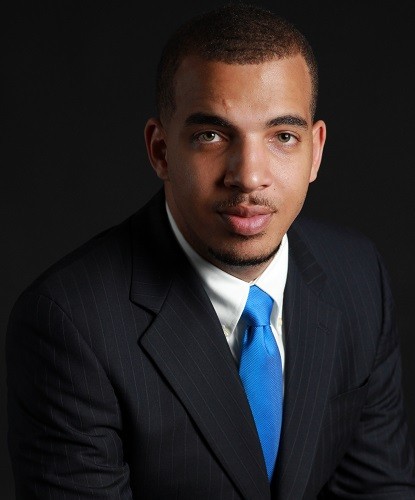
Michael Gilmore announced today that he intends to sue Gov. Snyder to move up the election for Conyer's vacant U.S. House seat. - PHOTO COURTESY MICHAEL GILMORE FOR U.S. HOUSE
Michael Gilmore
As the Associated Press noted earlier this month judging by a review of roughly 100 vacancies and successors listed on the House website for the last 20 years, it is unusual for a congressional district to stay vacant for so long. Eleven months would be the longest time a House seat stayed empty during that period.

Gov. Snyder had said his decision would both save money and give candidates ample time to campaign. But given his role in establishing Emergency Management in Michigan, this situation calls another lawsuit to mind — namely one filed by the Detroit Branch of the NAACP against Gov. Snyder that Emergency Management has violated the voting rights of the state's African Americans, effectively stripping representation away from residents in majority-minority cities and school districts. By some estimates, more than half of the state's blacks had their representatives overruled by Snyder-appointed viceroys.

None of this is lost on candidate Michael Gilmore, who has announced his intention to sue the governor over the scheduling of this election:

"Gov. Snyder continues to treat residents of urban areas across the state as second-class citizens and is violating a laundry list of constitutional laws in doing so," Gilmore said in a statement released today. "By holding this congressional seat vacant for 11 months, he is denying minority residents of the 13th Congressional District the right to vote and the right to be represented in Congress. This is yet another attempt to further silence the voice of minorities in the state and disregard their views. From putting emergency managers only in minority school districts and city halls to signing off on the Flint water crisis for fiscal benefit, Gov. Snyder has historically cited cost-saving measures as his reason for denying civil and human rights to urban areas. Here, he is once again attempting to balance the state's budget on the backs of Black people, in the name of 'cost savings.'"
Gilmore says he will discuss his lawsuit against Gov. Snyder at 10 a.m. Tuesday, Jan. 2, 2018, at the Fort Street entrance of the Theodore Levin United States Courthouse, Detroit.


One man hoping to win an empty congressional seat is suing the governor for waiting until November to fill the seat. Most residents have a representative in Congress until the next election.

However, because Congressman John Conyers resigned in 2017, and Gov. Rick Snyder set an election to fill his seat starting in November, residents of the 13th congressional district will not have a representative in Congress for 11 months in 2018.

"Governor Snyder continues to treat residents of urban areas across the street as second class citizens," Michael Gilmore said. Governor Snyder has historically cited cost saving measures as his reason for denying civil rights and human rights to urban areas," he said.

The governor does believe setting the date for the special election in August and November on the same dates as the regular general election will save local taxpayers up to $2 million.

"Divide $2 million by the 658,000 residents, that totals roughly $3 per person," he said.
Gilmore calls this systemic discrimination in the 13th congressional district, which he says is composed of over 62 percent minority residents.

"He is once again attempting to balance the state's budgets on the backs of black people in the name of cost savings," he said.

Gilmore is also a candidate for this seat. Might his lawsuit be self-serving?

"I don't believe this is self-serving, in fact I'm actually quite ashamed that I'm the only one talking about it," he said. "Donald Trump has already begun to illuminate important social programs that we need in this area, and no one else is talking about it?"

Gilmore says that typically vacancies are filled within a few months and he has asked the federal court to make a quick ruling hopefully by the end of February. There's been no formal response from the governor's office. 


Stay tuned.

Voting is beautiful, be beautiful ~ vote.©

Wednesday, December 6, 2017

CONYERS Is About To Blow The Whistle

Who said the "allegations at the hightest levels of government" had to be just about sex scandals?

Perhaps it has to do with fraud and public corruption.


Stay tuned.

Is the dam about to burst open? John Conyers' lawyer hints at allegations at the higest levels of government

Are various members of the House and Senate about to be embroiled in sex scandals of their own? According to Arnold E. Reed, an attorney for Rep. John Conyers (D-MI), the damn may be about to break when it comes to future allegations.

Daily Caller reports:
The attorney for Democratic Michigan Rep. John Conyers, who is accused of continuously sexually harassing his female staffers, defended Conyers by indicating that there are allegations against "many members" of the House and Senate.

Conyers' attorney, Arnold E. Reed, released a statement defending the Michigan Democrat and pushing back against the "disturbing allegations." The bizarre statement was written in all-CAPS and referred to both Reed and Conyers in the third person.

"Reed acknowledged that while these allegations are serious, they are simply allegations," the statement said. "If people were required to resign over allegations, a lot of people would be out of work in this country including many members of the House, Senate and even the president."
Below is Arnold E. Reed's letter in full.


As one Senate staffer admitted to the Daily Caller, "Things have gotten dark around here," in light of the Franken allegations. "Everyone is walking on eggshells, asking who's next?"

According to Axios reporter Jonathan Swan, claims against the Democrat lawmaker are the "very tip of the congressional iceberg.

"Democratic Sen. Al Franken is the very tip of the congressional iceberg. Many more stories are coming and we wouldn't be surprised if they end several careers. A Republican source told me he's gotten calls from well-known D.C. reporters who are gathering stories about sleazy members," says Swan. 

The "next wave," is coming, Swan adds.

In a new report by CNN, over 50 current and former lawmakers, aides and staff say they have personally experienced sexual harassment on Capitol Hill.

As The Gateway Pundit's Cristina Laila reported, prominent Democrats are calling for Al Franken to resign after model and radio host Leeann Tweeden came forward accusing the Senator of sexual assault.

It was revealed Monday evening that one Congressman who settled a harassment suit in 2015 was Democrat Rep John Conyers. According to affidavits, Conyers used taxpayer money to fly women into D.C. to meet with him in hotel rooms.

Voting is beautiful, be beautiful ~ vote.©

CONYERS Under New Ethics Committee Investigation

Trump Overseas, What Could Go Wrong??Boy, oh boy...

I wonder what Cynthia Martin has to say.

This is about to get really, really juicy.

Much, much more to come.

On a mission...

#FollowTheWhiteRabbit

Ethics Committee Opens Investigation Into Top Democrat Who Paid Off Sexual Harassment Accuser

The House Ethics Committee has opened an investigation into Michigan Democrat Rep. John Conyers, after it was revealed Monday that Conyers paid a former employee more than $27,000 in taxpayer funding after allegedly firing her for refusing his sexual advances.

Sworn affidavits signed by former Conyers staffers portray him as a serial sexual predator who preyed on young, vulnerable female staffers. Conyers confirmed the settlement on Tuesday but denied any wrongdoing.

(RELATED: REVEALED: Top Democrat Paid Off Sexual Harassment Accuser With $27K In Taxpayer Money)

“The Committee is aware of public allegations that Representative John Conyers, Jr. may have engaged in sexual harassment of his staff, discriminated against certain staff on the basis of age, and used official resources for impermissible personal purposes,” the committee said in a statement Tuesday afternoon. The statement adds that the committee “has begun an investigation and will gather additional information regarding these allegations.”

Conyers regularly made sexual advances on female staffers and would ask them for sexual favors, according to the affidavits signed by his former staffers. “Rep. Conyers strongly postulated that the performing of personal service or favors would be looked upon favorably and lead to salary increases or promotions,” one former employee said in an affidavit.

BuzzFeed News first reported the bombshell allegations and accompanying settlement on Monday after right-wing blogger Mike Cernovich provided the website with the documents.
Conyrers also allegedly abused taxpayer funds to shuttle in women with whom he had sexual relationships.

“One of my duties while working for Rep. Conyers was to keep a list of women that I assumed he was having affairs with and call them at his request and, if necessary, have them flown in using Congressional resources,” one former Conyers stated in an affidavit. Another staffer told BuzzFeed that Conyers used taxpayer funds to fly women into see him.

House Democrats had called for an investigation into Conyers, the longest-serving member of Congress, but stopped short of calling on him to resign.

Their reaction is similar to Senate Democrats’ call for a Senate Ethics Committee investigation into Minnesota Sen. Al Franken, after multiple women came forward saying the Democratic senator had groped them. Franken asked for an ethics committee investigation into himself, but declined to resign.

Voting is beautiful, be beautiful ~ vote.©

Saturday, September 23, 2017

CONYERS: Top Democrats Ask Equifax, TransUnion, & Experian: Will Restore Consumers Rights In The Wake Of The Equifax Data Breach?


September 21, 2017 (Washington, DC) – Following the Equifax data breach of 143 million Americans’ personal information, House Judiciary Committee Ranking Member John Conyers, Jr. (D-MI), Ranking Member of the House Judiciary Committee’s Subcommittee on Regulatory Reform, Commercial and Antitrust Law Rep. David N. Cicilline (D-RI), and Representatives Don Beyer (D-VA) and Henry C. “Hank” Johnson, Jr. (D-GA), wrote to the three main credit rating agencies—Equifax,TransUnion, and Experian—to hear whether these companies will continue to include forced arbitration clauses in their terms of service or end their campaign against the Consumer Financial Protection Bureau’s rule to restore consumers’ day in court.

They wrote:

“The economic security of nearly half of all Americans has been jeopardized because Equifax’s failure to safeguard our most sensitive information, which is now in the hands of criminals. Making matters worse, many of those affected by this massive security breach are unsure whether they even have legal recourse because of your company’s use of forced arbitration clauses. Although Equifax has revised its policy in response to public outcry, this limited change is simply not enough given the systemic nature of this problem and the scope of the lives affected. We therefore request information concerning your plans to revise your terms of service and stance on the Consumer Financial Protection Bureau’s (CFPB) arbitration rule to restore consumers’ day in court.”

The CFPB arbitration rule includes important safeguards for consumers against forced arbitration, a practice that routinely allows corporate entities to avoid class-action lawsuits by burying legal language in the fine print of contracts that require consumers to waive their right to court.

A Republican measure to repeal that rule, supported by all three credit rating agencies, passed in the House of Representatives in July on a nearly-straight party-line vote. It is currently pending in the Senate.

The House Democrats denounced the three credit agencies for their opposition to the forced arbitration rule, writing, “Rather than support this commonsense protection, your company and others like it have reportedly campaigned against it, spending millions in campaign contributions and other efforts to undermine both the rule and the CFPB. Now is the time to demonstrate your respect for the rights of your customers, not undermine them.”


Voting is beautiful, be beautiful ~ vote.©

Tuesday, August 8, 2017

CONYERS, CUMMINGS, CONNOLLY & CICILLINE Request Documents about President Trump’s Regulatory Task Forces’ Secret Meetings and Conflicts of Interest


Washington, D.C. (August 7, 2017)—Today, Reps. John Conyers, Jr., Ranking Member of the House Committee on the Judiciary, Elijah E. Cummings, Ranking Member of the House Committee on Oversight and Government Reform, Gerry Connolly, Ranking Member of the Subcommittee on Government Operations, and David Cicilline, Ranking Member of the Subcommittee on Regulatory Reform, Commercial and Antitrust Law, sent a letter, below, to Office of Management and Budget Director Mick Mulvaney and Office of Information and Regulatory Affairs Administrator Neomi Rao expressing grave concerns about the secrecy of the Regulatory Reform Task Forces and requesting information about the nature of their meetings.

“We write to express our alarm concerning the lack of transparency, accountability, and independence of the Regulatory Reform Task Forces,” the Members wrote. “We believe that the interests of the American public must be paramount when reviewing the worthiness of regulations. Therefore, these Task Forces must have an effective and transparent guard against conflicts of interest, especially those in which industry lobbyists seek to overturn environmental and health protections for financial gain. It appears that the current Task Forces are already failing on this front, and instead are actively hiding their members and their meetings from public view.”

The Democrats explained that press reports indicate these Task Forces appear to have operated in private without public input, and some agencies have refused to release basic information about their activity or maintain a record of their meetings as required by the Federal Records Act.

“Withholding the names and titles of Task Force participants may also violate the Freedom of Information Act (FOIA),” the Members wrote. “Simply put, it is unacceptable for federal agencies to operate in such a clandestine and unaccountable manner especially when the result could be the undoing of critical public health and safety protections.”

The Members also expressed concern that several employees stand to profit from their work on the Task Force. For example, the wife of one Task Force member at the Environmental Protection Agency is the top lobbyist for a large oil company.

“Rather than ‘drain the swamp,’ these conflicts threaten to influence the outcome of the review process against hardworking Americans and in favor of regulated industries and agency staff,” the Members wrote.

The Members requested documents and information, including a description of every Task Force created pursuant to the executive order, a list of the names and titles of every member of each Task Force, and communications related to non-governmental entities participating in Task Force meetings.

Voting is beautiful, be beautiful ~ vote.©

Tuesday, July 25, 2017

CONYERS: Statement for the Hearing on H.R. 2887, the No Regulation Without Representation Act of 2017


Dean of the U.S. House
of Representatives
John Conyers, Jr.
Before I begin my remarks, I’d like to take a moment to recognize Joseph Ehrenkrantz for his dedicated service to the House of Representatives.

Over the past two years, he has diligently served the House Judiciary Committee as a Professional Staff Member.

Joe began his career with the House Judiciary Committee Democrats shortly after graduation, and has worked tirelessly on issues of civil rights, state and local taxation, and voting rights ever since.

Joe has served the Members and staff of the Committee with great energy and enthusiasm, working to ensure the smooth functioning of Committee business by coordinating briefings, staffing hearings, and clerking markups.

We thank Joe for his many outstanding contributions to the House Judiciary Committee and the U.S. House of Representatives, and wish him well as he begins law school at Georgetown University this fall.

He will surely be missed.

Turning to today’s hearing, which focuses on H.R. 2887, the “No Regulation Without Representation Act of 2017,” it appears that supporters of this legislation intend to address the apparent problem of states regulating beyond their borders.

Twenty-five years ago, the Supreme Court in Quill held that a state may require a business to remit a sales tax only if such business had a physical presence in the state where the goods or services are provided. 

In an effort to respond to this holding, various legislative responses have been introduced over the years, including two of which I strongly supported, namely, The Remote Transactions Parity Act and the Marketplace Fairness Act. 

Although one of these bipartisan measures overwhelmingly passed the Senate in 2013, our Committee has unfortunately failed to consider either of these bills. 

Instead, we are focusing today on H.R. 2887, a highly-flawed measure. 

Among its many flaws, this bill would eviscerate the 10th Amendment and override the powers of all 50 states by expanding the physical presence standard to all taxes and all regulations.

H.R. 2887 represents an extreme rethinking of the constitutional role of states in our Nation and would strip essential consumer protection powers and taxing authority from all 50 states.

To quote the bipartisan National Governors Association and the National Conference of State Legislatures, this legislation “is a direct threat to representative self-government.”

Simply put, H.R. 2887 would preempt tens of thousands of state laws and saddle these states with untenable budget constraints by reducing their ability to collect tax revenues.
Second, this bill appears to ignore the real problems that main street retailers face today.

Local retailers—that have to collect sales taxes—are desperately struggling to compete with the reduced prices and conveniences offered by remote Internet sellers, whose online prices are generally lower because many consumers do not pay any sales taxes and thereby can save upwards of 10% or more on the purchase price of these items.

Technological advancements have made it easier for consumers to take advantage of this disparity and the consequences of this loophole are becoming increasingly more apparent.

Since October, at least 10 major, nationwide brick and mortar retailers have filed for bankruptcy and more than 90,000 workers have been laid off. 

Retail sector growth is at its weakest since the Great Recession, and recent projections estimate that a quarter of all U.S. shopping malls will close in the next five years.

Without question, I am a strong supporter of competition, especially when it benefits consumers and encourages innovation. Nevertheless, competitors should compete on things other than sales tax policy.

We should ensure parity at the point of sale among retailers and level the playing field.

Finally, H.R. 2887, by codifying Quill, would effectively prevent states and local governments from accessing a substantial part of their tax base.

State governments rely on sales and use taxes for nearly one third of their total tax revenue. Yet, as more Americans purchase more of their goods on the internet, the states receive less in sales tax revenue.

We owe it to our local communities and local retailers, as well as state and local governments, to take up helpful legislation rather than considering such flawed measures as H.R. 2887.  Accordingly, I urge Committee Chairman Goodlatte and Subcommittee Chairman Marino to instead consider H.R. 2193, the “Remote Transaction Parity Act,” bipartisan legislation introduced by Representative Kristi Noem earlier this year.

In closing, I look forward to hearing the testimony from our witnesses today and yield back the balance of my time.

Voting is beautiful, be beautiful ~ vote.©

Wednesday, May 17, 2017

CONYERS, BOOKER & CICILLINE Introduce Bill To Repeal Congressional Review Act


Republicans have abused law to roll back health, environmental, and consumer protections, while benefiting special interests

WASHINGTON – Today, House Judiciary Committee Ranking Member JohnConyers, Jr. (D-MI), U.S. Congressman David N. Cicilline (D-RI), and Senator Cory Booker (D-NJ) introduced a bill to repeal the Congressional Review Act, a measure Republicans have exploited this year to overturn public health, environmental, and consumer protections while advancing special interests.  

Dean of the U.S. House
of Representatives
John Conyers, Jr.
“From stripping the privacy rights of American consumers to repealing women’s healthcare protections, President Trump has recklessly used the Congressional Review Act (CRA) to abolish fourteen critical protections for hardworking Americans without a single hearing or markup,” Cicilline said. “Rather than keep his promise to protect American workers, President Trump has repealed guarantees that federal contractors actually comply with the law—including workers’ wage, safety, and civil rights protections—before receiving new contracts, along with rules to provide economic security to retirees. There can be no mistake that this for-profit President has no interest in putting people ahead of corporate profits. I am introducing the SCRAP Act to repeal the CRA once and for all so that this never happens again and to provide agencies with fast-track authority to reinstate the rules that have been repealed through the CRA by President Trump.”

The CRA allows Congress to quickly overturn recently issued agency rules – many of which were years or decades in the making – by bypassing Congress’s regular lawmaking process. Once a rule is reversed by the CRA, an agency can never reissue a substantially similar rule unless specifically authorized to do so under a new law.

Since February, Republicans have used the CRA to roll back a wide range of public health, environmental, and consumer protections, benefiting special interests by making it easier for internet providers to collect users’ personal information, making it easier for businesses to hide workplace dangers from workers, and making it easier for states to discriminate against family planning providers, to name just a few examples.

“Abuse of the CRA has allowed Congressional Republicans to fast track the repeal of a host of protections that benefit everyday Americans with little notice or public debate,” Booker added. “President Trump and Republicans are misusing this legislative mechanism to reward special interests and big corporations at the expense of consumers, working families, and the environment."

“Congressional Republicans and President Trump have just provided us with all the evidence needed to conclude that the Congressional Review Act is nothing more than a crass corporate payback scheme,” Public Citizen President Robert Weissman said. “Republicans repealed 14 popular and important public protections, including measures to protect consumers, worker health, and the environment. They even repealed a rule to protect privacy on the Internet; it’s hard to imagine that any American not connected to the telecom industry favored that move – but Republicans responded to their political patrons nonetheless. If there was any doubt before, it’s now certain that the CRA must go. Public Citizen applauds Senators Booker and Udall and Rep. Cicilline for introducing legislation to repeal the CRA.”

In addition to repealing the CRA, the Sunset the CRA and Restore American Protections (SCRAP) Act would remove the prohibition on agencies reissuing a previously overturned rule and would give those agencies greater flexibility in reinstating such rules.

The CRA was designed to go after “midnight” rules issued in the final days of an administration, but as written, it authorizes rule reversals going as far back as six months or more into the previous administration. Since early February, House and Senate Republican leadership in Congress has used the CRA to reverse 14 agency rules, yet prior to this Congress, the CRA had been used only once in 20 years.

Voting is beautiful, be beautiful ~ vote.©

Wednesday, February 8, 2017

Bipartisan Coalition of House Members Introduce Legislation to Ban Juvenile Solitary Confinement

MERCY Act Would Prohibit Solitary Confinement of Juveniles Tried in Federal System 

Washington, D.C. (Feb. 7, 2017)—Today, Reps. John Conyers (D-MI), Elijah E. Cummings (D-MD), Mia Love (R-UT), Raúl Labrador (R-ID), Sheila Jackson Lee (D-TX), Sean Patrick Maloney (D-NY) and Karen Bass (D-CA) introduced the Maintaining dignity and Eliminating unnecessary Restrictive Confinement of Youths Act of 2017 (MERCY Act).  The MERCY Act would prohibit the solitary confinement of juveniles who are tried in the federal system and held in pretrial facilities or juvenile detention facilities, barring some extremely exceptional temporary circumstances.  Sens. Cory Booker (D-NJ), Rand Paul (R-KY), Mike Lee (R-UT), James Lankford (R-OK), Richard Durbin (D-IL), and Bob Casey (D-PA) introduced the bill in the Senate.

Dean of the U.S. House
of Representatives
John Conyers, Jr.
Conyers said, “We must reinforce actions taken by President Obama last year with respect to solitary confinement of juveniles in the federal system  by enacting legislation to address this serious issue.   As he noted, solitary confinement has the potential to lead to devastating, lasting psychological consequences, and this is particularly so with respect to juveniles.  Over time, we have come to recognize these negative impacts and it is time that Congress act.  Pursuing smarter strategies for dealing with challenges posed by individual prisoners, especially juveniles, will lead to more effective prison administration, a reduction in recidivism, and safer communities. ” 

“When our youth are incarcerated, they are often already forced to reckon with the stark reality of the consequences of their actions—such as being separated from their friends and family and grappling with uncertain futures,” Cummings said.  “Compounding incarceration with solitary confinement can break a young person’s spirt beyond repair, and it can have devastating long-term impacts on their mental and physical health.  The MERCY Act will take a strong step toward eliminating this barbaric practice, so that we can ensure our youth have a chance to be rehabilitated and become contributing members of their communities.”

“Our corrections system should not just administer justice but also aim to rehabilitate – not create new or exacerbate existing problems,” Love said.  “Unfortunately, extended solitary confinement is linked to a host of long-term psychological issues. By ending its long-term use, this legislation preserves the dignity of individuals and protects their mental health. I am proud to join with my colleagues in introducing this legislation and look forward to helping move these reforms forward.”

Labrador said, “Reforming our criminal justice system demands a focus on long-term outcomes. Solitary confinement of juveniles presents serious risk to the mental and physical health of young offenders who will return to our communities. We must ensure that incarceration practices don’t hinder their development as we work to set them on a path to become responsible, law-abiding members of society.”

“I am glad to see meaningful criminal justice reform incorporate the valuable insights offered by the MERCY Act in the pursuit of policy change to remedy the inhumane and harsh treatment suffered by juveniles and youth involved in our justice system,” Jackson Lee said. “I am delighted to be an original co-sponsor of this critical legislation and much needed effort to alleviate the cruel, brutal and inhumane conditions of confinement that prevent adolescent rehabilitation and participation in reentry programming.  As I have often stated in the past, ‘meaningful criminal justice reform must look at all the ways the system touches the lives of our young people and communities and recognize that restoring their vulnerable population requires trauma-informed and age appropriate care.  This legislation is step toward catapulting this nation into action on criminal and juvenile justice reform.”
“Our criminal justice system is broken, especially when it comes to how we approach juvenile offenders – focusing on retribution instead of rehabilitation,”Maloney said. “Holding children and adolescents in solitary confinement is barbaric, detrimental to their health and can be extremely harmful to their development both mentally and physically. The MERCY Act takes an important step towards breaking the cycle of incarceration and gives young offenders the opportunity to become contributing members of our schools and community after they have served their time.”

“The MERCY Act rightly calls attention to the need for smart reform and trauma-informed care for all justice-involved youth and is a necessary piece of legislation that aims to eliminate harmful and dangerous confinement practices for this vulnerable population.  It is time we start addressing the underlying issues of trauma and abuse, as well as the emotionally damaging triggers of adolescent behaviors in a humane and medically informed way. The bottom line here is that cruel and inhumane conditions of confinement for youth in America must stop,” Bass said.

The solitary confinement of young people is a serious and widespread problem in the United States. Each day, in jails and prisons across America, youth under the age of 18 are held in solitary confinement often for weeks or months at a time. In 2011 alone, more than 95,000 youth were held in prisons and jails, and a significant number were held in solitary confinement. In 2013, the Department of Justice found that 47 percent of juvenile detention centers locked youth in solitary confinement for more than four hours at a time, and some held youth for up to 23 hours a day with no human interaction.

When subjected to solitary confinement, adolescents are often denied access to treatment and programming that would meet their psychological, developmental, and rehabilitative needs. Because youths are still developing, solitary confinement often seriously harms their mental and physical health, as well as their development.

The Maintaining dignity and Eliminating unnecessary Restrictive Confinement of Youths Act (MERCY Act):

·         Bans Juvenile Solitary Confinement. The MERCY Act bans the use of “room confinement” in juvenile facilities, except as a temporary response to a behavioral issue that poses serious and immediate risk to any individual.
·         Requires Use of Less Restrictive Techniques. The bill ensures that before a juvenile is placed in room confinement, the staff member must use less restrictive techniques, including de-escalation techniques or discussions with a qualified mental health professional.
·         Encourages Transparency. The bill mandates that the juvenile be informed of why the room confinement placement occurred and that release will occur upon regaining self-control or after a certain period of time in solitary confinement.  It also requires that the juvenile’s attorney and parents be notified when certain actions are taken.
·         Places Time Limits on Usage of Confinement. The MERCY Act limits solitary confinement on juveniles that pose a risk of harming others to no more than 3 hours and to juveniles who pose a risk of harm to themselves to no more than half an hour. It requires that juveniles be removed from room confinement once the risk of harm subsides.
·         Sets Minimum Conditions of Confinement. The bill ensures that the room used for room confinement in exceptional circumstances have adequate space, lighting, heating, cooling, ventilation, and access to water, toilet facilities, and hygiene supplies.
·         Requires Post-Confinement Services. After the maximum period of confinement, the bill mandates that juveniles be transferred to a facility where services can be provided.
·        Requires an Analysis. The MERCY Act requires that the Attorney General submit a detailed report to Congress on uses of force, restraints, and room confinement for juveniles.

Voting is beautiful, be beautiful ~ vote.©

Monday, January 9, 2017

CONYERS Statement In Opposition To REINS Act


Washington, DC – House Judiciary Committee Ranking Member John Conyers, Jr. (D-MI) submitted the following statement for the Congressional Record in opposition to the Regulations from the Executive in Need of Scrutiny Act of 2017 (REINS Act):

Dean of the U.S. House
'of Representatives
John Conyers, Jr.
Mr. Chair, H.R. 26, the “Regulations from the Executive in Need of Scrutiny Act of 2017,” otherwise known as the REINS Act, would amend the Congressional Review Act to require that both Houses of Congress pass and the President sign a joint resolution of approval within 70 legislative days before any major rule issued by an agency can take effect.

Simply put, H.R. 26 would impose unworkable deadlines for the enactment of a major rule under procedures that could charitably be referred to as convoluted.

Under this bill, the House may only consider a resolution for a major rule on the second and fourth Thursday of each month.  Keep in mind that typically 80 major rules are promulgated annually.  Yet, there may be as little as just 15 days available to consider such measures based on the Majority’s legislative calendar for the current year. 

Furthermore, Congress may only consider such resolutions within 70 legislative days of receiving a major rule. This process would constructively end rulemaking as we know it.
           
Now, Mr. Chair, the reason why my friends on the other side of the aisle say we need this kind of gumming-the-works legislation -- is because they claim regulations stifle economic growth.
           
For example, they point to the outgoing Administration and say that regulations promulgated during its tenure have hurt our Nation’s economy.
           
What they fail to tell the American people is that it was the Republican George Bush Administration’s economic policies that caused the Great Recession.
           
Without question, it was the lack of regulatory controls that facilitated rampant predatory lending, which nearly destroyed our Nation’s economy.
           
It led to millions of home foreclosures and devastated neighborhoods across America.  In fact, it nearly caused a global economic meltdown. 
           
Nevertheless, as a consequence of strong regulatory policies implemented by President Obama through such measures as the Dodd-Frank Act, our Nation has recovered to a point where the unemployment has been cut nearly in half to less than 5%.
           
Yet, the REINS Act would reverse these gains by empowering Congress to control and override the rulemaking process, even in the absence of any substantive expertise.

More than 80 of the Nation's leading professors on environmental and administrative law have warned in connection with substantively identical legislation considered in the last Congress, that without this expertise, any congressional disapproval is more likely to reflect the political power of special interests.
           
Lastly, by upending the process for agency rulemaking so that Congress can simply void major rules through inaction, the REINS Act likely violates the presentment and bicameralism requirements of article I of the Constitution.
           
As a leading expert on administrative law states:  “The reality is that the act is intended to enable a single House of Congress to control the implementation of the laws through the rulemaking process. Such a scheme transgresses the very idea of separation of powers, under which the Constitution entrusts the writing of the laws to the legislative branch and the implementation of the laws to the executive branch.''
           
The REINS Act will further encourage corporate giants to hold our country hostage through a deregulatory, profits-first agenda and facilitate a political influence process rivaling the destructive industrial monopolies from the past century.
           
In sum, H.R. 26, like the “Midnight Rules Relief Act” we considered yesterday on the House floor, is yet another blatant gift to big business to weaken the critical regulatory protections that ensure the safety of the air we breathe, the cars we drive, the toys we give our children, and the food we eat. 
               
Accordingly, I strongly urge my colleagues to oppose this ill-conceived bill and I reserve the balance of my time.

CLOSING REMARKS

Mr. Chair, we need real solutions for real problems. 
           
In stark contrast, however, the REINS Act attempts to address a non-existent problem with a very dangerous solution. 
           
We need legislation that creates middle class financial security and opportunity.
           
We need sensible regulations that protect American families from economic ruin and that bring predatory financial practices to an end.
           
We need workplace safety regulations that ensure hardworking Americans who go to work each day are protected from hazardous work environments.
           
We need strong regulations that protect the safety of the food we eat, the air we breathe, and the water we drink. 
           
Unfortunately, H.R. 26 does nothing to advance those critical goals. 

This explains why more than 150 organizations strongly oppose this legislation, including:
·         Americans for Financial Reform
·         The American Lung Association
·         Consumers Union
·         The Humane Society of the United States
·         The League of Conservation Voters
·         Public Citizen
·         The American Federation of State, County, and Municipal Employees
·         Earthjustice
·         The Coalition for Sensible Safeguards
·         The American Public Health Association
·         The Environmental Defense Action Fund
·         The Center for American Progress, and
The Trust for America’s Health.

I therefor urge my colleagues to oppose H.R. 26 and I yield back the balance of my time.

Voting is beautiful, be beautiful ~ vote.©

Wednesday, January 4, 2017

CONYERS House Floor Statement In Opposition To H.R. 21, The So-Called “Midnight Rules Relief Act"

LEGISLATION WOULD EMPOWER CONGRESS TO ROLL BACK MORE THAN 6 MONTHS OF CRITICAL PROTECTIONS


I rise in strong opposition to H.R. 21, the so-called Rules Relief Act of 2017.”

This sweeping measure would empower Congress to undo virtually every regulation submitted to Congress since mid-June of last year through the end of 2016.

The bill accomplishes this end by authorizing Congress to disapprove these rules through a single joint resolution thereby depriving Members to consider the merits of each individual regulation.

H.R. 21 presents numerous concerns.

To begin with, this bill would provide special interests with yet another opportunity to block critical, life-saving regulations.

Long before regulations are submitted to Congress, agencies often take many years to ensure that these rules are carefully vetted through a deliberative process based on extensive analysis, public notice, and comment. 

As one recognized administrative law expert has observed, much of modern rulemaking involves a “very detailed analysis of legal, factual, and policy issues, many of them highly technical. This work is better suited to the subject matter specialists in the respective agencies.”

Yet, H.R. 21 would effectively force Congress to rely on industry input when presented with an up-or-down vote on a long list of complicated and often highly technical rules.

David Goldston of the Natural Resources Defense Council warns that this would result in special interests descending on “Congress with even greater fervor than is currently the case.”

I am also concerned that H.R. 21 is based on the fundamentally flawed premise that rules finalized during the final year of a President’s term are somehow rushed or improperly vetted.

The nonpartisan Administrative Conference of the United States, for example, conducted an extensive study in 2012. 

It concluded that “a dispassionate look at midnight rules issued by past administrations of both political parties reveals that most were under active consideration long before the November election.”

The Conference also reported that many of these rules involved purely routine matters initiated before the Presidential transition period or as the result of deadlines outside the agency’s control, such as year-end statutory or court-ordered deadlines.

Indeed, so-called midnight rules often take longer to promulgate than other rules.

For example, Public Citizen reports that rules adopted during a presidential transition period were typically proposed 3.6 years prior to their adoption, while other rules adopted in non-transition periods took nearly 2.8 years to complete.

The Center for Progressive Reform likewise concludes that concerns about midnight rulemaking are overstated, stating that “there simply is no reason to believe that a rule released at the end of an administration is worse than those that are released at any other point.”

Perhaps this is because Congress already has the tools to vacate an unreasonable rule under current law—the Congressional Review Act.

Lastly, as with the many other anti-regulatory bills we considered in the last congress, this legislation completely ignores the benefits of regulation and is premised on the unsubstantiated belief that regulations undermine employment or economic growth.

This also explains why H.R. 21 is opposed by a broad coalition of organizations, including the AFL-CIO, the Consumer Federation of America, Consumers Union, and the Natural Resources Defense Council. 
           
As the Obama Administration stated in connection with its veto threat of an identical version of this bill considered last November, the legislation “would create tremendous regulatory uncertainty, potentially impose additional costs on businesses, and represent a step backwards for applying sound regulatory principles to protect public health, safety, the environment, and other critical aspects of society.”

If we care about clean water and air, if we care about the safety of the toys we give our children, if we care about the environment, then we must oppose this bill.

Accordingly, I urge my colleagues on both sides of the aisle to join me in rejecting this legislation and I reserve the balance of my time. 

CLOSING FLOOR STATEMENT OF THE HONORABLE JOHN CONYERS, JR. IN OPPOSITION TO H.R. 21, THE SO-CALLED “MIDNIGHT RULES RELIEF ACT”


With so many other pressing issues for the Congress to act on, it is a disservice to the American people that we, as one of our first legislative actions in the 115th Congress, take up H.R. 21, a bill that has far-ranging consequences in the absence of anydeliberative process.
Even though just yesterday more than 50 new Members of the House were sworn in and even though there was not a single legislative hearing on this bill in the last Congress, the Majority has chosen to rush this bill literally on the second day of this new Congress.

And, as further insult to all Members, this bill is being considered under a closed rule, depriving our colleagues of any opportunity to offer amendments.

But, most importantly, this bill jeopardizes public health and safety because it will further empower special interests that prioritize profits over lives to derail regulations they just do not like. 

So, in closing, I must oppose H.R. 21, a bill that is utterly unnecessary, unwarranted, and ill-conceived.

I yield back balance of my time.  

Voting is beautiful, be beautiful ~ vote.©