Showing posts with label Rick Snyder. Show all posts

Friday, June 1, 2018

CONYERS Retired, Resigned Or Is It A Federal Investigation?: Michael Gilmore Wants A Special Election


He is going to do the dramatic Hollywood style ceremonial "filing of the complaint" on the courthouse steps.

I am excited to see the video and what he is going to do with it for his campaign, because you know he is going to use the federal litigation for his campaign.

Well, the days of the political drama have been, oh, let us just say, have been placed under the lens of the cyber community, so all eyes shall be watching this case, in real time.

To begin, let us exam the reason why Michael is filing this lawsuit.

On second thought, that would be a waste of time so I am just going to identify his motivation to file the lawsuit in the title of the article, below.

He is filing to launch his campaign, and not for the greater good of society.

I say this because a congressional seat does not belong to a man nor is it an American title of nobility; it belongs to all people of the 13th Congressional District of Michigan, not just a targeted population of Detroit.

Can one use federal resources, in this case, the federal court, for a political campaign, particularly if the suit of law is for the seat you are attempting to sway to public to win?

This is a questionable way to kick off a political campaign.

This is also the part that where I defenestrate my reservations and remain consistent.

There is a formal process for a Member of Congress to resign and it is my belief that process was executed in a fraudulent manner.

The following is copy of the Congressional Letter of "retirement" of John Conyers, Jr. which was found published with media outlets.


That does not look like his signature to me and I should know.

How could he sign a letter dated December 5, 2017 and enter it into public record when it was reported that he was hospitalized, medically incapacitated, November 30, 2017 in Detroit?

Hmmmmm....

According to media reports, Conyers' "retirement" was lobbied by a non-governmental, unlicensed attorney, and other Members of Congress, despite the fact that Arnold Reed was retained to represent Mr. Conyers.

Hmmmmm....
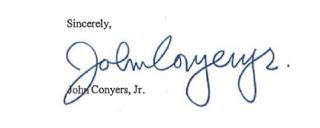
Date of signature: December 5, 2017

Date of signature: July 7, 2007


Date of signature: November 18, 2017

Date of signature: December 16, 2016


Only one of these signatures from United States Congressional Letters, is the real signature of John Conyers, Jr.

Can you guess which one is his?


Mother Superior Augustine would have had a heart attack if she bared witness to the reading of this letter with just about every sentence commencing with first person pronoun, "I", giving me every indication that the Gentlelady Jackson Lee was in rather a pressurized bind by a few unsavory characters.

See, I know what Nancy Pelosi did last summer, and the summer before that, and so on, with Bitch Boy, which is another reason why I speculate the legality of the process, because Nancy has been terribly mean to my Sweetie for quite some time.

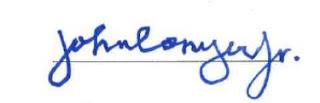
I challenge the veracity of Mr. Conyers' voting record and policy positions because people have been forging his signature on congressional letters, for a long time, which is why I did this.

Original signature of John Conyers, Jr.
I was quite shocked when I found out how much individuals were getting for his forged signatures on congressional letters.

Quintessentially, if there are relevent questions raised surrounding the legitimacy of the "retiring" of Mr. Conyers, perhaps, this is the real reason why there will be no special election, as there are multiple, ongoing federal investigations.

Maybe Michael could attempt to validate his racist theories in discovery, or he could just do a basic internet search.

It is just a jurisdictional issue that would immediately halt any state "retirement" process.

But, hey, what do I know?

Candidate says he'll sue Gov. Snyder to move up election for Conyers' seat

A candidate for the U.S. House seat vacated by former U.S. Rep John Conyers filed a lawsuit against Gov. Rick Snyder demanding that the election be moved up to an earlier date.

On Dec. 8, Gov. Snyder had announced that Conyers' congressional seat would remain empty until the regularly scheduled November election, leaving it vacant for nearly a year. What's more, political observers have pointed out that since the post will be listed twice — once in the August primary and again in the November general election ballots — the office could be held by two different people before January is out.

In short, the move would leave Detroiters without effective representation for 11 months — and perhaps even longer.
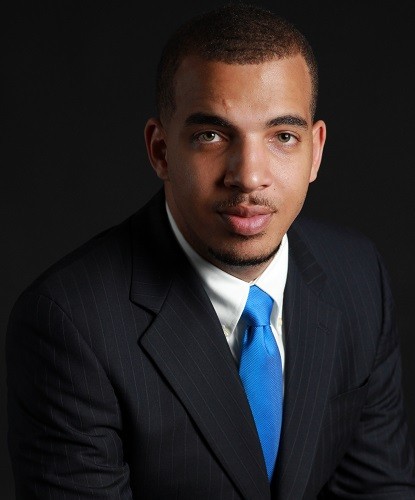
Michael Gilmore announced today that he intends to sue Gov. Snyder to move up the election for Conyer's vacant U.S. House seat. - PHOTO COURTESY MICHAEL GILMORE FOR U.S. HOUSE
Michael Gilmore
As the Associated Press noted earlier this month judging by a review of roughly 100 vacancies and successors listed on the House website for the last 20 years, it is unusual for a congressional district to stay vacant for so long. Eleven months would be the longest time a House seat stayed empty during that period.

Gov. Snyder had said his decision would both save money and give candidates ample time to campaign. But given his role in establishing Emergency Management in Michigan, this situation calls another lawsuit to mind — namely one filed by the Detroit Branch of the NAACP against Gov. Snyder that Emergency Management has violated the voting rights of the state's African Americans, effectively stripping representation away from residents in majority-minority cities and school districts. By some estimates, more than half of the state's blacks had their representatives overruled by Snyder-appointed viceroys.

None of this is lost on candidate Michael Gilmore, who has announced his intention to sue the governor over the scheduling of this election:

"Gov. Snyder continues to treat residents of urban areas across the state as second-class citizens and is violating a laundry list of constitutional laws in doing so," Gilmore said in a statement released today. "By holding this congressional seat vacant for 11 months, he is denying minority residents of the 13th Congressional District the right to vote and the right to be represented in Congress. This is yet another attempt to further silence the voice of minorities in the state and disregard their views. From putting emergency managers only in minority school districts and city halls to signing off on the Flint water crisis for fiscal benefit, Gov. Snyder has historically cited cost-saving measures as his reason for denying civil and human rights to urban areas. Here, he is once again attempting to balance the state's budget on the backs of Black people, in the name of 'cost savings.'"
Gilmore says he will discuss his lawsuit against Gov. Snyder at 10 a.m. Tuesday, Jan. 2, 2018, at the Fort Street entrance of the Theodore Levin United States Courthouse, Detroit.


One man hoping to win an empty congressional seat is suing the governor for waiting until November to fill the seat. Most residents have a representative in Congress until the next election.

However, because Congressman John Conyers resigned in 2017, and Gov. Rick Snyder set an election to fill his seat starting in November, residents of the 13th congressional district will not have a representative in Congress for 11 months in 2018.

"Governor Snyder continues to treat residents of urban areas across the street as second class citizens," Michael Gilmore said. Governor Snyder has historically cited cost saving measures as his reason for denying civil rights and human rights to urban areas," he said.

The governor does believe setting the date for the special election in August and November on the same dates as the regular general election will save local taxpayers up to $2 million.

"Divide $2 million by the 658,000 residents, that totals roughly $3 per person," he said.
Gilmore calls this systemic discrimination in the 13th congressional district, which he says is composed of over 62 percent minority residents.

"He is once again attempting to balance the state's budgets on the backs of black people in the name of cost savings," he said.

Gilmore is also a candidate for this seat. Might his lawsuit be self-serving?

"I don't believe this is self-serving, in fact I'm actually quite ashamed that I'm the only one talking about it," he said. "Donald Trump has already begun to illuminate important social programs that we need in this area, and no one else is talking about it?"

Gilmore says that typically vacancies are filled within a few months and he has asked the federal court to make a quick ruling hopefully by the end of February. There's been no formal response from the governor's office. 


Stay tuned.

Voting is beautiful, be beautiful ~ vote.©

Wednesday, March 22, 2017

CONYERS: For Once, I Agree With Governor Snyder!


Washington, D.C. – Today, Michigan Governor Rick Snyder sent a letter to the entire Michigan Congressional Delegation informing them of his opposition to the American Health Care Act, the House Speaker Paul Ryan and President Donald Trump backed plan to sharply cut Medicaid and reduce taxes for the wealthiest Americans. In his letter, Governor Snyder points out that the bill “shifts significant financial risk and cost from the federal government to states without providing sufficient flexibility to manage this additional responsibility,” and that it “reduces federal resources that our state relies on to assist 2.4 million Michiganders enrolled in traditional Medicaid and the Healthy Michigan Plan …”

In response, Congressman John Conyers, Jr. (MI-13) released the following statement:

Dean of the U.S, House
of Representatives
John Conyers Jr.
“For once, I agree with Governor Snyder’s views on the Republican healthcare bill — or as I call it, wealth care bill. As Snyder points out, about half of all children in Michigan are served by Medicaid, and those children will suffer if Donald Trump and Paul Ryan pass this massive tax cut for the wealthy.

“The bill is a massive transfer of wealth that takes money from those most in need and gives it to the rich. Under this bill, the 400 wealthiest families in America get a tax break worth $7 million per year. The bill undoes protections that the Affordable Care Act provides by allowing insurance companies to discriminate against cancer survivors or people with disabilities by charging them higher rates, or denying them coverage altogether. This Trump/Ryan backed bill also allows insurance companies to charge seniors five times more than what others pay for the same plan.

“Governor Snyder is right to be concerned about the additional costs this bad bill will shift to the state of Michigan. Because I believe that healthcare is a right for all, not a privilege for those who can afford it, I have long championed a single-payer, Medicare-for-All approach to healthcare that would finally establish truly universal care. If Governor Snyder is serious about reducing the strain on state resources, I call on him to join me in supporting Medicare-for-All, which would virtually eliminate state spending to subsidize care.”

Voting is beautiful, be beautiful ~ vote.©

Thursday, December 22, 2016

CONYERS Statement On Criminal Charges In Flint Water Crisis


Detroit, MI - Congressman John Conyers, Jr. (MI-13) released the following statement after criminal charges were filed concerning the Flint water crisis:

Dean of the U.S. House
of Representatives
John Conyers, Jr.
“We welcome all efforts to secure justice for the people of Flint, including the investigation of criminal actions by emergency managers and others. However, much remains to be done in the pursuit of justice for Flint residents and to ensure that no other community suffers from the actions of unaccountable political appointees that they did not elect.

“The simple fact is that no matter how many people are prosecuted or sued by Attorney General Schuette, it will not undo the damage Flint has suffered. The State must continue its efforts to ameliorate the harms committed in Flint and the Governor and others must ensure that sufficient resources are provided to those who continue to be harmed.  If the state is unwilling to secure the requisite funding, the City of Flint should have the opportunity to bring a civil action seeking compensation from the State for the harms it caused to the citizens of Flint. The State also needs to finally repeal its Emergency Law which is antidemocratic, discriminatory, and a vehicle for corporate privatization, conflicts of interest, and corruption.

“Until Flint’s water is fully safe, its children are made whole, and we see consequences for all those who stripped Flint’s citizens of their political and civil rights to protect themselves, there will be neither justice nor resolution for the people of Flint.”

Voting is beautiful, be beautiful ~ vote.©

Saturday, September 24, 2016

Members of the Congressional Black Caucus (CBC) Demand Assistance for Flint Recovery in GOP Funding Bill


WASHINGTON, D.C. – CBC Chairman G. K. Butterfield (D-NC), Rep. John Conyers, Jr. (D-MI), and Rep. Brenda Lawrence (D-MI) issued the following response to Speaker of the House Paul Ryan (R-WI) and Senate Majority Leader Mitch McConnell (R-KY) regarding the Republican spending bill:

Dean of the U.S. House
of Representatives
John Conyers, Jr.
“Flint’s citizens have suffered unacceptable damage and continue to suffer because Republicans are more interested in providing lip service than they are resources,” said Congressman Conyers. “Water is a basic human right and it’s shameful that many Flint residents are stuck with using water bottles to bathe, cook, drink and care for themselves and their families; some not having access to any clean water at all because they are homebound or cannot afford transportation. With funding for Flint omitted from the continuing resolution, it’s clear: minority and low-income communities are not even the slightest priority for our Republican-led Congress. We must ensure Flint’s water is made fully safe, its children and families made whole, and justice is served to those who stripped Flint’s citizens of the right to protect themselves.”

“The Congressional Black Caucus was early to call for immediate funding to assist in the recovery of the Flint, Michigan water crisis, and we are deeply concerned that such assistance is not included in the Republican’s bill to fund the government,” said CBC Chairman Butterfield. “Clean drinking water is a basic human right. Yet, since April 2014, tens of thousands of American children and families in Flint have been drinking and bathing in poisonous water –thousands of families have been harmed—and it is simply outrageous to think that Republicans have moved in a direction to not find a remedy for those who are most affected. Members of the CBC have been outspoken regarding Flint, we have traveled to the city where we met with families to hear their concerns, and we stand united in this effort to call upon our Republican colleagues to help these families recover. Flint still lacks safe water, and as elected officials, we all have a responsibility to ensure the safety of our constituents.”

“The people of Flint, Michigan have suffered enough,” said Congresswoman Lawrence. “A continuing resolution (CR) that fails to address the man-made crisis in Flint demonstrates our lack of commitment to helping the 100,000 citizens that have been poisoned by lead in their drinking water supply. I urge my colleagues on both sides of the aisle to do the right thing and include funding for the residents of Flint.”

Today, the CBC delivered this letter to House Speaker Ryan and Senate Majority Leader McConnell further addressing concerns for the lack of funding for the City of Flint.
Voting is beautiful, be beautiful ~ vote.©
Saturday, May 21, 2016

CONYERS, Kildee & Lawrence Urge Governor Snyder To Ensure Local Taxpayers Don't Foot The Bill For Emergency Managers' Mistakes


Washington, D.C. – Congressman John Conyers, Jr. (MI-13), Ranking Member of the House Judiciary Committee, today led a letter to Michigan Governor Rick Snyder, urging him to strongly reconsider requirements that local governments operating under Emergency Management, pay the legal fees and judgements against their Emergency Managers.  In addition to Congressman John Conyers, Jr., the letter to Governor Snyder is signed by Congressman Dan Kildee (MI-5) and Congresswoman Brenda Lawrence (MI-14). 

Currently, Michigan’s Local Financial Stability and Choice Act, MCL § 141.1560, requires local governments to cover the costs associated with appointed emergency managers who are sued in that capacity. However, legal fees incurred during Congressional investigations by former Emergency Manager for Detroit Public Schools and the City of Flint, Darnell Earley, have been voluntarily paid by the state. Congressman Conyers, Congressman Kildee, and Congresswoman Lawrence are calling on Governor Snyder to ensure all of Earley’s legal fees are covered by the state, not local taxpayers; and to ensure local governments are not required to pay legal fees associated with emergency managers’ mistakes.

“The exception made in the case of Darnell Earley, should be the rule moving forward,” said Congressman Conyers. “Local taxpayers shouldn’t have to foot the bill for mistakes made by state appointed officials who they didn’t elect. Governor Snyder must ensure the burden of legal fees incurred by emergency managers falls on the state, not local governments.”

“Michigan families should not have to pay the legal bills for state-appointed emergency financial managers. Unelected emergency financial managers are accountable only to the Governor and the state should have to pay for their mistakes,” Congressman Kildee 
Dean of the U.S. House
of Representatives
John Conyers, Jr.
said.

“I find it unreasonable to place the burden of legal fees incurred by emergency managers on local taxpayers,” said Congresswoman Lawrence. “Michiganders should not be on the hook for the mistakes of the Governor’s appointed emergency managers. The State’s emergency manager law disenfranchises voters and takes away local control. Local taxpayers should not be required to foot the bill of fraud and abuse committed by Snyder’s appointees. The State should absorb the financial burden imposed by such crimes and Governor Snyder should ensure that taxpayers are protected from the misuse of their hard earned dollars.”

In their letter, the Members wrote, “…we find it deeply troubling that the former Emergency Manager of the Detroit Public Schools and the City of Flint, Darnell Earley, requested that Flint reimburse more than $75,000 in legal fees that he incurred while under investigation by Congress regarding his role in causing the City’s water crisis…By diverting local taxes from crucial priorities to pay for unelected officials’ legal fees representation and damages, this law places a burden on local taxpayers even as it removes their control of that burden.”

“Further, it would appear to frustrate several federal statutes designed to protect the civil and constitutional rights of our citizens.  And, it permits the State of Michigan to shift responsibility for its actions to localities by dipping into the local taxpayers’ pocketbooks, even in cases where those taxpayers are injured by an Emergency Manager’s conduct…,” the Members continued.

Voting is beautiful, be beautiful ~ vote.©

Saturday, May 7, 2016

Conyers Calls for Real Action to Restore Detroit Public Schools

DETROIT – Yesterday, the Michigan House of Representatives introduced a package of bills that is intended to fix the financial problems being faced by Detroit Public Schools. Congressman John Conyers, Jr. (D-MI) issued the following statement after the proposed legislation passed the Michigan House:

Dean of the U.S.House
of Representatives
John Conyers, Jr.
“The legislative proposal put forward by the Michigan House is unserious and regrettable.  It continues to pursue the failed model that has brought us to this precipice: it denies students the resources they need to learn and educators the conditions they need to teach.  After the Michigan Senate worked out a deal all sides could work with, it is distressing to see our state representatives offering nothing more than austerity cloaked in the language of reform.
“Everyday, our schools struggle to educate children who come to school hungry for the lives and futures that too many take for granted.  That the majority of Michigan House members cannot even overcome their own selfish interests tells us where real reform is needed.
“I am calling on Governor Snyder to stand up to the fringes of his party, and with my state colleagues--Republicans and Democrats--who put the public good ahead of their own ideological crusades. The Governor must announce he would veto the House bills if presented before him, and show Michiganders that the children in Detroit should have the same opportunities as their Representatives want for their own children.”
Voting is beautiful, be beautiful ~ vote.©

Thursday, April 21, 2016

Conyers: Charges in Flint Water Crisis are not the Final Resolution to Long-Standing Inequities


WASHINGTON – Today, Representative John Conyers, Jr. released the following statement in response to the charges filed against three government officials (two state officials and a city employee) in Michigan in connection with the Flint Water Crisis.

Dean of the U.S. House
of Representatives
John Conyers, Jr.
“Today’s news demonstrates the regrettable consequences of encouraging state and local workers to put the health and safety of Michiganders behind cutting costs, pleasing industry, and fighting federal authorities.  The decision to charge low-level employees is one that may give the people of Flint some small sense of reckoning—but under no circumstances should these charges or this trial be seen as bringing either closure or justice to the people of Flint.”

“Charging these individuals and even convicting these individuals may be the legally correct course, but it does not one single thing to address the fundamental inequality that communities like Flint and Detroit have to face every single day—and will do so regardless of the outcome of this case.  Tomorrow, they will still live in toxic homes, send their children to toxic schools, and be forced to plan for a future with a dwindling safety net and fewer ladders of opportunity.”

“The simple truth is that we are seeing action on Flint because there is a trail of evidence that leads to the conservative ideology currently in power. For those who have pushed a deregulatory, anti-environment agenda, it appears that their outrage and compassion begins and ends with their own legal culpability—and their support vanishes once the blame is fixed on someone else. Were that not true, we would see the governor taking a substantial part of that billion-dollar surplus and rebuilding Flint’s infrastructure.  Were that not true, we would see the state investing in Detroit’s literally toxic public schools in the way that they invest in the schools where they send their children.  Were that not true, we would see the Attorney General’s office stop wasting resources fighting to permit mercury pollution in Michigan.

“While I want to see people held accountable, I am worried that people are being charged today so that tomorrow the problem can be swept under the rug and the conservatives running Lansing can again focus on their most important issues: eliminating worker and environmental protections, cutting public support services, and usurping the political power of urban and low-income communities.  We cannot afford any more of the governance that has brought places like Flint and Detroit to their knees, and charging low-level civil servants will not prevent that.”

Rep. John Conyers, together with 31 original cosponsors, introduced H.R. 4754, the Emergency Financial Manager Reform Act of 2016 to address unchecked decision-making powers that appointed emergency financial managers have in financially distressed cities which cause 
Voting is beautiful, be beautiful ~ vote.©

Friday, April 15, 2016

Conyers: Time to rein in Michigan’s emergency managers

By John Conyers, Jr.
A task force appointed by Gov. Rick Snyder confirmed last month what we had suspected all
Dean of the U.S. House
of Representatives
John Conyers, Jr.
along — the water crisis in Flint was caused by emergency management. It’s time Michigan reins in its out-of-control emergency manager law. The questions now are: how our state got to this point, and what the lessons for reform are going forward.
When Snyder had just been elected governor and the Republicans took control of the Michigan Legislature in 2011, one of their first orders of business was to radically expand the Michigan financial distress law. The new statute granted EMs unprecedented powers to take over all aspects of local government — not just finances — and unilaterally reject collective bargaining agreements. Under Snyder, the frequency of EM appointments greatly increased due to the Great Recession and state-imposed cutbacks in local revenue sharing.
The result has not only led to public health disasters, such as Flint and the Detroit Public Schools, but numerous instances of conflicts of interest and abuse. This includes documented mismanagement by EMs in Pontiac (potential loss of $1.4 million in federal grant money), Highland Park (terminated for making $200,000 in unauthorized payments to himself), and Benton Harbor (exceeded budget and failed to make required pension contributions).
Worse still is the law’s encroachment on our constitutional rights, most notably by disproportionately targeting African-American voters. A recent academic study found that while 73 percent of black residents were subject to emergency management over the last decade, only 21 percent of whites were covered over the same period.
The EM law has also been found to contravene constitutional protections for collective bargaining agreements. Professor Kenneth Klee, a pre-eminent bankruptcy expert, testified at a 2011 forum I held that “no prior legislature has had the audacity to legislate the unilateral termination, rejection, or modification of a collective bargaining agreement” and that the law “is violative of (the U.S. Constitution’s) Contracts Clause.”
I, along with U.S. Reps. Brenda Lawrence and Dan Kildee, recently introduced legislation responding to the most problematic features of the EM law. We had little choice given that Snyder and Republicans in Lansing had previously overruled a voter referendum repealing the statute.
The “Emergency Financial Manager Reform Act” would authorize the U.S. Attorney General to withhold a small portion of law enforcement funds from the state if the EM fails to adequately protect against discrimination in voting, harm to public health, conflicts of interest and mismanagement, or unilaterally denying collective bargaining rights. Adoption of these incentives would allow the state the ability to assist financially troubled local governments without jeopardizing our citizens’ safety or constitutional rights.
We cannot retroactively undo the damage already done in Flint or Detroit’s schools, but we can help make sure the unaccountable emergency managers are not permitted to inflict further harm on our citizens.
Voting is beautiful, be beautiful ~ vote.©

Friday, March 18, 2016

Michigan emergency manager law targeted in congressional bill

DETROIT, MI -- Democrats in Congress on Thursday introduced a bill seeking to hinder emergency management policies that give far-reaching power over local governments to state appointees.
Michigan Former Emergency Manager, Darnell Earley
U.S. Rep. John Conyers, D-Detroit, introduced the bill with support from 30 other Democrats, including Michigan Reps. Dan Kildee, D-Flint Twp., and Brenda Lawrence, D-Southfield.
The Emergency Financial Manager Reform Act would give the U.S. Attorney General authority to withhold law enforcement funding from states where an state-appointed emergency manager rejects collective bargaining agreements or other contractual agreements without local consent.
The law would also allow funding to the be withheld if an emergency manager "fails to protect against... discriminatory impact on voting rights, harm to public health or safety, conflicts of interest, mismanagement, and abuse of discretion," according to Conyers' office.
It would allow states to be stripped of up to 5 percent of funds allocated under the Edward Byrne Justice Assistance Grant Program.
"We cannot undo the damage already done by the lead-poisoned water in Flint or fix the harm already caused by the hazardous conditions in Detroit's public schools," Conyers said in a statement.
"But we can stand together and make sure the unaccountable emergency managers responsible for these disasters – and the legal system that empowered them – are not permitted to inflict further harm on our citizens or our constitutional rights."
Michigan's powerful emergency manager law has placed state appointees in control of Detroit, Pontiac, Flint, Ecorse, Hamtramck, Allen Park Lincoln Park and Benton Harbor in recent years.
Each of those cities have since transitioned out of emergency management and remain under oversight of financial advisory boards.
Emergency managers remain in the school districts of Detroit, Highland Park and Muskegon Heights.
"Sadly one only has to look at my hometown of Flint, Michigan, to see the dangerous consequences of emergency financial managers," said Kildee in a statement.
"It was decisions by such unelected emergency financial managers that led to the current water crisis in Flint. They are entirely bottom-line focused, bringing a failed philosophy to government that puts saving money at any cost ahead of the livelihood of people. Under Michigan's current laws, democracy is suspended in cities like Flint in favor of absolute power in the hands of emergency financial managers."
Detroit schools have been under emergency management since 2009, and the district is now seeking $715 million from the state legislature to relieve it of burdensome debt built up over years of state control.
But state control over Detroit city government in 2013 and 2014 has faced less criticism, with the city being relieved of $7 billion in debt after a bankruptcy case that was led by an emergency manager.
A message seeking comment on the bill was left with Gov. Rick Snyder's office.

Voting is beautiful, be beautiful ~ vote.©

Thursday, March 17, 2016

Congressman John Conyers to Join National Action Network for Press Conference To Urge Congressional Action on the Flint Water Crisis


Immediately following the testimony of Michigan Republican Governor Rick Snyder before the House Oversight Committee, Congressman John Conyers (D-MI), Rev. Sharpton and Rev. Williams will join families from Flint, Michigan that have been impacted by the water crisis to call for a greater Congressional response.

WASHINGTON – Tomorrow, March 17, 2016, U.S. Congressman John Conyers, Jr. (MI-13) will join the National Action Network in urging Congressional action to resolve the Flint water crisis and to announce introduction of legislation to reform the Michigan Emergency Financial Manager law.

Dean of the u.S. House
of Representatives
John Conyers, Jr.
WHO:  U.S. Congressman John Conyers, Jr. (MI-13)
Rev. Al Sharpton, President and Founder of National Action Network
Rev. Charles Williams, President of National Action Network Michigan Chapter
Families from Flint, Michigan affected by water crisis

WHAT:  Press conference to announce introduction of legislation to reform the MI Emergency Financial Manager law and urge Congressional action to resolve the Flint water crisis.

WHEN:  Thursday, March 17, 2016 – NOON

WHERE:  House TriangleU.S. Capitol Complex (map)
*Please note the House Triangle is adjacent to the intersection of Independence Avenue and South Capitol Street SE. *

All media is invited to attend/cover the press conference. For any specific questions, please reach out to Stephanie Báez at(202) 999 – 9699.

Voting is beautiful, be beautiful ~ vote.©

Wednesday, February 17, 2016

Flint Is the Predicted Outcome of Michigan’s Long, Dangerous History With ‘Emergency Managers’

By John Conyers, Jr.

Dean of the U.S. House
of Representatives
John Conyers, Jr.
For years, I have joined voters, other elected officials, and even courts in warning that the right-wing takeover of local government would end this way.

The immediate causes of the water-contamination crisis in Flint and the hazardous conditions of Detroit’s public schools are by now common knowledge: the poor, shortsighted decisions made by the emergency managers appointed by Michigan’s Republican governor, Rick Snyder. Far less known are the numerous warning signs of the dangers posed by these unaccountable EMs to the people of Michigan—signs that Governor Snyder chose to ignore. The resulting tragedies were thus not only foreseeable, but entirely preventable.

Enacted in 1988, Michigan’s original financial-distress law—which simply authorized the state to involve itself in the affairs of local governments facing a “financial emergency”—was rarely used. Then, in 2005, the right-wing think tank Mackinac Center for Public Policy advocated that law be broadened to grant EMs the power to take over all aspects of local government, including the power to unilaterally reject collective-bargaining agreements, and to insulate EMs from any resulting legal liability. By 2011, Snyder had been elected governor, and Republicans had taken control of both the State Senate and House. One of their first orders of business was to dramatically expand the law along the lines proposed by the Mackinac Center. The EM law soon came to be seen as a vehicle for corporate privatization, with a 2011 New York Times investigation revealing that EM training sessions were “run primarily by representatives from companies who stand to benefit financially.”

As EM appointments increased sharply due to state-imposed cutbacks in local revenue-sharing as well as the impact of the Great Recession, numerous red flags were raised. The Michigan Department of Treasury’s own internal analysis highlighted the law’s overreach, concluding: “This bill allows emergency managers too much power and control over local units of government. Emergency managers can’t be trusted to act in the interests of the local unit and will use the enhanced powers granted under this bill for their own gain.” Professor Kenneth Klee, one of the nation’s preeminent experts on bankruptcy, wrote that the law “is violative of [the US Constitution’s] Contracts Clause…. No prior legislature has had the audacity to legislate the unilateral termination, rejection, or modification of a collective bargaining agreement.” Voting-rights expert Jocelyn Benson, the current dean of Wayne State Law School, found that “there is significant evidence [that the] amended Emergency Financial Manager law has disproportionate impact on the state’s Black and Latino population.”

The appointment of EMs with the power to usurp local elected officials proved to have a significant negative impact on minority communities and their votes, with more than half of the state’s black voters subject to governance by EMs since 2009. Emergency managers have run cities with large African-American populations, such as Highland Park (94 percent), Benton Harbor (89 percent), Detroit (83 percent), Flint (56 percent), Pontiac (52 percent), and Ecorse (46 percent). Benton Harbor, which has been operating under an EM since 2010, saw its voter-participation rate decline by more than half.

Organized labor, civil-rights groups, and others challenging the law’s unprecedented scope initiated a series of lawsuits. The Ingham County Circuit Court found the law’s implementation to be in contravention of the Open Meetings Act. In 2010, a Wayne County court found the Detroit Public Schools EM had exceeded his mandate by attempting to make academic reforms, which at that time were within the elected school board’s sole discretion.

Numerous instances of abuse, conflict of interest, and mismanagement by EMs came to light. In Pontiac, EMs incurred a potential loss of $1.4 million in US Department of Housing and Urban Development funding due to mismanagement of grants. EM Michael Stampfler outsourced the city’s wastewater treatment to United Water shortly after the firm faced a 26-count indictment in Indiana for violating the Clean Water Act. In Highland Park, the EM had previously been terminated for making more than $200,000 in unauthorized payments to himself.

The sad part is that there are more sensible alternatives than the top-down approach to which Governor Snyder clings.

In Benton Harbor, an independent audit found that the EM had exceeded the budget by more than $650,000, had inadequate controls over its financial reporting, and had failed to make required contributions to pension plans. Senator Gary Peters and I called for a Government Accountability Office investigation, which found in 2015 that under the Flint EM, workforce cuts had reduced the city’s ability to obtain critical federal grants and led to federal funds being withheld from the city as a result of its failure to address grant-monitoring deficiencies.

* * *

None of this went unnoticed by elected officials and voters. Along with two other members of Congress, 55 state legislators, and eight members of the Detroit City Council, I wrote a letter in December 2011 expressing concerns regarding the legislation’s implementation. Similar letters were issued by both of Michigan’s senators and two additional congressional representatives. In March 2012, we again wrote the governor seeking evidence that he was properly overseeing his emergency managers.

But voters themselves delivered perhaps the most significant warning sign. When a petition drive was initiated to allow Michigan voters to decide whether to retain the emergency-manager law, Republicans sought to thwart the effort with a series of legal and legislative maneuvers. Those attempts ultimately failed, and in November 2012, 52 percent of Michigan voters opted to repeal the controversial law outright.

Governor Snyder and the Republicans in Lansing responded to all of these warning signs by doubling down on the flawed law. Instead of listening to the voters and their elected representatives, independent experts, and watchdogs, they passed a substitute bill during a hastily called lame-duck session that retained many of its predecessor’s deficiencies. Even worse, the legislature added an appropriations rider, thereby preventing the citizens of Michigan from being able to overturn the new law. The same failed EMs that had been in place earlier returned to work or were recycled to other jurisdictions. For example, Darnell Earley, who presided over the Flint water debacle, was later appointed to run the Detroit public-school system, where he ignored health hazards that endanger our teachers, students, and parents.

The sad part is that there are more sensible alternatives than the heavy-handed, top-down approach to which Governor Snyder clings. There are numerous cases in which more effective legal alternatives have been used to restore fiscal stability while remaining true to the principles of representative government through the use of financial-control boards and similar supportive fiscal devices. Such methods have been used in New York City (1975), Cleveland (1978), Philadelphia (1991), Bridgeport, Connecticut (1991), the District of Columbia (1995), and Harrisburg, Pennsylvania (2011), among other cities.

But after we’ve seen cities starved of desperately needed revenues; and citizens denied the right to elect their own leaders; and short-sighted, mindless budget cuts and privatization schemes; and failed EMs recycled into new jobs; and a steady drumbeat of warnings—from the courts, elected officials, independent watchdogs, and the voters themselves—ignored, the real question isn’t how the disasters in Flint and the Detroit public schools could have happened, but how many other state-made catastrophes are looming.

We can’t undo the damage already done by the lead-poisoned water in Flint, or fix the harm already caused by the deplorable conditions in Detroit’s public schools. But we can make sure that the unaccountable emergency managers responsible for these debacles—and the legal system that empowered them—are not permitted to inflict further harm on our citizens.

Voting is beautiful, be beautiful ~ vote.©