Showing posts with label human trafficking. Show all posts

Sunday, October 27, 2019

CONYERS: The Report Of His Death

I have no comment.

I am watching the heavens fall.

U.S. Rep. John Conyers, former dean of Congress, dies at the age of 90

Kathleen Gray and Todd Spangler, Detroit Free Press

Published 4:34 p.m. ET Oct. 27, 2019 | Updated 5:09 p.m. ET Oct. 27, 2019

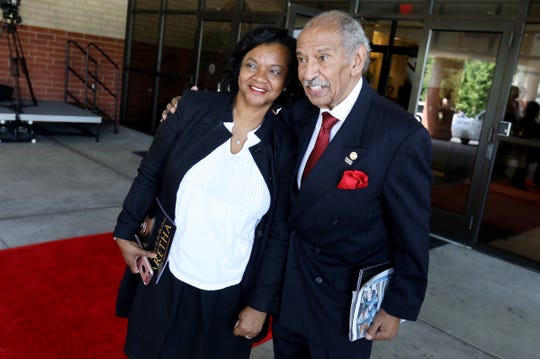
Monica and John Conyers pose for a photograph outside of Aretha Franklin's funeral at Greater Grace Temple in Detroit on Friday, August 31, 2018.
The Conyers - Post-vows
U.S. Rep. John Conyers, a civil rights icon who during five decades in Congress co-founded the National Black Caucus and pushed to establish a national holiday to honor the Rev. Martin Luther King Jr., died Sunday of natural causes at the age of 90.

His death comes after a long and illustrious career that spanned more than 50 years and 27 terms in office, but ended in 2018 with a sudden resignation amidst claims of sexual harassment and verbal abuse of employees and misuse of taxpayer funds to cover-up those claims.

Conyers' tenure was a remarkable 53-year-run during which the lawmaker, the son of a well-known labor lawyer in Detroit, compiled a near-record legacy of civil rights activism, longevity and advocacy for the poor and underprivileged.

He died with the sixth-longest tenure in congressional history.

"For a long time he was black America's congressman," said Sam Riddle, a longtime family friend and consultant to the Conyers family, who confirmed the death Sunday. "On the streets of Detroit, he'll be mourned."

Detroit Mayor Mike Duggan in a statement said he "was deeply saddened" by Conyers' death.

"One of my most special memories was spending time with him at Gordon Park on 12th Street and Clairmount on the 50th anniversary of the violence of 1967 as he recounted the story of his courageous efforts to calm the angry crowds," Duggan said.  "He has fought for a better Detroit for more than half a century.


"From co-founding the Congressional Black Caucus to leading the fight in Congress to enshrine Martin Luther King’s birthday as a national holiday, John Conyers’ impact on our city and nation will never be forgotten," Duggan said.

Michigan Gov. Gretchen Whitmer called Conyers a "lifelong Detroiter who was deeply committed to the city and to those he represented."

"His impact on our state, whether by spearheading reforms in criminal justice and voting rights in Congress or through his lifetime of civil rights activism, will not be forgotten," Whitmer said in a statement.

Conyers was born in Detroit and graduated from Northwestern High School. After a tour of duty with the U.S. Army during the Korean War, Conyers returned home to earn bachelor's and law degrees from Wayne State University.

His law practice and work in the auto plants in Detroit led him to the office of former U.S. Rep. John Dingell, D-Dearborn, where he worked as a legislative assistant for three years. But by 1964, at the age of 35, Conyers went after a seat of his own in Congress, winning the first of 27 general elections and serving portions of Detroit and some surrounding Wayne County suburbs for the next five decades.

He may not have had many bills that carried his name — only 26 of the 712 bills he introduced became law, according to the Library of Congress — but he fought for issues of civil rights and social justice, including seeking reparations for the descendants of African-American slaves, modifying the mandatory sentences for those convicted of non-violent drug crimes, defending assaults on the Voting Rights Act, reforming laws that put juvenile offenders in prison for life and calling for investigations into police brutality of African-American men.

And he was the key sponsor of the bill, introduced each session for 20 years, that designated the third Monday of January as a federal holiday in honor of Martin Luther King Jr. Conyers introduced the bill four days after King was assassinated in 1968, but it wasn’t signed into law until 1989.

In the thick of the civil rights battles, Conyers walked alongside King and other leaders of the movement in Selma, Ala., to bring equal voting rights to blacks.

In 2015, during his 50th year in Congress, Conyers told the Washington Post that King was one of the most important historical figures in history.

"I felt the civil rights movement was a powerful chapter in American history, King to me is the outstanding international leader of the 20th century without every holding office," he said. "He advanced us forward even though there was a terrible loss of life and violence and injustice. But Martin Luther King Jr. moved us in a way that changed history."

He moved among those involved in the disturbance in Detroit in August 1967, urging calm. And he burnished his civil rights record even more by hiring icon Rosa Parks after she moved from Alabama to Detroit. The secretary and receptionist job in Conyers' Detroit office was a job she held until her retirement in 1988.

U.S. Rep. Rashida Tlaib, who won election to Conyers' seat after his resignation, on Twitter called Conyers "our Congressman forever."

"He never once wavered in fighting for jobs, justice and peace," Tlaib tweeted. "We always knew where he stood on issues of equality and civil rights in the fight for the people. Thank you Congressman Conyers for fighting for us for over 50 years."

Career ends amidst a sex scandal
Despite facing a rising chorus of voices demanding he step down because of the sexual harassment claims, Conyers, D-Detroit, refused to do so for several months in 2017. The scandal was a swift and crushing fall from grace for the longest-serving active member of Congress.

Conyers, 90, resigned  after an article on BuzzFeed.com detailed a secret settlement of more than $27,000 with a former staffer who accused him of making sexual advances toward her and paying her out of funds from his taxpayer-supported office.

Within days, several other women had come forward with accusations against Conyers, who, despite his express denials that he harassed anyone, saw House leaders and members of his own party abandon him, with three of the four Democrats in the Michigan delegation calling for him to resign.

In addition to Marion Brown, the staffer who received the settlement, six other women claimed they either experienced or saw him touching and rubbing women in his office, making sexual advances toward them or making inappropriate remarks. One of them filed a lawsuit against him early this year and then withdrew it, saying she didn't want to hurt Conyers' reputation.

Another woman, Washington lawyer Melanie Sloan, also told the Free Press that Conyers had verbally mistreated her, forced her to babysit his children and, on one occasion, showed up at a meeting with her at his office in his underwear —though she didn't consider it sexual harassment.

From accusation to resignation, Conyers' colleagues went from being warily supportive, urging caution while an investigation by the House Ethics Committee was completed to issuing outright calls for his resignation, even from at least one fellow member of the Congressional Black Caucus, which he helped to create in 1971.

U.S. Rep. Jim Clyburn of South Carolina, who is the third-ranking Democrat in the House and had been a colleague of Conyers' on the Congressional Black Caucus since 1993, called for him to resign  shortly after similar calls by House Speaker Paul Ryan and Democratic Leader Nancy Pelosi.

Conyers' lawyer, Arnold Reed, of Southfield, had reiterated on several occasions that the congressman was not ready to resign and wanted to see the ethics investigation completed.


But with allegations swirling not only over the harassment claims but his use of taxpayer funds to pay at least one settlement, he abruptly stepped down as the ranking Democrat on the House Judiciary Committee, a position he had held for more than two decades.

Then  — with media reports that some members of the caucus were privately urging him to resign — he suddenly quit Washington, missing several votes, including one mandating sexual harassment training for members, as he headed back to Detroit and his family.

Conyers record in Congess
During his time in office, which he won with huge margins ever two years like clockwork, Conyers was considered one of the most liberal members of Congress, with a 100% rating from the American Civil Liberties Union, Planned Parenthood and the Human Rights Campaign.

The conservative Freedom Works gave him a 15% rating, while the Club for Growth and Americans for Prosperity give him ratings of 8% and 6% respectively.

Conyers, however, had already come under scrutiny twice from the House Ethics Committee in Congress for possible transgressions in his office.

In 2017, the committee confirmed it was continuing to look at whether he had wrongly paid his former chief of staff more than $50,000 for time she didn't work. Conyers said he was only paying her for accrued leave time and severance as part of a separation agreement reached after she pleaded guilty to a misdemeanor charge of receiving stolen property unrelated to her job.

In 2003, the Free Press reported on complaints from six unnamed Conyers aides who said they were forced to work on various campaigns, including a failed legislative campaign for Conyers' wife, Monica, on government time. A follow-up Ethics Committee report, however, focused on allegations that the congressman used staff to babysit his sons, help his wife with her law studies and chauffeur him to private events.

Conyers' office denied the accusations and eventually reached a deal to ensure staff knew where their responsibilities began and ended.

In 2014, Conyers nearly didn’t get the chance to run for reelection because of irregularities in the petitions he filed to run for office. Wayne County Clerk Cathy Garrett said he had used ineligible people to gather signatures, but a federal court disagreed and the state Legislature passed a law that people who collected signatures didn’t need to be registered voters.

Voting is beautiful, be beautiful ~ vote.©

Wednesday, July 11, 2018

Cocktails & Popcorn: Arnold Reed, Attorney For John Conyers, Enters The Stage


Image result for happy girl eating popcorn
I have popcorn. Want some?
I wonder if the DOJ OIG Report is about to be declassified.

Oh, and I forgot to mention that Perkins Coie Sucks.

#perkinscoiesucks

Marc Elias Of Perkins Coie Sucks & So Does The FEC

Learn more: BEVERLY TRAN: Marc Elias Of Perkins Coie Sucks & So Does The FEC http://beverlytran.blogspot.com/2017/10/marc-elias-of-perkins-coie-sucks-so.html#ixzz5Kiw2nDU6
Stop Medicaid Fraud in Child Welfare 

Arnold Reed, 'lawyer on the side of the people'

When his beloved father fell ill, Arnold E. Reed didn't hesitate. He swapped the cloistered halls of law school for Chicago's south side, where his dad owned a barbershop. To keep the business going, Reed, who'd learned the craft from his father, spent the next few months cutting hair.

636664856462526737-2018-0509-bb-ArnoldReed3.jpg

Meanwhile, a classmate would mail Reed homework, and he studied when he could.
In the end, not only did the University of Iowa College of Law student graduate, he did so on time.

"I read the books and taught it to myself," said Reed, 54, whose Dad lived to see him graduate.

"Really, there was never a question that I would finish. Some things ought to be a given."

That kind of decisiveness, devotion and determination would mark his career as one of the state's pre-eminent trial lawyers, specializing in criminal, personal injury, civil litigation, medical malpractice and entertainment law, plus damage control for high-profile clients, such as now-retired Congressman John Conyers and Aretha Franklin. This year, he was cited by Michigan's Lawyers Weekly as one of 30 Leaders in the Law Class of 2018.

While the widely respected trade newspaper is mum on how it culls from a pool of nominees, its website says winners are honored for significant accomplishments in law practice; outstanding contributions to the practice of law in Michigan; seeking improvements to the legal community and their communities at large; and setting an example for other lawyers. In its current form, the award has existed for the last decade.

In many ways, it's an improbable achievement for the Southfield-based legal firebrand, known for dogged representation and an outsize courtroom presence.


Reed was the first in his family to graduate college, let alone law school. While his father operated the barbershop, his mother took two trains and a bus each way to a factory job to help support the family, which included Reed and his older brother.

At age 9, Reed saw someone gunned down on the street. While fleeing, the killer had looked right at Reed, too petrified to move. That’s when Reed decided he needed to be fearless, a mindset that defines his approach to law.

Wayne County Circuit Judge Deborah Thomas described Reed's courtroom manner as a cross between a bulldog and a chihuahua.

"I've watched him since he was a baby lawyer," Thomas said. "He is always prepared, and he will not let go. He is always focused, and he will work that case. He's also a good family man, and what you would like to see in the community and in the profession."

While his childhood community had its share of scofflaws, most of his neighbors were honest blue-collar types. Time and again, he’d see them falsely accused by police, or unable to retain proper representation. Reed decided that knowledge was power and he needed to get it.

In the sixth grade, he ran for class president — and lost. “That made me angry, so I started learning about the Constitution and how to impeach somebody,” said Reed, who is married to a lawyer, has a son in law school and a daughter pursuing graduate studies.

Reed received his undergraduate degree in journalism and political science from Indiana University in Bloomington. After law school at Iowa, he worked as chief law clerk for former Michigan Supreme Court Justice Conrad Mallet Jr., who remembers him as being the strongest member of his team.

"He would consistently present their work in a way that allowed for uncomplicated digestion of whatever argument they helped craft," said Mallet, now chief administrative officer for the Detroit Medical Center. "He's a very, very, very good lawyer."
Attorney Arnold Reed speaks about Congressman John Conyers' health and the latest accusations of sexual harassment in front of the congressman's home in Detroit. Daniel Mears, The Detroit News

That stint as a law clerk was followed by corporate work and a job in Detroit with the public defender's office. Because the fledgling lawyer couldn't convince his boss to give him a capital case, Reed, with no money to speak of, went out on his own, setting up a law practice in Detroit and winning his first multimillion-dollar verdict, in a police misconduct case, at just 29 years old.

Since then, the member of Kappa Alpha Psi Fraternity Inc. has represented former Detroit Mayor Kwame Kilpatrick, Conyers, Franklin and an upstart vocalist named R. Kelly in the mid-'90s.
Reed recalled meetings early on with the Queen of Soul, who he successfully represented about five years ago in a case involving misappropriation of her name and likeness.

"She's a woman who tends to be formal with people she doesn't know or have a relationship with, so it was always, 'Ms. Franklin' and 'Attorney Reed.' After I won the case for her I said, 'Now can I call you Aretha?' She didn't say anything, so I took that to mean she was still 'Ms. Franklin,'" he said, chuckling.

As for Conyers, Reed represented him last year after the congressman became embroiled in allegations of sexual harassment. Conyers ultimately retired.

Reed remembers encountering Conyers years earlier after a particularly long community event. Reed had asked him why he devoted so much time and effort to so many causes when he could find more lucrative work elsewhere.

"He looked at me, smiled and said, 'Arnold, money has never been my motivating factor. I have the best job in the world. I can help people.' So when he needed my help, I answered the call."
Reed's legal battles often extend into the court of public opinion. For instance, he took a lot of heat for representing Kilpatrick in a case stemming from the former mayor's conviction for lying under oath about an affair with his chief of staff.

 "It took me aback a bit," he said of the criticism. "Everyone deserves a right to representation no matter the allegation. Also, I've been in this game over 25 years, and I'd be lying if I said I weren't ever discriminated against based on my color, because I have been.

"When I put my suit and tie on every day and I go out, there are some people who look at me like I'm Kilpatrick simply because I'm African-American. I have to explain to people that when I represent Kwame Kilpatrick, I represent you, I represent your son.

 "In any case, I have a social responsibility not to shy away from cases merely because of allegations."

Reed's brazen style, however, leaves some cold, said Solon Phillips, in-house counsel for Southfield Public Schools.

"I have a great deal of respect for his zeal and tenacity in terms of what he does for his clients, but he is aggressive, so I can see how he could rub people the wrong way," said Phillips, who has known Reed for about 15 years.

"In his younger years, for example, he would press opposing counsel when he saw them by asking them why they weren't working, asking them whether they were working as hard as he was.

 "If you're on the receiving end, I can see where he might make some folks uncomfortable."

 His high-profile client roster notwithstanding, Reed is a self-described "lawyer on the side of the people." Everyone, he says, deserves representation under the law.

"I'm always around rich and powerful individuals, but I know my upbringing," said Reed, who often rides to work on his motorcycle, the back of his leather jacket emblazoned with "Not Guilty."

The voracious reader prides himself on going all out for his clients, often spending days and nights with them. He leans on his journalism background to do his own investigative work and visualizes courtroom plans.

“The major thing is having belief in your cause,” Reed said. “If you don’t believe, you’re not going to convince 12 others.”

He has a fan in Donna Pope, for whom Reed won a $4.2 million judgment in an unlawful termination whistleblower case in 2009.

“He’s very thorough and very patient, very poised and convincing,” said Pope, who lives in western Michigan. “This was one of the hardest things I had to go through in life, and he made it manageable to survive it.”

Mary Chapman is a Detroit-based freelance writer.


Arnold E. Reed
Age: 54
Occupation: Owner, Arnold E. Reed and Associates, Southfield
Education: Bachelor's degree, Indiana University; Juris Doctorate, University of Iowa College of Law

Voting is beautiful, be beautiful ~ vote.©

Saturday, September 16, 2017

CONYERS: Pass DREAM Act Now

The six-month delay in initiating this process does no justice for these DREAMers and the families who will be torn apart.

And the Trump Administration’s pretext for this action—DACA’s supposed unconstitutionality—simply doesn’t carry water. I stand with DREAMers & call on House Republicans' Leaders to pass the DREAMAct now.


#ProtectDREAMers

Voting is beautiful, be beautiful ~ vote.©
Sunday, September 10, 2017

CONYERS, CUMMINGS, GOMEZ & LOFGREN Seek Immediate Hearings On President's Decision To End DACA


Washington, D.C. (Sept. 7, 2017)—Democratic leaders on the Committee on Oversight and Government Reform and the Committee on the Judiciary sent a letter, below, to their respective Chairmen, Reps. Trey Gowdy and Bob Goodlatte, requesting immediate congressional hearings on the impact of President Trump’s decision to end the Deferred Action for Childhood Arrivals (DACA) program.

“This action is cruel and heartless, and it is now up to Congress to reverse it,” the Members wrote.  “We believe it is critical for the American people to hear public testimony regarding the President’s decision, including the resulting economic costs and social harm to the nation.”  

Last Congress, the Oversight Committee held 11 hearings on issues related to immigration, and the Judiciary Committee regularly holds hearings on immigration issues.  Yet no full Committee hearings on the President’s termination of DACA have been scheduled to date.

The letter was signed by Oversight Committee Ranking Member Elijah E. Cummings, Oversight Committee Member Jimmy Gomez, Judiciary Committee Ranking Member John Conyers, Jr., and Subcommittee on Immigration and Border Security Ranking Member Zoe Lofgren.


Voting is beautiful, be beautiful ~ vote.©

Wednesday, July 12, 2017

CONYERS: Judiciary Democrats Demand Answers On Abrupt DOJ Settlement Of Fraud Case Handled By Russian Lawyer Who Met With Trump Jr.


DOJ Abruptly Settled Money Laundering Case that Involved Russia Sanctions, New York Real Estate Holdings, and Kremlin-Linked Lawyer Who Met with Donald Trump Jr.

Washington, D.C. – Today, all seventeen Democratic members of the House Committee on the Judiciary wrote to Attorney General Jeff Sessions to request information about his decision to abruptly settle United States v. Prevezon Holdings Ltd, a money laundering case that the Department of Justice (DOJ) abruptly settled that involved Russia sanctions, New York real estate holdings, and the lawyer who met with Donald Trump, Jr. 

In their letter, the Members wrote, “Last summer, Donald Trump, Jr. met with a Kremlin-connected attorney in an attempt to obtain information “that would incriminate Hillary.”  Earlier this year, on May 12, 2017, the Department of Justice made an abrupt decision to settle a money laundering case being handled by that same attorney in the Southern District of New York.   We write with some concern that the two events may be connected—and that the Department may have settled the case at a loss for the United States in order to obscure the underlying facts.”

In addition to the letter, House Judiciary Ranking Member John Conyers, Jr., issued the following statement:

“The connections here are too substantial to ignore.  Why was a Russian money-laundering case involving more than $230 million dismissed without explanation?  Why was a central figure in that case chosen to approach the Trump campaign about assistance from the Russian government?  Was the firing of Preet Bharara in any way related to his office’s prosecution of these crimes?  Wittingly or unwittingly, was the Department of Justice involved?

“Even if these facts are mere coincidence—and there is reason to be doubtful that they are mere coincidence—they merit immediate explanation by the Attorney General and immediate investigation by the House Judiciary Committee.”

Background: The Prevezon case relates to a massive tax-theft and money laundering scheme uncovered in 2007 by Russian lawyer Sergei Magnitsky.  His 2012 death in Russian custody led to the passage of the Sergei Magnitsky Rule of Law Accountability Act, which enabled President Obama to sanction the Russian officials thought responsible for such human rights abuses.

A 2013 complaint filed in federal court alleged that Prevezon helped to launder more than $230 million stolen from the Russian treasury, largely through high-end real estate in Manhattan.  One of Prevezon’s attorneys was Natalia Veselnitskaya—a lawyer known for lobbying against the Magnitsky Act, and the “Russian government attorney” who met with Donald Trump, Jr. and others to discuss “information and official documents that would incriminate Hillary” on June 9, 2016.  Even Donald Trump Jr.’s alternative explanations for this meeting—he described the discussion, at one point, as “primarily about adoption”—appear to turn on Ms. Veselnitkaya’s efforts to protect her client and undo U.S. sanctions on Russian officials.

On May 12, 2017—just two days before the Prevezon trial was set to begin—the Department of Justice settled the case for less than $6 million and no admission of guilt.  Ms. Veselnitskaya told one Russian news outlet that the penalty was so light that it seemed “almost an apology from the government.”

Voting is beautiful, be beautiful ~ vote.©

Thursday, March 16, 2017

CONYERS Statement for the Hearing, “Combating Crimes against Children: Assessing the Legal Landscape,” by the Subcommittee on Crime, Terrorism, Homeland Security, and Investigations

Dean of the U.S. House
of Representatives
John Conyers. Jr.
Today’s hearing by this subcommittee will discuss the serious and disturbing issue of the criminal victimization of children.  With all of our efforts to fight the various forms of child exploitation, it continues to be a threat to our young people. 

However, we have developed strategies to both prevent and respond to these crimes, and to assist the many children who are victims.  I trust we will learn about the strategies that are working and how we can do better. 

In April of last year, the Department of Justice reported to us that the main threats in this area in the next five years will be:  child pornography, sextortion, child sex trafficking, sex offender registry violations, and child sex tourism.

The response to these crimes involves an intricate network of federal, state, and local law enforcement and prosecutorial agencies, and private, nonprofit organizations and advocates, supported by direct federal funding authorizations and grant programs, all working together to keep our youngest constituents safe from harm.

Today we will hear from individuals, representing some of the entities involved in this very necessary mission.  Their roles illustrate the ways we can do more and do better. 

First, we in Congress must recognize that, while we can enact federal legislation, state and local law enforcement are on the front lines and we must support their partnerships with federal agencies.  The Internet Crimes against Children Task Force program, funded through the Justice Department’s Office of Juvenile Justice and Delinquency Prevention, provides training and technical assistance and regularly conducts undercover online investigative operations.

Since Congress mandated creation of this program, 3,500 federal, state, and local law enforcement and prosecutorial agencies have joined to form 61 coordinated regional task forces.  These task forces are especially important now, because we are seeing a tremendous increase in crimes perpetrated against children on the Internet.

Detective Patrick Beaver, from the Loudon County Virginia Sheriff’s Office, will speak with us today about the successes his office has had working with the Northern Virginia Internet Crimes Against Children Task Force to conduct an operation targeting internet predators last year.

Next, we must provide specialized assistance to families, victims, and law enforcement to help prevent child abductions, recover missing children, identify and assist victims of child pornography and child sex trafficking.  That is the mission of the National Center for Missing and Exploited Children, and we will hear from their representative today about what they are experiencing in providing this assistance. 

As a former local and federal prosecutor, Ms. Francey Hakes will also help tell us about the challenges at the state and federal levels in fighting these crimes and enforcing our laws. 

All of this will help us as we consider legislation to amend and reauthorize important statutes such as the Adam Walsh Act and the Trafficking Victims Protection Act.  

Clearly, we must do more to prevent and investigate these crimes – and especially assist their many victims.  When we do apprehend and convict offenders, we must recognize that most of them will be released back into society at some point.  

The Sex Offender Registration and Notification Act is intended to establish a nationwide system of monitoring and tracking sex offenders, particularly after they are released from prison.  Currently, there are over 850,000 registered sex offenders in this country.

If we are going to have such a system, we must ensure that it is used in appropriate circumstances and in the most effective manner.  However, only 17 states are in substantial compliance with its requirements.

States, policy makers, researchers, and advocates continue to object to the requirements established by SORNA for many reasons.

One of the most pervasive criticisms of SORNA is the inclusion of juveniles on registries. Ms. Nicole Pittman is here with us today to discuss the real impact of juvenile registration – on the juveniles, their families, and the overall effectiveness of SORNA.

Thank you, Mr. Chairman, for holding this hearing on this important topic.  We all wish that child exploitation could be eradicated, but the problem persists.  With what we learn today, I hope we can work together to come closer to achieving our goal.

Voting is beautiful, be beautiful ~ vote.©

Thursday, February 16, 2017

CONYERS Speaks On The Need To Study Impact Of Slavery

As part of #BlackHistoryMonth, I spoke at briefing regarding my bill, H.R. 40, A Commission to Study and Develop Reparation Proposals for African-Americans Act. H.R. 40 is a crucial piece of legislation because it goes beyond exploring the economic implications of slavery and segregation. It is a holistic bill in the sense that it seeks to establish a commission to also examine the moral and social implications of #slavery. — at United States Capitol.

#FosterCare #Adoption #ChildWelfare 

Image may contain: one or more people, people sitting and indoor

115th CONGRESS
1st Session
H. R. 40

To address the fundamental injustice, cruelty, brutality, and inhumanity of slavery in the United States and the 13 American colonies between 1619 and 1865 and to establish a commission to study and consider a national apology and proposal for reparations for the institution of slavery, its subsequent de jure and de facto racial and economic discrimination against African-Americans, and the impact of these forces on living African-Americans, to make recommendations to the Congress on appropriate remedies, and for other purposes.

IN THE HOUSE OF REPRESENTATIVES
January 3, 2017
Mr. Conyers (for himself, Mr. Serrano, Mr. Al Green of Texas, Ms. Norton, Mr. Hastings, Mr. Ellison, Mrs. Beatty, Mr. Lewis of Georgia, Mr. Nadler, Mr. Danny K. Davis of Illinois, Mr. Clay, Mr. Gutiérrez, Mr. Cohen, Mr. Cummings, Mr. Meeks, Ms. Schakowsky, Ms. Jackson Lee, and Ms. Lee) introduced the following bill; which was referred to the Committee on the Judiciary

A BILL
To address the fundamental injustice, cruelty, brutality, and inhumanity of slavery in the United States and the 13 American colonies between 1619 and 1865 and to establish a commission to study and consider a national apology and proposal for reparations for the institution of slavery, its subsequent de jure and de facto racial and economic discrimination against African-Americans, and the impact of these forces on living African-Americans, to make recommendations to the Congress on appropriate remedies, and for other purposes.
Be it enacted by the Senate and House of Representatives of the United States of America in Congress assembled,
SECTION 1. SHORT TITLE.
This Act may be cited as the “Commission to Study and Develop Reparation Proposals for African-Americans Act”.
SEC. 2. FINDINGS AND PURPOSE.
(a) Findings.—The Congress finds that—
(1) approximately 4,000,000 Africans and their descendants were enslaved in the United States and colonies that became the United States from 1619 to 1865;
(2) the institution of slavery was constitutionally and statutorily sanctioned by the Government of the United States from 1789 through 1865;
(3) the slavery that flourished in the United States constituted an immoral and inhumane deprivation of Africans’ life, liberty, African citizenship rights, and cultural heritage, and denied them the fruits of their own labor;
(4) a preponderance of scholarly, legal, community evidentiary documentation and popular culture markers constitute the basis for inquiry into the on-going effects of the institution of slavery and its legacy of persistent systemic structures of discrimination on living African-Americans and society in the United States; and
(5) following the abolition of slavery the United States Government, at the Federal, State, and local level, continued to perpetuate, condone and often profit from practices that continued to brutalize and disadvantage African-Americans, including share cropping, convict leasing, Jim Crow, redlining, unequal education, and disproportionate treatment at the hands of the criminal justice system; and
(6) as a result of the historic and continued discrimination, African-Americans continue to suffer debilitating economic, educational, and health hardships including but not limited to; having nearly 1,000,000 Black people incarcerated; an unemployment rate more than twice the current White unemployment rate; and an average of less than 1⁄16 of the wealth of White families, a disparity which has worsened, not improved over time.
(b) Purpose.—The purpose of this Act is to establish a commission to study and develop Reparation proposals for African-Americans as a result of—
(1) the institution of slavery, including both the Trans-Atlantic and the domestic “trade” which existed from 1565 in colonial Florida and from 1619 through 1865 within the other colonies that became the United States, and which included the Federal and State governments which constitutionally and statutorily supported the institution of slavery;
(2) the de jure and de facto discrimination against freed slaves and their descendants from the end of the Civil War to the present, including economic, political, educational, and social discrimination;
(3) the lingering negative effects of the institution of slavery and the discrimination described in paragraphs (1) and (2) on living African-Americans and on society in the United States;
(4) the manner in which textual and digital instructional resources and technologies are being used to deny the inhumanity of slavery and the crime against humanity of people of African descent in the United States;
(5) the role of Northern complicity in the Southern based institution of slavery;
(6) the direct benefits to societal institutions, public and private, including higher education, corporations, religious and associational;
(7) and thus, recommend appropriate ways to educate the American public of the Commission’s findings;
(8) and thus, recommend appropriate remedies in consideration of the Commission’s findings on the matters described in paragraphs (1), (2), (3), (4), (5), and (6); and
(9) submit to the Congress the results of such examination, together with such recommendations.
SEC. 3. ESTABLISHMENT AND DUTIES.
(a) Establishment.—There is established the Commission to Study and Develop Reparation Proposals for African-Americans (hereinafter in this Act referred to as the “Commission”).
(b) Duties.—The Commission shall perform the following duties:
(1) Identify, compile and synthesize the relevant corpus of evidentiary documentation of the institution of slavery which existed within the United States and the colonies that became the United States from 1619 through 1865. The Commission’s documentation and examination shall include but not be limited to the facts related to—
(A) the capture and procurement of Africans;
(B) the transport of Africans to the United States and the colonies that became the United States for the purpose of enslavement, including their treatment during transport;
(C) the sale and acquisition of Africans as chattel property in interstate and intrastate commerce;
(D) the treatment of African slaves in the colonies and the United States, including the deprivation of their freedom, exploitation of their labor, and destruction of their culture, language, religion, and families; and
(E) the extensive denial of humanity, sexual abuse and the chatellization of persons.
(2) The role which the Federal and State governments of the United States supported the institution of slavery in constitutional and statutory provisions, including the extent to which such governments prevented, opposed, or restricted efforts of formerly enslaved Africans and their descendents to repatriate to their homeland.
(3) The Federal and State laws that discriminated against formerly enslaved Africans and their descendents who were deemed United States citizens from 1868 to the present.
(4) The other forms of discrimination in the public and private sectors against freed African slaves and their descendents who were deemed United States citizens from 1868 to the present, including redlining, educational funding discrepancies, and predatory financial practices.
(5) The lingering negative effects of the institution of slavery and the matters described in paragraphs (1), (2), (3), (4), (5), and (6) on living African-Americans and on society in the United States.
(6) Recommend appropriate ways to educate the American public of the Commission’s findings.
(7) Recommend appropriate remedies in consideration of the Commission’s findings on the matters described in paragraphs (1), (2), (3), (4), (5), and (6). In making such recommendations, the Commission shall address among other issues, the following questions:
(A) How such recommendations comport with international standards of remedy for wrongs and injuries caused by the State, that include full reparations and special measures, as understood by various relevant international protocols, laws, and findings.
(B) How the Government of the United States will offer a formal apology on behalf of the people of the United States for the perpetration of gross human rights violations and crimes against humanity on African slaves and their descendants.
(C) How Federal laws and policies that continue to disproportionately and negatively affect African-Americans as a group, and those that purpetuate the lingering effects, materially and psycho-social, can be eliminated.
(D) How the injuries resulting from matters described in paragraphs (1), (2), (3), (4), (5), and (6) can be reversed and provide appropriate policies, programs, projects and recommendations for the purpose of reversing the injuries.
(E) How, in consideration of the Commission’s findings, any form of compensation to the descendants of enslaved African is calculated.
(F) What form of compensation should be awarded, through what instrumentalities and who should be eligible for such compensation.
(G) How, in consideration of the Commission’s findings, any other forms of rehabilitation or restitution to African descendants is warranted and what the form and scope of those measures should take.
(c) Report To Congress.—The Commission shall submit a written report of its findings and recommendations to the Congress not later than the date which is one year after the date of the first meeting of the Commission held pursuant to section 4(c).
SEC. 4. MEMBERSHIP.
(a) Number And Appointment.—(1) The Commission shall be composed of 13 members, who shall be appointed, within 90 days after the date of enactment of this Act, as follows:
(A) Three members shall be appointed by the President.
(B) Three members shall be appointed by the Speaker of the House of Representatives.
(C) One member shall be appointed by the President pro tempore of the Senate.
(D) Six members shall be selected from the major civil society and reparations organizations that have historically championed the cause of reparatory justice.
(2) All members of the Commission shall be persons who are especially qualified to serve on the Commission by virtue of their education, training, activism or experience, particularly in the field of African-American studies and reparatory justice.
(b) Terms.—The term of office for members shall be for the life of the Commission. A vacancy in the Commission shall not affect the powers of the Commission and shall be filled in the same manner in which the original appointment was made.
(c) First Meeting.—The President shall call the first meeting of the Commission within 120 days after the date of the enactment of this Act or within 30 days after the date on which legislation is enacted making appropriations to carry out this Act, whichever date is later.
(d) Quorum.—Seven members of the Commission shall constitute a quorum, but a lesser number may hold hearings.
(e) Chair And Vice Chair.—The Commission shall elect a Chair and Vice Chair from among its members. The term of office of each shall be for the life of the Commission.
(f) Compensation.—(1) Except as provided in paragraph (2), each member of the Commission shall receive compensation at the daily equivalent of the annual rate of basic pay payable for GS–18 of the General Schedule under section 5332 of title 5, United States Code, for each day, including travel time, during which he or she is engaged in the actual performance of duties vested in the Commission.
(2) A member of the Commission who is a full-time officer or employee of the United States or a Member of Congress shall receive no additional pay, allowances, or benefits by reason of his or her service to the Commission.
(3) All members of the Commission shall be reimbursed for travel, subsistence, and other necessary expenses incurred by them in the performance of their duties to the extent authorized by chapter 57 of title 5, United States Code.
SEC. 5. POWERS OF THE COMMISSION.
(a) Hearings And Sessions.—The Commission may, for the purpose of carrying out the provisions of this Act, hold such hearings and sit and act at such times and at such places in the United States, and request the attendance and testimony of such witnesses and the production of such books, records, correspondence, memoranda, papers, and documents, as the Commission considers appropriate. The Commission may invoke the aid of an appropriate United States district court to require, by subpoena or otherwise, such attendance, testimony, or production.
(b) Powers Of Subcommittees And Members.—Any subcommittee or member of the Commission may, if authorized by the Commission, take any action which the Commission is authorized to take by this section.
(c) Obtaining Official Data.—The Commission may acquire directly from the head of any department, agency, or instrumentality of the executive branch of the Government, available information which the Commission considers useful in the discharge of its duties. All departments, agencies, and instrumentalities of the executive branch of the Government shall cooperate with the Commission with respect to such information and shall furnish all information requested by the Commission to the extent permitted by law.
SEC. 6. ADMINISTRATIVE PROVISIONS.
(a) Staff.—The Commission may, without regard to section 5311(b) of title 5, United States Code, appoint and fix the compensation of such personnel as the Commission considers appropriate.
(b) Applicability Of Certain Civil Service Laws.—The staff of the Commission may be appointed without regard to the provisions of title 5, United States Code, governing appointments in the competitive service, and without regard to the provisions of chapter 51 and subchapter III of chapter 53 of such title relating to classification and General Schedule pay rates, except that the compensation of any employee of the Commission may not exceed a rate equal to the annual rate of basic pay payable for GS–18 of the General Schedule under section 5332 of title 5, United States Code.
(c) Experts And Consultants.—The Commission may procure the services of experts and consultants in accordance with the provisions of section 3109(b) of title 5, United States Code, but at rates for individuals not to exceed the daily equivalent of the highest rate payable under section 5332 of such title.
(d) Administrative Support Services.—The Commission may enter into agreements with the Administrator of General Services for procurement of financial and administrative services necessary for the discharge of the duties of the Commission. Payment for such services shall be made by reimbursement from funds of the Commission in such amounts as may be agreed upon by the Chairman of the Commission and the Administrator.
(e) Contracts.—The Commission may—
(1) procure supplies, services, and property by contract in accordance with applicable laws and regulations and to the extent or in such amounts as are provided in appropriations Acts; and
(2) enter into contracts with departments, agencies, and instrumentalities of the Federal Government, State agencies, and private firms, institutions, and agencies, for the conduct of research or surveys, the preparation of reports, and other activities necessary for the discharge of the duties of the Commission, to the extent or in such amounts as are provided in appropriations Acts.
SEC. 7. TERMINATION.
The Commission shall terminate 90 days after the date on which the Commission submits its report to the Congress under section 3(c).
SEC. 8. AUTHORIZATION OF APPROPRIATIONS.
To carry out the provisions of this Act, there are authorized to be appropriated $12,000,000.

Voting is beautiful, be beautiful ~ vote.©