Voting is beautiful, be beautiful ~ vote.©

Showing posts with label civil rights. Show all posts
Showing posts with label civil rights. Show all posts
Saturday, September 19, 2020

Sunday, October 27, 2019
CONYERS: The Report Of His Death
 I have no comment.
I am watching the heavens fall.
U.S. Rep. John Conyers, former dean of Congress, dies at the age of 90
Kathleen Gray and Todd Spangler, Detroit Free PressPublished 4:34 p.m. ET Oct. 27, 2019 | Updated 5:09 p.m. ET Oct. 27, 2019
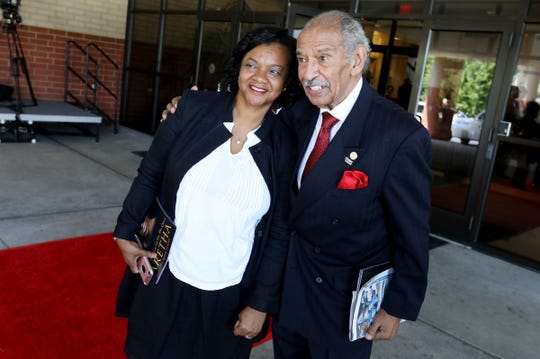
Monica and John Conyers pose for a photograph outside of Aretha Franklin's funeral at Greater Grace Temple in Detroit on Friday, August 31, 2018.
The Conyers - Post-vows
U.S. Rep. John Conyers, a civil rights icon who during five decades in Congress co-founded the National Black Caucus and pushed to establish a national holiday to honor the Rev. Martin Luther King Jr., died Sunday of natural causes at the age of 90.
His death comes after a long and illustrious career that spanned more than 50 years and 27 terms in office, but ended in 2018 with a sudden resignation amidst claims of sexual harassment and verbal abuse of employees and misuse of taxpayer funds to cover-up those claims.
Conyers' tenure was a remarkable 53-year-run during which the lawmaker, the son of a well-known labor lawyer in Detroit, compiled a near-record legacy of civil rights activism, longevity and advocacy for the poor and underprivileged.
He died with the sixth-longest tenure in congressional history.
"For a long time he was black America's congressman," said Sam Riddle, a longtime family friend and consultant to the Conyers family, who confirmed the death Sunday. "On the streets of Detroit, he'll be mourned."
Detroit Mayor Mike Duggan in a statement said he "was deeply saddened" by Conyers' death.
"One of my most special memories was spending time with him at Gordon Park on 12th Street and Clairmount on the 50th anniversary of the violence of 1967 as he recounted the story of his courageous efforts to calm the angry crowds," Duggan said. "He has fought for a better Detroit for more than half a century.
"From co-founding the Congressional Black Caucus to leading the fight in Congress to enshrine Martin Luther King’s birthday as a national holiday, John Conyers’ impact on our city and nation will never be forgotten," Duggan said.
Michigan Gov. Gretchen Whitmer called Conyers a "lifelong Detroiter who was deeply committed to the city and to those he represented."
"His impact on our state, whether by spearheading reforms in criminal justice and voting rights in Congress or through his lifetime of civil rights activism, will not be forgotten," Whitmer said in a statement.
Conyers was born in Detroit and graduated from Northwestern High School. After a tour of duty with the U.S. Army during the Korean War, Conyers returned home to earn bachelor's and law degrees from Wayne State University.
His law practice and work in the auto plants in Detroit led him to the office of former U.S. Rep. John Dingell, D-Dearborn, where he worked as a legislative assistant for three years. But by 1964, at the age of 35, Conyers went after a seat of his own in Congress, winning the first of 27 general elections and serving portions of Detroit and some surrounding Wayne County suburbs for the next five decades.
He may not have had many bills that carried his name — only 26 of the 712 bills he introduced became law, according to the Library of Congress — but he fought for issues of civil rights and social justice, including seeking reparations for the descendants of African-American slaves, modifying the mandatory sentences for those convicted of non-violent drug crimes, defending assaults on the Voting Rights Act, reforming laws that put juvenile offenders in prison for life and calling for investigations into police brutality of African-American men.
And he was the key sponsor of the bill, introduced each session for 20 years, that designated the third Monday of January as a federal holiday in honor of Martin Luther King Jr. Conyers introduced the bill four days after King was assassinated in 1968, but it wasn’t signed into law until 1989.
In the thick of the civil rights battles, Conyers walked alongside King and other leaders of the movement in Selma, Ala., to bring equal voting rights to blacks.
In 2015, during his 50th year in Congress, Conyers told the Washington Post that King was one of the most important historical figures in history.
"I felt the civil rights movement was a powerful chapter in American history, King to me is the outstanding international leader of the 20th century without every holding office," he said. "He advanced us forward even though there was a terrible loss of life and violence and injustice. But Martin Luther King Jr. moved us in a way that changed history."
He moved among those involved in the disturbance in Detroit in August 1967, urging calm. And he burnished his civil rights record even more by hiring icon Rosa Parks after she moved from Alabama to Detroit. The secretary and receptionist job in Conyers' Detroit office was a job she held until her retirement in 1988.
U.S. Rep. Rashida Tlaib, who won election to Conyers' seat after his resignation, on Twitter called Conyers "our Congressman forever."
"He never once wavered in fighting for jobs, justice and peace," Tlaib tweeted. "We always knew where he stood on issues of equality and civil rights in the fight for the people. Thank you Congressman Conyers for fighting for us for over 50 years."
Career ends amidst a sex scandal
Despite facing a rising chorus of voices demanding he step down because of the sexual harassment claims, Conyers, D-Detroit, refused to do so for several months in 2017. The scandal was a swift and crushing fall from grace for the longest-serving active member of Congress.
Conyers, 90, resigned after an article on BuzzFeed.com detailed a secret settlement of more than $27,000 with a former staffer who accused him of making sexual advances toward her and paying her out of funds from his taxpayer-supported office.
Within days, several other women had come forward with accusations against Conyers, who, despite his express denials that he harassed anyone, saw House leaders and members of his own party abandon him, with three of the four Democrats in the Michigan delegation calling for him to resign.
In addition to Marion Brown, the staffer who received the settlement, six other women claimed they either experienced or saw him touching and rubbing women in his office, making sexual advances toward them or making inappropriate remarks. One of them filed a lawsuit against him early this year and then withdrew it, saying she didn't want to hurt Conyers' reputation.
Another woman, Washington lawyer Melanie Sloan, also told the Free Press that Conyers had verbally mistreated her, forced her to babysit his children and, on one occasion, showed up at a meeting with her at his office in his underwear —though she didn't consider it sexual harassment.
From accusation to resignation, Conyers' colleagues went from being warily supportive, urging caution while an investigation by the House Ethics Committee was completed to issuing outright calls for his resignation, even from at least one fellow member of the Congressional Black Caucus, which he helped to create in 1971.
U.S. Rep. Jim Clyburn of South Carolina, who is the third-ranking Democrat in the House and had been a colleague of Conyers' on the Congressional Black Caucus since 1993, called for him to resign shortly after similar calls by House Speaker Paul Ryan and Democratic Leader Nancy Pelosi.
Conyers' lawyer, Arnold Reed, of Southfield, had reiterated on several occasions that the congressman was not ready to resign and wanted to see the ethics investigation completed.
But with allegations swirling not only over the harassment claims but his use of taxpayer funds to pay at least one settlement, he abruptly stepped down as the ranking Democrat on the House Judiciary Committee, a position he had held for more than two decades.
Then — with media reports that some members of the caucus were privately urging him to resign — he suddenly quit Washington, missing several votes, including one mandating sexual harassment training for members, as he headed back to Detroit and his family.
Conyers record in Congess
During his time in office, which he won with huge margins ever two years like clockwork, Conyers was considered one of the most liberal members of Congress, with a 100% rating from the American Civil Liberties Union, Planned Parenthood and the Human Rights Campaign.
The conservative Freedom Works gave him a 15% rating, while the Club for Growth and Americans for Prosperity give him ratings of 8% and 6% respectively.
Conyers, however, had already come under scrutiny twice from the House Ethics Committee in Congress for possible transgressions in his office.
In 2017, the committee confirmed it was continuing to look at whether he had wrongly paid his former chief of staff more than $50,000 for time she didn't work. Conyers said he was only paying her for accrued leave time and severance as part of a separation agreement reached after she pleaded guilty to a misdemeanor charge of receiving stolen property unrelated to her job.
In 2003, the Free Press reported on complaints from six unnamed Conyers aides who said they were forced to work on various campaigns, including a failed legislative campaign for Conyers' wife, Monica, on government time. A follow-up Ethics Committee report, however, focused on allegations that the congressman used staff to babysit his sons, help his wife with her law studies and chauffeur him to private events.
Conyers' office denied the accusations and eventually reached a deal to ensure staff knew where their responsibilities began and ended.
In 2014, Conyers nearly didn’t get the chance to run for reelection because of irregularities in the petitions he filed to run for office. Wayne County Clerk Cathy Garrett said he had used ineligible people to gather signatures, but a federal court disagreed and the state Legislature passed a law that people who collected signatures didn’t need to be registered voters.
Voting is beautiful, be beautiful ~ vote.©
Friday, August 9, 2019
Rufus Cormier Discusses the House Committee on the Judiciary Impeachment Inquiry
How come Rufus has no Wikipedia page?
Lawyer Rufus Cormier was born on March 2, 1948, in Beaumont, Texas to Rufus Cormier and Katie Cormier. Cormier attended Hebert High School, where he played football with Jerry LeVias. Both Cormier and LeVias received full athletic scholarships to play football at Southern Methodist University in Dallas, Texas, where Cormier was named outstanding lineman in the 1968 Bluebonnet Bowl. Cormier graduated with honors, earning his B.A. degree in anthropology in 1970. Cormier then received his J.D. degree from Yale University Law School in 1973.
Cormier began his legal career at the law firm of Paul Weiss, Rifkind, Wharton, & Garrison in New York. During his time there, Cormier was hired as a special assistant to John Doar, the lead counsel to the House Judiciary Committee for the Nixon Impeachment Inquiry. In 1974, he joined the law firm of Baker Botts LLP, becoming not only the first African American lawyer to be hired as a partner at a major Houston law firm, but also the first African American partner at a major corporate law firm in the State of Texas. After thirty-nine years with Baker Botts LLP, Cormier retired in 2013.
In addition to his law practice, Cormier served on numerous boards. He was appointed to Texas Southern University's Board of Regents in 1991. He also served on the board of directors for the Memorial Hermann Healthcare System, the board of visitors for the M.D. Anderson Cancer Center, the board of directors of the Center For Houston’s Future, the executive board of SMU School of Law, and the board of directors for the Gulf Coast Legal Foundation, among others. Cormier was also honored for his professional and volunteer work. He received the Leon Jaworski award from the Houston Bar Association Auxiliary, the Anti-Defamation League’s Karen H. Susman Jurisprudence Award, and the Silver Anniversary Mustang Award from Southern Methodist University. He was also named one of The Best Lawyers in America, and a Super Lawyer by both Texas Monthly and Law and Politics magazines.
Cormier and his wife, Yvonne Clement Cormier, have three children: Michelle, Geoffrey, and Claire.
Rufus Cormier was interviewed by The HistoryMakers on November 30, 2016.
Voting is beautiful, be beautiful ~ vote.©
Saturday, July 20, 2019
CONYERS: FBI Broke the Law and General Counsel’s Office, Headed by Valerie Caproni, Sanctioned It and Must Face Consequences

MARCH 20, 2007
 |
| Dean of the U.S. House of Representatives John Conyers, Jr. |
(Washington) April 14, 2010 - House Judiciary Committee Chair John Conyers, Jr. (D-Mich.) issued the following statement after the Judiciary Subcommittee Hearing on the Report by the Office of Inspector General (IG) of the Department of Justice on the FBI’s Use of Exigent Letters and Other Informal Requests for Telephone Records.
"Today’s hearing showed that the FBI broke the law on telephone records privacy and the General Counsel’s Office, headed by Valerie Caproni, sanctioned it and must face consequences," said Conyers. "I call upon FBI Director Mueller to take immediate action to punish those who violated the rules, including firing them from the agency. This must include the FBI Office of General Counsel, headed by Valerie Caproni, which the IG testified today had ‘approved [the] continued use’ of exigent letters and ‘provided legal advice that was inconsistent with’ federal law.
https://www.c-span.org/video/?186015-2/personal-information-privacy
https://www.c-span.org/video/?197219-1/fbi-national-security-letters
https://www.c-span.org/video/?286761-2/security-privacy-technology
| Valerie Caproni |
"The FBI must fulfill its obligations to protect the rights as well as the security of all Americans. I share the concerns of my colleague, the former Republican chairman of the Committee James Sensenbrenner (R-Wis.), who today said,
‘I’m extremely disappointed that every time Congress has tried to plug potential civil rights and civil liberties violations in our counterterrorism activities, the FBI seems to have figured out a way to get around it.’
Voting is beautiful, be beautiful ~ vote.©
Friday, April 26, 2019
Ringleader in 1998 gruesome Texas dragging death to be executed
Matthew Shepard and James Byrd Jr. Hate Crimes Prevention Act
The bill was first introduced into the 107 Congress's House of Representatives on April 3, 2001, by Rep. John Conyers and was referred to the Subcommittee on Crime. The bill died when it failed to advance in the committee. It was reintroduced by Rep. Conyers in the 108th and 109th congresses (on April 22, 2004, and May 26, 2005, respectively). As previously, it died both times when it failed to advance in committee.
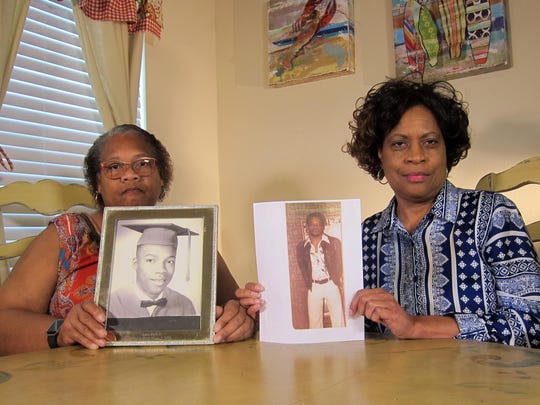 |
| Mylinda Byrd Washington, 66, left, and Louvon Byrd Harris, 61, hold photographs of their brother James Byrd Jr. in Houston. James Byrd Jr. was the victim of what is considered to be one of the most gruesome hate crime murders in recent Texas history. |
John William King, who is white and an avowed racist, was put on death row for chaining Byrd to the back of a truck and dragging his body for nearly 3 miles along a secluded road in the piney woods outside Jasper, Texas. The 49-year-old Byrd, who was black, was alive for at least 2 miles before his body was ripped to pieces in the early morning hours of June 7, 1998.
Prosecutors said he was targeted because he was black.
Authorities say the 44-year-old King is openly racist and has offensive tattoos on his body, including one of a black man with a noose around his neck hanging from a tree.
If executed, King would be the fourth inmate put to death this year in the U.S. and the third in Texas, the nation’s busiest capital punishment state.
The hate crime put a national spotlight on Jasper, a town of about 7,600 residents near the Texas-Louisiana border that was branded with a racist stigma it has tried to shake off ever since. Local officials say the reputation is undeserved.
King’s attorneys have asked the U.S. Supreme Court to halt his execution, arguing that King’s trial lawyers violated his constitutional rights by not presenting his claims of innocence and conceding his guilt. His lawyers cited a 2018 Supreme Court ruling in a Louisiana case in which the justices said that a lawyer for a criminal defendant cannot override his client’s wish to maintain his innocence at trial.
“From the time of indictment through his trial, Mr. King maintained his absolute innocence, claiming that he had left his co-defendants and Mr. Byrd sometime prior to his death and was not present at the scene of his murder. Mr. King repeatedly expressed to defense counsel that he wanted to present his innocence claim at trial,” A. Richard Ellis, one of King’s appellate attorneys, wrote in his petition to the Supreme Court.
The Texas Court of Criminal Appeals on Monday rejected a similar request to stop the execution.
 |
| John William King |
Over the years, King has also suggested the brutal slaying was not a hate crime, but a drug deal gone bad involving his co-defendants.
King, who grew up in Jasper and was known as “Bill,” will be the second man executed in the case. Lawrence Russell Brewer was executed in 2011. The third participant, Shawn Allen Berry, was sentenced to life in prison.
King declined an interview request from The Associated Press in the weeks leading up to his planned execution.
In a 2001 interview with the AP, King said he was an “avowed racist” but wasn’t “a hate-monger murderer.”
Louvon Byrd Harris, one of Byrd’s sisters, said she and other family members plan to attend King’s execution.
“I think it will be a message to the world that when you do something horrible like that, that you have to pay the high penalty,” she said.
Harris said she doesn’t expect King to be remorseful. Brewer said nothing to Byrd’s family before he was put to death.
“All they are going to do is go to sleep. But half the things they did to James, all the suffering he had to go through, they still get an easy way out to me,” Harris said.
Billy Rowles, who led the investigation into Byrd’s death when he was sheriff in Jasper County, said after King was taken to death row in 1999, he offered to detail the crime as soon as his co-defendants were convicted. When Rowles returned, all King would say was, “I wasn’t there.”
“He played us like a fiddle, getting us to go over there and thinking we’re going to get the rest of the story,” said Rowles, now the sheriff of neighboring Newton County.
A week before Brewer was executed in 2011, Rowles said he visited Brewer, who confirmed “the whole thing was Bill King’s idea.”
Mylinda Byrd Washington, another of Byrd’s sisters, said she and her family will work through the Byrd Foundation for Racial Healing to ensure her brother’s death continues to combat hate everywhere.
“I hope people remember him not as a hate crime statistic. This was a real person. A family man, a father, a brother and a son,” she said.
Voting is beautiful, be beautiful ~ vote.©
Tuesday, March 12, 2019
Congressman Conyers Soon to Speak at Coretta Scott King Funeral - 2-7-2006
Congressman Conyers Soon to Speak at Coretta Scott King Funeral
 |
| John Conyers, Jr. & Coretta Scott King |
Congressman John Conyers, Jr. is in Lithonia, Georgia for Coretta Scott King's funeral. The Congressman, who worked with Mrs. King to author the bill making Martin Luther King Day a national holiday, will be honoring her life's work with following remarks.
Today we mourn the passing of a dignified and peaceful woman who should be remembered as an equal partner in the struggle for civil rights. For more than forty years, she continued the pursuit of her husband's legacy of justice and equality - proving that she was an activist in her own right. For that, our nation owes her its most profound gratitude.
I first met Coretta when I traveled South during the civil rights movement as a lawyer. What many people may not realize is that Martin did not bring her to the Movement. She was already there. As a child of the South, she recognized the injustices of segregation and as a college student, began her own work to obtain equality.
We all recognize Coretta as a vibrant and dedicated partner to Dr. King. When he insisted that the Civil Rights Movement begin in the deep South, where racial injustice permeated every aspect of its society, she could have joined those who tried to dissuade him. Coretta could have made a strong case for standing on the sidelines when he was called to lead the Montgomery Bus Boycott with Mrs. Rosa Parks. After all, King was working on his doctorate, they had just started a family, and there was a great deal of danger involved in this struggle. However, she recognized the fact that the importance of this struggle transcended personal interest and people would have to step out on faith and do the right thing.
As Martin Luther King grew in the struggle, Mrs. King grew along with him. When he traveled to India in 1959 on a pilgrimage to disciples and sites associated with Gandhi, Mrs. King was by his side. She would travel around the country, giving speeches, singing, and leading marches. Coretta was not trying to make headlines or gain personal recognition, but she quietly and eloquently acted as a leader in the Movement.
Following Dr. King's assassination, Coretta continued to advance their shared vision of a free and equal America. She honored her husband's legacy by founding the King Center in 1968, the largest repository of King's speeches, writings, and other works. Coretta devoted her life to advancing racial and economic justice and the recognition of the rights of women, children, the poor, the homeless, and all those disenfranchised. Most notably, this woman stood for equality and peace - the virtues to which her husband dedicated his life.
With Coretta's approval, four days after Martin's death on April 4, 1968, I introduced a bill to name a federal holiday in his honor, and in 1969, I was proud to join her at the King Center in Atlanta to kick off the campaign for a King holiday. A stalwart leader, she orchestrated a national grassroots movement that urged passage of this legislation and would come to Congress in 1979, 1980, 1981, 1982, and 1983 to testify before Congress and urge support of the King Holiday, which was passed into law in 1986.
Today, as we mourn her loss, we also pledge to continue the King legacy just as Coretta has done for the last 38 years. Their contributions impacted millions during their lifetimes; it is our challenge to ensure that their legacies continue to compel justice and peace, and the very best that this country can be.
https://votesmart.org/public-statement/152233/congressman-conyers-soon-to-speak-at-coretta-scott-king-funeral&speechType=1#.XDlcpFxKg2zVoting is beautiful, be beautiful ~ vote.©
Judiciary: Hearing on the History and Enforcement of the Voting Rights Act of 1965
Voting is beautiful, be beautiful ~ vote.©
Monday, December 17, 2018
MLK Memorial Foundation Forced To Change Name By King Children
By Joseph Williams and Roland S. Martin
TV One, Washington Watch
TV One, Washington Watch
They spent six years raising more than $100 million, one cocktail fundraiser, and souvenir mug and lapel pin at a time.
And on October 16, 2011, the idea to build a monument in honor of the Rev. Dr. Martin Luther King on the National Mall in Washington, D.C., an idea that began 28 years earlier at the kitchen table of a member of his fraternity, Alpha Phi Alpha Fraternity, Inc., came to fruition.
Thousands of people of different races and backgrounds watched as President Barack Obama, two of King’s children, and countless other entertainers and veterans of the Civil Rights Movement, dedicated a bold statue to civil rights icon.
Less than two years later, however, the organizing force behind the national monument – the Dr. Martin Luther King Jr. Memorial Foundation – is no more after the surviving children of Martin and Coretta Scott King refused to grant a license for the group to continue to use the name “Martin Luther King Jr.”
The website that served as the centerpiece of the foundation’s fundraising and informational efforts – www.mlkmemorial.org – no longer exists. What used to be a vibrant site that served as the centerpiece for online donations and information related to the memorial has vanished after the King children, through their attorneys, demanded it be turned over to them.
King’s surviving children – Dexter, Bernice and MLK III – control the copyrights to their father’s images and words through a for-profit entity, King, Inc., which was set up after his death to handle all affairs of his estate.
There have been a number of contentious moments between the MLK foundation and King, Inc., over the last few years. At one point as the memorial was ready to be dedicated, King, Inc. had all of Dr. King’s books removed from the bookstore on the site of the memorial. The King children wanted to control the bookstore and reap all profits from the selling of merchandise.
All of this despite the foundation paying MLK children through King, Inc., $2.7 million to use the likeness of King and his quotes on the memorial on the National Mall.
“We are trying to keep the memorial relevant,” said Harry E. Johnson Sr., a Houston lawyer and president of The Memorial Foundation, the foundation’s new name (The site is www.thememorialfoundation.org and bears the slogan, “Builders of the Martin Luther King Jr. Memorial).
“We had planned a hundred events around the memorial” and King’s famous name – including year-long classes and a seminar on nonviolent protest featuring the grandson of Mahatma Gandhi, who was King’s inspiration, Johnson said.
Clarence Jones, who served as a personal advisor and attorney for Dr. King, called the refusal to grant a new license by King, Inc., to the foundation “obscene.”
“They have done something unique in the history of this country in getting corporate America, private America to fund a memorial to honor the greatest hero of the 20th century,” said Jones, a scholar-in-residence at the Martin Luther King, Jr. Institute at Stanford University.
“They did this in a tribute to his legacy as an Alpha member…it’s not about protecting the legacy or encouraging discussions of King. It’s not about that. It’s about unexplained, selfish interests, which I believe Martin King would be appalled.”
Civil rights historians who have studied King and his family say the move follows a familiar pattern, one in which King’s children tightly control his image – and use a heavy hand to protect it.
That pattern could be at the center of plans to commemorate the 50th anniversary of the March on Washington for Jobs and Freedom.
The historic August 28,1963, event has left an indelible imprint on the history of America when 250,000 people gathered before the Lincoln Monument to present a series of demands to the federal government. The march has long been credited with setting the stage for the signing of the Civil Rights Act of 1964.
But it has also gone down in history due to the stunning speech of Dr. King. Today it is known as the “I Have A Dream” speech, even though that wasn’t the initial name, and the dream portion of it was never in the written text.
The march was convened by the top civil rights organizations and organized labor, including Congress of Racial Equality, the National Urban League, NAACP, the Student Nonviolent Coordinating Committee), and the Southern Christian Leadership Conference. It was organized by A. Phillip Randolph and Bayard Rustin.
The 50th anniversary march was supposed to commemorate that historic day, but the King children have different plans. For them, that day is more about King’s speech rather than the march. In fact, the King Center, the non-profit entity set up to continue his works, is promoting August 28 as the 50th anniversary of the speech first, and the march second, based on a logo they are using on various materials.
Since late last year, leaders of the civil rights organizations who organized the original march, as well as the Rev. Al Sharpton, founder of the National Action Network, have been quietly meeting with King family representatives and officials from the National Park Service, which issues permits for demonstrations on the Mall.
The latest meeting took place two weeks ago in Washington, and involved high-level representatives from some of the organizations involved in the event planning. The talks are so sensitive, however, that no one is willing to speak about them publicly or privately.
National Urban League CEO Marc Morial, Wade Henderson of the Lawyers’ Committee for Civil Rights, and Ben Jealous, NAACP president and CEO, all declined to comment on the record. Sharpton did not return several calls requesting an interview.
“Some things are being sorted out,” said one activist with knowledge of the situation. “In two weeks, we will have a clearer picture… The march is going to happen.”
Eric Tilden, a principal of Intellectual Properties Management, which controls Rev. King’s words and image, agreed to facilitate an interview with Dexter and Bernice King, two of the three shareholders of King, Inc. Their brother, Martin Luther King III, is the other (Yolanda King, the eldest child, died in 2007).
Tilden has not responded to follow-up calls and emails and the King siblings have not been made available for comment. We also called and texted Bernice King and MLK III to no avail.
Civil rights historian David Garrow said if the March on Washington organizers are negotiating with the King children – and putting money on the table – they’re making a mistake.
“As we’ve seen for over 15 years now, the behavior of the family’s financial representatives continue to do active harm to Dr. King’s legacy,” said Garrow, a University of Pittsburgh law professor and author of “Bearing the Cross: Martin Luther King, Jr., and the Southern Christian Leadership Conference.”
“King’s legacy has a reduced visibility and less substantive visibility because of the family’s demands,” said Garrow, noting that the family’s estate has raked in millions through the years by managing their father’s “brand” — something King himself would have adamantly rejected.
At the same time, “it’s not as if (King, Inc.) Is using any of this income for charitable good deeds,” Garrow said. “We’ve seen none of that whatsoever. It appears to be simply self-enrichment for a small number of people.”
For years, the King heirs have used the courts to stop any unauthorized use of their father’s likeness and words, suing for custody of documents or a share of any proceeds in merchandise and publications. In the 1990s, the family reached undisclosed settlements with USA Today and CBS over their use of King’s seminal “I Have a Dream” speech without permission; in 1999 a federal appeals court sided with the estate, ruling that the speech was not in the public domain.
Yet the civil rights hero’s words and picture – including images from the March on Washington – have been used in major ad campaigns for products like Apple Computers, Mercedes-Benz and Chevrolet. Neither the corporations nor Intellectual Properties Management have disclosed the amount of money the foundation received for the ads.
In June 2006, Dexter King, then-head of King, Inc., put up the bulk of Dr. King’s personal papers for auction. But then-Atlanta Mayor Shirley Franklin prevented the sale by orchestrating a $32 million deal to buy them and have the papers preserved in the city of Atlanta. That money went directly to King, Inc.
Lawyers for King, Inc. even tried to demand that the man who helped Dr. King craft the “I Have A Dream” speech, and the one who filed the copyright, pay for using the full speech in his book.
Clarence Jones, who served as a personal advisor, attorney and speech writer for King, says when he wrote his book, “Behind the Dream: The Making of the Speech that Transformed a Nation,” he was told by attorneys for King, Inc., that if he wanted to use the full speech in the book, he could for $20,000.
A stunned Jones said, “If it wasn’t for me copyrighting that speech, the King children wouldn’t today own their biggest moneymaker.”
His small publisher was afraid of getting sued by King, Inc., so Jones indemnified them from any costs associated with a lawsuit and dared lawyers for the King children to sue him.
They never did.
The King children angered many civil rights leaders in September 2011 when King, Inc. sued Jackson, Miss., TV anchor Howard Ballou after he broadcasted a story about the papers his mom collected working for King at the SCLC.
The estate wanted possession of documents, photographs and other items that Ballou’s mother, Maude Ballou, said King gave her when they worked together at the Montgomery Improvement Association and the Southern Christian Leadership Conference in the 1950s.
Attorneys for King, Inc. asserted they owned any and all papers of his mom. But last week, a federal court in Mississippi ruled that Ballou could keep documents and other materials associated with Rev. King. The documents include a sermon; a written statement King made after a landmark Supreme Court ruling on segregation; and a handwritten letter to Ballou’s mother from Rosa Parks.
While the March on Washington commemoration is still in the early planning stages, Carol Johnson, a National Park Service spokeswoman, said the Park Service holds the event permit for Aug. 28 on the National Mall. That’s not uncommon, she said, particularly since the march is months away, organizers haven’t specified their plans or outlined how they intend to cover the millions of dollars in baseline logistical and security costs.
Given the costs, it’s likely that the March on Washington organizers will have to raise significant amounts of money just to put the march on the National Park Service calendar. Throw in additional events, such as seminars and a prayer breakfast, and the financial hurdles they must clear get even steeper.
At least one member of the organizing committee, however, isn’t worried.
“The preparations I know about are going just fine,” Clayola Brown, president of the Randolph Institute, told TV One’s Washington Watch. She said organizers have tentatively planned a weeklong series of events, culminating in a rally on the Mall expected to draw hundreds of thousands of people.
So far, she said, there have been about four meetings in Atlanta and elsewhere involving civil rights leaders and various unions. They also met with the National Park Service and members of the King family for additional planning, though she wouldn’t specify the nature of the discussions.
The NAACP’s Jealous wouldn’t talk about the meetings with the King family and rejected any suggestion that the march wouldn’t happen.
“The 50th anniversary of the March for Jobs and Freedom comes in the midst of a moment in which black unemployment remains the highest in recent memory,” he said. “There needs to be a march, and it needs to happen now, or we risk our children becoming truly the first generation of African Americans to be decidedly more worse off than their parents.”
But Garrow cautions Jealous and others from reaching a deal with the King children at any cost without keeping the meaning of the original march in mind.
The organizers “don’t need to deal with [the King heirs] to do a 50th anniversary event, so long as they’re not rebroadcasting a 50th anniversary of the ‘I Have A Dream’ speech,” Garrow said. “Dexter King doesn’t represent anybody, while you’ve got a number of organizations that do represent the African American community. You can honor Dr. King’s legacy without talking to Dexter in the slightest.”
“I think the big question is whether it goes off in a significant way or goes off in an insignificant way,” he added. “Does it really present a policy agenda and focus on issues? Or is it just a commemoration for the sake of commemoration?”
Disclosure: Roland S. Martin is a life member of Alpha Phi Alpha Fraternity, Inc., and played a role in helping the Dr. Martin Luther King Jr. Memorial Foundation raise money to help build the memorial. He has also emceeded a fundraising dinner for the Martin Luther King Jr. Center for Nonviolent Social Change, and wrote an endorsement for the book published by Bernice King about her mom, “Desert Rose: The Life and Legacy of Coretta Scott King.”
http://rolandmartinreports.com/blog/2013/03/mlk-memorial-foundation-forced-to-change-name-by-king-children/Voting is beautiful, be beautiful ~ vote.©
Friday, December 8, 2017
Day 48.5 Carmichael and Carpenter
U.S. regulators drop fraud case against Wall Street financier Wey
(Reuters) - U.S. securities regulators on Friday moved to drop their fraud case against Wall Street financier Benjamin Wey, about a month after prosecutors dropped a related criminal case after a judge threw out some evidence
In a filing in federal court in Manhattan, the U.S. Securities and Exchange Commission said its case relied on the same evidence as the criminal case, and that it believed it would no longer be able to use it.
Prosecutors and the SEC in 2015 accused Wey, the founder of New York Global Group, of making tens of millions of dollars by secretly controlling large blocks of shares through “reverse mergers” between Chinese companies and U.S. shell companies, and selling his shares at artificially high levels.
The SEC also sued Wey’s wife, Michaela Wey, who was not criminally charged.
“Today’s dismissal can only be described as a complete victory for our clients, Benjamin and Michaela Wey,” said David Siegal, a lawyer for the Weys.
SEC spokesman Ryan White declined to comment.
The criminal case against Wey collapsed in June, when U.S. District Judge Alison Nathan ruled that a huge cache of materials seized from Wey’s home and offices could not be used because they were obtained with overly broad search warrants that violated Wey’s constitutional rights.
Nathan said the seizure of items such as children’s school records, family photos and X-rays at minimum reflected “grossly negligent or reckless disregard” of the Fourth Amendment, which protects against unreasonable search and seizure.
Voting is beautiful, be beautiful ~ vote.©
Subscribe to:
Posts (Atom)