Voting is beautiful, be beautiful ~ vote.©

Showing posts with label Detroit. Show all posts
Showing posts with label Detroit. Show all posts
Saturday, September 19, 2020

Monday, November 4, 2019
Sunday, November 3, 2019
Public viewing held today for former Congressman John Conyers, Jr.
 |
| Bill & John Campaigning in Detroit 2016 |
DETROIT (WXYZ) — One of two public viewings was held today for former Congressman John Conyers, Jr.
Both viewings will be held at the Charles H. Wright Museum of African American History. The first is scheduled for Saturday, Nov. 2 from 10 a.m. to 2 p.m. and the second Sunday, Nov. 3 from noon to 5 p.m.
Funeral arrangements announced for former Congressman John Conyers Jr.
Conyers's funeral service will be held Monday, Nov. 4 at Greater Grace Temple on 3500 W. Seven Mile Road in Detroit.
The service will take place at 11 a.m., with a preceding family hour beginning at 10 a.m.
https://www.wxyz.com/news/public-viewing-today-for-former-congressman-john-conyers-jr
Voting is beautiful, be beautiful ~ vote.©
Sunday, October 27, 2019
CONYERS: The Report Of His Death
 I have no comment.
I am watching the heavens fall.
U.S. Rep. John Conyers, former dean of Congress, dies at the age of 90
Kathleen Gray and Todd Spangler, Detroit Free PressPublished 4:34 p.m. ET Oct. 27, 2019 | Updated 5:09 p.m. ET Oct. 27, 2019
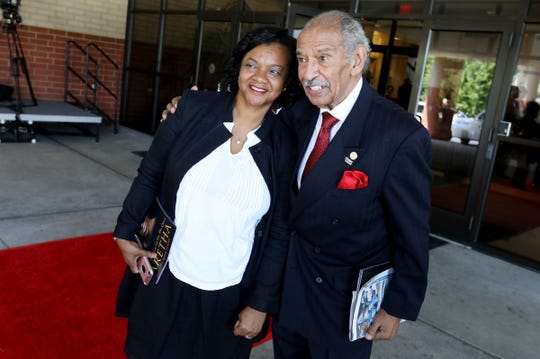
Monica and John Conyers pose for a photograph outside of Aretha Franklin's funeral at Greater Grace Temple in Detroit on Friday, August 31, 2018.
The Conyers - Post-vows
U.S. Rep. John Conyers, a civil rights icon who during five decades in Congress co-founded the National Black Caucus and pushed to establish a national holiday to honor the Rev. Martin Luther King Jr., died Sunday of natural causes at the age of 90.
His death comes after a long and illustrious career that spanned more than 50 years and 27 terms in office, but ended in 2018 with a sudden resignation amidst claims of sexual harassment and verbal abuse of employees and misuse of taxpayer funds to cover-up those claims.
Conyers' tenure was a remarkable 53-year-run during which the lawmaker, the son of a well-known labor lawyer in Detroit, compiled a near-record legacy of civil rights activism, longevity and advocacy for the poor and underprivileged.
He died with the sixth-longest tenure in congressional history.
"For a long time he was black America's congressman," said Sam Riddle, a longtime family friend and consultant to the Conyers family, who confirmed the death Sunday. "On the streets of Detroit, he'll be mourned."
Detroit Mayor Mike Duggan in a statement said he "was deeply saddened" by Conyers' death.
"One of my most special memories was spending time with him at Gordon Park on 12th Street and Clairmount on the 50th anniversary of the violence of 1967 as he recounted the story of his courageous efforts to calm the angry crowds," Duggan said. "He has fought for a better Detroit for more than half a century.
"From co-founding the Congressional Black Caucus to leading the fight in Congress to enshrine Martin Luther King’s birthday as a national holiday, John Conyers’ impact on our city and nation will never be forgotten," Duggan said.
Michigan Gov. Gretchen Whitmer called Conyers a "lifelong Detroiter who was deeply committed to the city and to those he represented."
"His impact on our state, whether by spearheading reforms in criminal justice and voting rights in Congress or through his lifetime of civil rights activism, will not be forgotten," Whitmer said in a statement.
Conyers was born in Detroit and graduated from Northwestern High School. After a tour of duty with the U.S. Army during the Korean War, Conyers returned home to earn bachelor's and law degrees from Wayne State University.
His law practice and work in the auto plants in Detroit led him to the office of former U.S. Rep. John Dingell, D-Dearborn, where he worked as a legislative assistant for three years. But by 1964, at the age of 35, Conyers went after a seat of his own in Congress, winning the first of 27 general elections and serving portions of Detroit and some surrounding Wayne County suburbs for the next five decades.
He may not have had many bills that carried his name — only 26 of the 712 bills he introduced became law, according to the Library of Congress — but he fought for issues of civil rights and social justice, including seeking reparations for the descendants of African-American slaves, modifying the mandatory sentences for those convicted of non-violent drug crimes, defending assaults on the Voting Rights Act, reforming laws that put juvenile offenders in prison for life and calling for investigations into police brutality of African-American men.
And he was the key sponsor of the bill, introduced each session for 20 years, that designated the third Monday of January as a federal holiday in honor of Martin Luther King Jr. Conyers introduced the bill four days after King was assassinated in 1968, but it wasn’t signed into law until 1989.
In the thick of the civil rights battles, Conyers walked alongside King and other leaders of the movement in Selma, Ala., to bring equal voting rights to blacks.
In 2015, during his 50th year in Congress, Conyers told the Washington Post that King was one of the most important historical figures in history.
"I felt the civil rights movement was a powerful chapter in American history, King to me is the outstanding international leader of the 20th century without every holding office," he said. "He advanced us forward even though there was a terrible loss of life and violence and injustice. But Martin Luther King Jr. moved us in a way that changed history."
He moved among those involved in the disturbance in Detroit in August 1967, urging calm. And he burnished his civil rights record even more by hiring icon Rosa Parks after she moved from Alabama to Detroit. The secretary and receptionist job in Conyers' Detroit office was a job she held until her retirement in 1988.
U.S. Rep. Rashida Tlaib, who won election to Conyers' seat after his resignation, on Twitter called Conyers "our Congressman forever."
"He never once wavered in fighting for jobs, justice and peace," Tlaib tweeted. "We always knew where he stood on issues of equality and civil rights in the fight for the people. Thank you Congressman Conyers for fighting for us for over 50 years."
Career ends amidst a sex scandal
Despite facing a rising chorus of voices demanding he step down because of the sexual harassment claims, Conyers, D-Detroit, refused to do so for several months in 2017. The scandal was a swift and crushing fall from grace for the longest-serving active member of Congress.
Conyers, 90, resigned after an article on BuzzFeed.com detailed a secret settlement of more than $27,000 with a former staffer who accused him of making sexual advances toward her and paying her out of funds from his taxpayer-supported office.
Within days, several other women had come forward with accusations against Conyers, who, despite his express denials that he harassed anyone, saw House leaders and members of his own party abandon him, with three of the four Democrats in the Michigan delegation calling for him to resign.
In addition to Marion Brown, the staffer who received the settlement, six other women claimed they either experienced or saw him touching and rubbing women in his office, making sexual advances toward them or making inappropriate remarks. One of them filed a lawsuit against him early this year and then withdrew it, saying she didn't want to hurt Conyers' reputation.
Another woman, Washington lawyer Melanie Sloan, also told the Free Press that Conyers had verbally mistreated her, forced her to babysit his children and, on one occasion, showed up at a meeting with her at his office in his underwear —though she didn't consider it sexual harassment.
From accusation to resignation, Conyers' colleagues went from being warily supportive, urging caution while an investigation by the House Ethics Committee was completed to issuing outright calls for his resignation, even from at least one fellow member of the Congressional Black Caucus, which he helped to create in 1971.
U.S. Rep. Jim Clyburn of South Carolina, who is the third-ranking Democrat in the House and had been a colleague of Conyers' on the Congressional Black Caucus since 1993, called for him to resign shortly after similar calls by House Speaker Paul Ryan and Democratic Leader Nancy Pelosi.
Conyers' lawyer, Arnold Reed, of Southfield, had reiterated on several occasions that the congressman was not ready to resign and wanted to see the ethics investigation completed.
But with allegations swirling not only over the harassment claims but his use of taxpayer funds to pay at least one settlement, he abruptly stepped down as the ranking Democrat on the House Judiciary Committee, a position he had held for more than two decades.
Then — with media reports that some members of the caucus were privately urging him to resign — he suddenly quit Washington, missing several votes, including one mandating sexual harassment training for members, as he headed back to Detroit and his family.
Conyers record in Congess
During his time in office, which he won with huge margins ever two years like clockwork, Conyers was considered one of the most liberal members of Congress, with a 100% rating from the American Civil Liberties Union, Planned Parenthood and the Human Rights Campaign.
The conservative Freedom Works gave him a 15% rating, while the Club for Growth and Americans for Prosperity give him ratings of 8% and 6% respectively.
Conyers, however, had already come under scrutiny twice from the House Ethics Committee in Congress for possible transgressions in his office.
In 2017, the committee confirmed it was continuing to look at whether he had wrongly paid his former chief of staff more than $50,000 for time she didn't work. Conyers said he was only paying her for accrued leave time and severance as part of a separation agreement reached after she pleaded guilty to a misdemeanor charge of receiving stolen property unrelated to her job.
In 2003, the Free Press reported on complaints from six unnamed Conyers aides who said they were forced to work on various campaigns, including a failed legislative campaign for Conyers' wife, Monica, on government time. A follow-up Ethics Committee report, however, focused on allegations that the congressman used staff to babysit his sons, help his wife with her law studies and chauffeur him to private events.
Conyers' office denied the accusations and eventually reached a deal to ensure staff knew where their responsibilities began and ended.
In 2014, Conyers nearly didn’t get the chance to run for reelection because of irregularities in the petitions he filed to run for office. Wayne County Clerk Cathy Garrett said he had used ineligible people to gather signatures, but a federal court disagreed and the state Legislature passed a law that people who collected signatures didn’t need to be registered voters.
Voting is beautiful, be beautiful ~ vote.©
Tuesday, September 10, 2019
CONYERS Portrait In The U.S. House Judiciary Committee 2017
The portrait was placed, stage left, on the wall of the U.S. House of Representative Judiciary Committee.


Voting is beautiful, be beautiful ~ vote.©
C-SPAN has locked the video on embedding, obstructing use in the public record.
Voting is beautiful, be beautiful ~ vote.©
Friday, August 30, 2019
John Conyers, Sr. - Forefather of the UAW - Detroit & GM
I remember when he told me of how his father was beaten and bloodied trying to form the union by GM in Detroit.
Since this his legacy has been omitted from the history books, I believe we shall have a few fun projects coming up.
John Conyers, Sr.
Published: January 4, 1986
DETROIT, Jan. 3— John Conyers Sr., a retired union official who was the father of Representative John Conyers Jr., Democrat of Michigan, died Wednesday at his Detroit home. He was 80 years old. Mr. Conyers had been an international representative for the United Automobile Workers.
In addition to his son John, Mr. Conyers is survived by his wife, Lucille, and another son, Nathan.
DETROIT – Between the two World Wars, the groundwork was laid in this city’s Black community that culminated in the 1941 organizing of the world’s most powerful corporation: the Ford Motor Company.
That piece of Detroit’s rich labor and civil rights history was brought to life by professors Beth Bates and Quill Pettway in a Department of Africana Studies Black History Month celebration at Wayne State University here.
Bates’ research has focused on political, social, and economic developments within the 20th century African American community. Pettway is both a student and maker of history. He was helped organize the huge Ford Rouge plant and continued working there for 27 years before becoming a professor. Now almost 90, he continues to teach math at Wayne County Community College.
The two traced the origins of Detroit’s Black population. Escaping what for many was life as a Southern sharecropper, Black migration north took place at record levels in the early part of the last century. From 1916 to1917, Black migration to Detroit averaged 1,000 a month. “Simply put, they came looking for a better life, better education, security and to escape lynching” said Pettway.
By the early 1920s, 45 percent of Black men in Detroit worked at Ford.
Bates said those jobs at Ford gave hope to Blacks, but Henry Ford “extracted more than his pound of flesh in speed-ups.” She quoted the late autoworker Dave Moore who said “there was nothing liberal in the bastard – Ford’s strategy was simply different than GM or Chrysler,” where cleaning rest rooms and mopping floors was the best Blacks could expect.
Interwoven in Ford’s strategy was a paternalistic philosophy. Bates said Ford imagined Blacks might be “the perfect workers for his open shop movement, what he called his American Plan.” However, Bates said, Blacks also had their own American Plan, one that grew more incompatible with Henry Ford as time went by. Contrary to what many scholars have written, it was Black workers who paved the way for unionization at Ford, she said.
Throughout the 1930s the old AFL autoworkers union missed opportunities to support the Black community in their fight for civil rights and against police brutality, and did not work to develop a broader-based union organizing drive. “Black workers not initially signing union cards had less to do with allegiance to Ford than wanting to be treated as equals” by the union, said Bates.
She credited the role played by the Communist Party and other radicals in organizations like the unemployed councils and the International Labor Defense (which led the fight to save the Scottsboro Boys) because they facilitated a “cross-fertilization” and politicalization within the Black community, between workers at Ford and community members, on issues like racism, civil rights and jobs.
“By 1935, Black Detroiters considered Communists friends you could count on,” said Bates.
Unlike the old AFL union, the CIO’s United Auto Workers had a policy of racial equality that gave it an advantage, Pettway said.
He noted the role played by white Ford worker and lead union organizer Bill McKie. McKie’s job in Ford’s maintenance department allowed him to circulate amongst different workers. The fact that McKie was a known Communist did not hurt his ability to organize. He was “second to none, highly respected by everyone. Elected as a trustee his first year,” said Pettway.
The CIO saw to it that a broad base of union support was built within the Black community and on three occasion organized rallies with Paul Robeson.
Pettway said the last rally, in Detroit’s downtown Cadillac Square, drew 60,000 people. “Regardless of race, creed or color, they came to hear Robeson, Walter Reuther, former City Council President Erma Henderson,” among others.
On May 21, 1941, Ford workers overwhelmingly voted for the union.
The vote shook the automotive industry and shaped it for decades to come.
During discussion, retired UAW activist General Baker pointed to the “high level of solidarity” still seen within UAW Ford Local 600. At its peak there were 17,000 Black workers and even today, most top UAW national leaders come out of Local 600 he said.
Pettway said “the unity needed to organize Ford was the same unity that elected Barack Obama. This is what is necessary to move forward.”
Voting is beautiful, be beautiful ~ vote.©
Since this his legacy has been omitted from the history books, I believe we shall have a few fun projects coming up.
John Conyers, Sr.
Published: January 4, 1986
 |
| John Conyers, Sr. Forefather of the UAW |
In addition to his son John, Mr. Conyers is survived by his wife, Lucille, and another son, Nathan.
Black history, labor history intertwined in Detroit
March 1, 2010 11:58 AM CDT BY JOHN RUMMELDETROIT – Between the two World Wars, the groundwork was laid in this city’s Black community that culminated in the 1941 organizing of the world’s most powerful corporation: the Ford Motor Company.
That piece of Detroit’s rich labor and civil rights history was brought to life by professors Beth Bates and Quill Pettway in a Department of Africana Studies Black History Month celebration at Wayne State University here.
Bates’ research has focused on political, social, and economic developments within the 20th century African American community. Pettway is both a student and maker of history. He was helped organize the huge Ford Rouge plant and continued working there for 27 years before becoming a professor. Now almost 90, he continues to teach math at Wayne County Community College.
The two traced the origins of Detroit’s Black population. Escaping what for many was life as a Southern sharecropper, Black migration north took place at record levels in the early part of the last century. From 1916 to1917, Black migration to Detroit averaged 1,000 a month. “Simply put, they came looking for a better life, better education, security and to escape lynching” said Pettway.
By the early 1920s, 45 percent of Black men in Detroit worked at Ford.
Bates said those jobs at Ford gave hope to Blacks, but Henry Ford “extracted more than his pound of flesh in speed-ups.” She quoted the late autoworker Dave Moore who said “there was nothing liberal in the bastard – Ford’s strategy was simply different than GM or Chrysler,” where cleaning rest rooms and mopping floors was the best Blacks could expect.
Interwoven in Ford’s strategy was a paternalistic philosophy. Bates said Ford imagined Blacks might be “the perfect workers for his open shop movement, what he called his American Plan.” However, Bates said, Blacks also had their own American Plan, one that grew more incompatible with Henry Ford as time went by. Contrary to what many scholars have written, it was Black workers who paved the way for unionization at Ford, she said.
Throughout the 1930s the old AFL autoworkers union missed opportunities to support the Black community in their fight for civil rights and against police brutality, and did not work to develop a broader-based union organizing drive. “Black workers not initially signing union cards had less to do with allegiance to Ford than wanting to be treated as equals” by the union, said Bates.
She credited the role played by the Communist Party and other radicals in organizations like the unemployed councils and the International Labor Defense (which led the fight to save the Scottsboro Boys) because they facilitated a “cross-fertilization” and politicalization within the Black community, between workers at Ford and community members, on issues like racism, civil rights and jobs.
“By 1935, Black Detroiters considered Communists friends you could count on,” said Bates.
Unlike the old AFL union, the CIO’s United Auto Workers had a policy of racial equality that gave it an advantage, Pettway said.
He noted the role played by white Ford worker and lead union organizer Bill McKie. McKie’s job in Ford’s maintenance department allowed him to circulate amongst different workers. The fact that McKie was a known Communist did not hurt his ability to organize. He was “second to none, highly respected by everyone. Elected as a trustee his first year,” said Pettway.
The CIO saw to it that a broad base of union support was built within the Black community and on three occasion organized rallies with Paul Robeson.
Pettway said the last rally, in Detroit’s downtown Cadillac Square, drew 60,000 people. “Regardless of race, creed or color, they came to hear Robeson, Walter Reuther, former City Council President Erma Henderson,” among others.
On May 21, 1941, Ford workers overwhelmingly voted for the union.
The vote shook the automotive industry and shaped it for decades to come.
During discussion, retired UAW activist General Baker pointed to the “high level of solidarity” still seen within UAW Ford Local 600. At its peak there were 17,000 Black workers and even today, most top UAW national leaders come out of Local 600 he said.
Pettway said “the unity needed to organize Ford was the same unity that elected Barack Obama. This is what is necessary to move forward.”
Voting is beautiful, be beautiful ~ vote.©
Wednesday, June 5, 2019
CONYERS CONTINUES AT 90: Birthday bash draws over 300 friends, Congress and Detroit VIP’s, well-wishers, and comments on news
 |
| John Conyers, Jr. |
Conyers said in an interview at the event:
· He suggests “not to impeach” Trump now but keep investigating. “The longer he stays in, the more mistakes he’ll make.” He added, “the election will be a tough race. If we’re not careful he’ll win again.”· Among his many achievements, he’s “most proud” of his Martin Luther King Birthday Holiday bill becoming law. He was asked, “Did you think it would grow into this big an event, a national day of service?” He responded, “Yes. At first there was a small group of people with me. A larger group said it “would never happen. Then other people joined. More introduced their own. Support grew. After the assassination, what he had done resounded with people.” Conyers mentioned he felt the “most association” with King among American leaders, marched with him, went to his home, was endorsed by him for Congress.
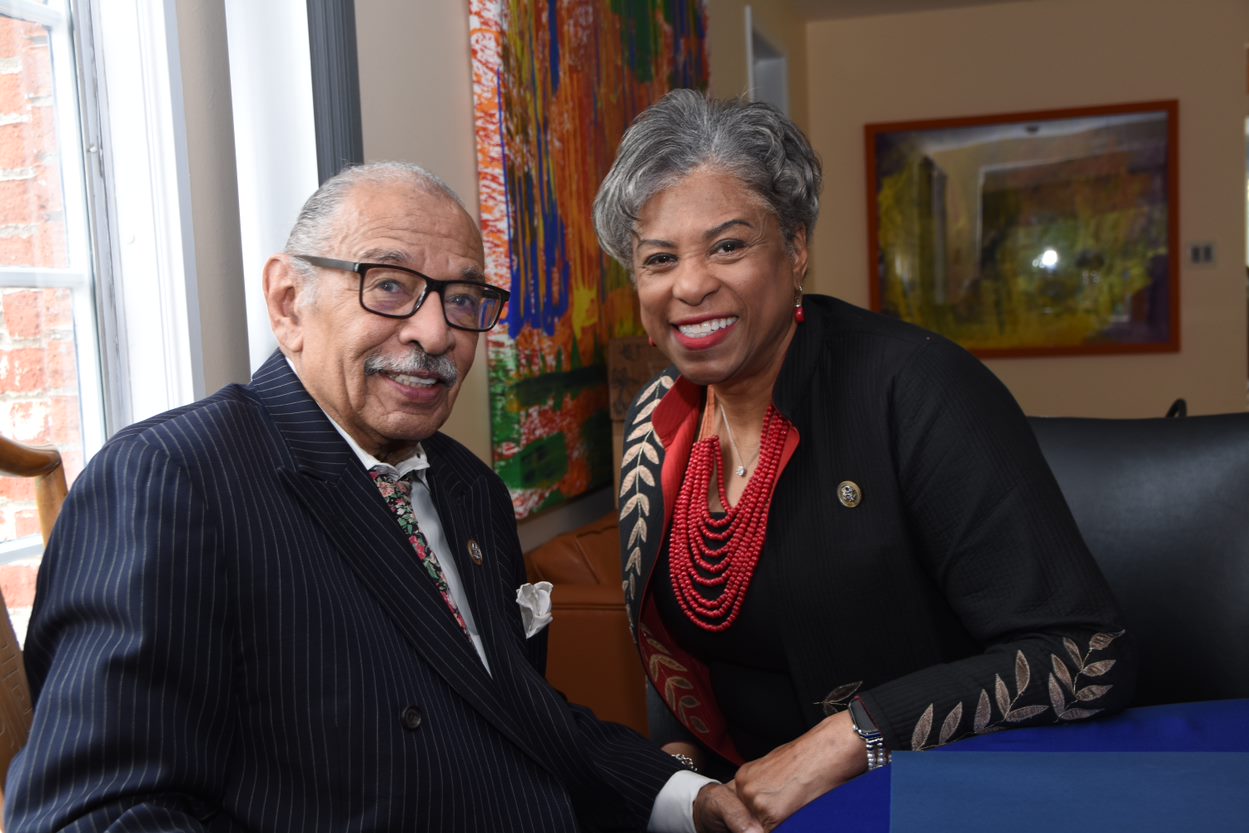 |
| Congressman John Conyers Jr. and Congresswoman Brenda Lawrence |
· He’s “all in” supporting Joe Biden’s run for President. Biden was a close colleague who chaired the Senate version of Conyers’ House Judiciary Committee and came to Conyers’ Hill portrait unveiling in Washington. Conyers said Saturday: “He has a good chance, better than Barack had at this point.” Conyers also supported Obama very early on.
· He’s happy his Reparations bill has become a major issue in the presidential campaign. Cong. Brenda Lawrence told him at the event, “It’s the talk of the country.” Conyers said, “It’s getting traction because it makes sense.” He joked, “Most of my stuff makes sense but it doesn’t always help it right away.”
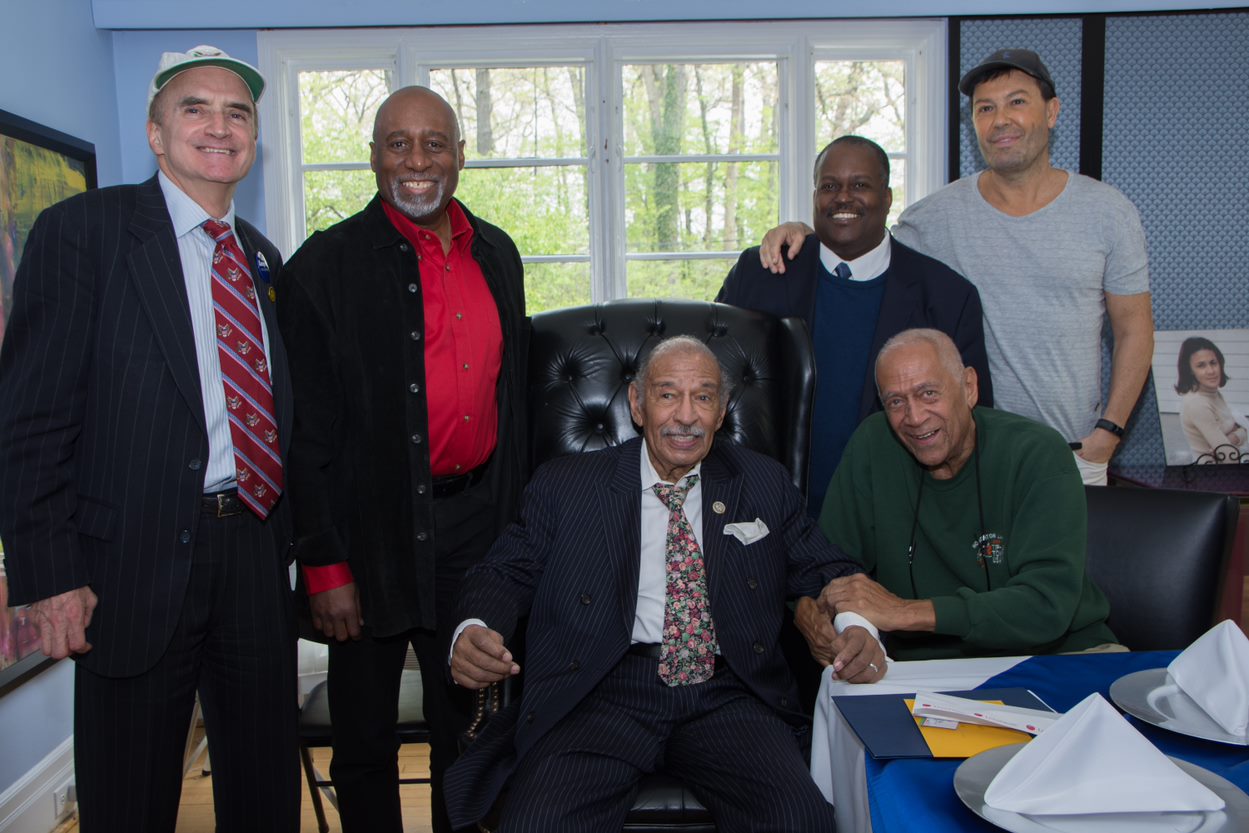 |
| Conyers and Friends at his birthday party. |
· On the Medicare-for-All movement where he enlisted a majority of House Democrats, but now weakening a bit under political arguments and industry lobbying since he’s left? Conyers said, “I still feel good about it, it’s moving, it takes time.”
· His resolution that passed in the House for no Iran war without congressional approval is “relevant especially now.”
· He noted that “the first person I hired when I was elected was Rosa Parks.”
· He said his health is good: “There’s not a thing wrong with me, no complaints.” He said he stays “active with events, there are so many who invite and welcome me. I’m privileged.” He said he’s been with many groups “from the beginning.” He’s thinking he’ll “write a book.”
· He offered positive words about his successors, Cong. Talib in Detroit and, at the Judiciary Committee in Washington, Jerold Nadler (D-NY). Talib presented Conyers with a flower bouquet. He said that despite some criticism of her rhetoric, people need to know she “means well.” He said that Nadler is carrying a “good program, well organized” on constitutional issues concerning Trump. Top Judiciary Counsel Perry Apelbaum came from Washington with a resolution congratulating Conyers signed by all Democratic Judiciary congressional members. Also at the party were former office Chief of Staff Ray Plowden and former Judiciary counsel Julian Epstein (and spokesman Bob Weiner, author of this article).
Congresswoman Dingell was seen crying at the event and was asked why. Perhaps summarizing the feelings of many, she said, “I’m just missing him. Lots of great memories of the ups and downs of life.”
Weiner is former communications director for Cong Conyers, a former Clinton and Bush White House spokesman, and former senior aide to Cong. Charles Rangel, Claude Pepper, Ed Koch, and Sen. Ted Kennedy. He now heads a group recruiting young journalists to write for top papers and contributes regularly to the Chronicle.
Voting is beautiful, be beautiful ~ vote.©
Tuesday, March 12, 2019
Judiciary: Hearing on the History and Enforcement of the Voting Rights Act of 1965
Voting is beautiful, be beautiful ~ vote.©
Monday, December 17, 2018
MLK Memorial Foundation Forced To Change Name By King Children
By Joseph Williams and Roland S. Martin
TV One, Washington Watch
TV One, Washington Watch
They spent six years raising more than $100 million, one cocktail fundraiser, and souvenir mug and lapel pin at a time.
And on October 16, 2011, the idea to build a monument in honor of the Rev. Dr. Martin Luther King on the National Mall in Washington, D.C., an idea that began 28 years earlier at the kitchen table of a member of his fraternity, Alpha Phi Alpha Fraternity, Inc., came to fruition.
Thousands of people of different races and backgrounds watched as President Barack Obama, two of King’s children, and countless other entertainers and veterans of the Civil Rights Movement, dedicated a bold statue to civil rights icon.
Less than two years later, however, the organizing force behind the national monument – the Dr. Martin Luther King Jr. Memorial Foundation – is no more after the surviving children of Martin and Coretta Scott King refused to grant a license for the group to continue to use the name “Martin Luther King Jr.”
The website that served as the centerpiece of the foundation’s fundraising and informational efforts – www.mlkmemorial.org – no longer exists. What used to be a vibrant site that served as the centerpiece for online donations and information related to the memorial has vanished after the King children, through their attorneys, demanded it be turned over to them.
King’s surviving children – Dexter, Bernice and MLK III – control the copyrights to their father’s images and words through a for-profit entity, King, Inc., which was set up after his death to handle all affairs of his estate.
There have been a number of contentious moments between the MLK foundation and King, Inc., over the last few years. At one point as the memorial was ready to be dedicated, King, Inc. had all of Dr. King’s books removed from the bookstore on the site of the memorial. The King children wanted to control the bookstore and reap all profits from the selling of merchandise.
All of this despite the foundation paying MLK children through King, Inc., $2.7 million to use the likeness of King and his quotes on the memorial on the National Mall.
“We are trying to keep the memorial relevant,” said Harry E. Johnson Sr., a Houston lawyer and president of The Memorial Foundation, the foundation’s new name (The site is www.thememorialfoundation.org and bears the slogan, “Builders of the Martin Luther King Jr. Memorial).
“We had planned a hundred events around the memorial” and King’s famous name – including year-long classes and a seminar on nonviolent protest featuring the grandson of Mahatma Gandhi, who was King’s inspiration, Johnson said.
Clarence Jones, who served as a personal advisor and attorney for Dr. King, called the refusal to grant a new license by King, Inc., to the foundation “obscene.”
“They have done something unique in the history of this country in getting corporate America, private America to fund a memorial to honor the greatest hero of the 20th century,” said Jones, a scholar-in-residence at the Martin Luther King, Jr. Institute at Stanford University.
“They did this in a tribute to his legacy as an Alpha member…it’s not about protecting the legacy or encouraging discussions of King. It’s not about that. It’s about unexplained, selfish interests, which I believe Martin King would be appalled.”
Civil rights historians who have studied King and his family say the move follows a familiar pattern, one in which King’s children tightly control his image – and use a heavy hand to protect it.
That pattern could be at the center of plans to commemorate the 50th anniversary of the March on Washington for Jobs and Freedom.
The historic August 28,1963, event has left an indelible imprint on the history of America when 250,000 people gathered before the Lincoln Monument to present a series of demands to the federal government. The march has long been credited with setting the stage for the signing of the Civil Rights Act of 1964.
But it has also gone down in history due to the stunning speech of Dr. King. Today it is known as the “I Have A Dream” speech, even though that wasn’t the initial name, and the dream portion of it was never in the written text.
The march was convened by the top civil rights organizations and organized labor, including Congress of Racial Equality, the National Urban League, NAACP, the Student Nonviolent Coordinating Committee), and the Southern Christian Leadership Conference. It was organized by A. Phillip Randolph and Bayard Rustin.
The 50th anniversary march was supposed to commemorate that historic day, but the King children have different plans. For them, that day is more about King’s speech rather than the march. In fact, the King Center, the non-profit entity set up to continue his works, is promoting August 28 as the 50th anniversary of the speech first, and the march second, based on a logo they are using on various materials.
Since late last year, leaders of the civil rights organizations who organized the original march, as well as the Rev. Al Sharpton, founder of the National Action Network, have been quietly meeting with King family representatives and officials from the National Park Service, which issues permits for demonstrations on the Mall.
The latest meeting took place two weeks ago in Washington, and involved high-level representatives from some of the organizations involved in the event planning. The talks are so sensitive, however, that no one is willing to speak about them publicly or privately.
National Urban League CEO Marc Morial, Wade Henderson of the Lawyers’ Committee for Civil Rights, and Ben Jealous, NAACP president and CEO, all declined to comment on the record. Sharpton did not return several calls requesting an interview.
“Some things are being sorted out,” said one activist with knowledge of the situation. “In two weeks, we will have a clearer picture… The march is going to happen.”
Eric Tilden, a principal of Intellectual Properties Management, which controls Rev. King’s words and image, agreed to facilitate an interview with Dexter and Bernice King, two of the three shareholders of King, Inc. Their brother, Martin Luther King III, is the other (Yolanda King, the eldest child, died in 2007).
Tilden has not responded to follow-up calls and emails and the King siblings have not been made available for comment. We also called and texted Bernice King and MLK III to no avail.
Civil rights historian David Garrow said if the March on Washington organizers are negotiating with the King children – and putting money on the table – they’re making a mistake.
“As we’ve seen for over 15 years now, the behavior of the family’s financial representatives continue to do active harm to Dr. King’s legacy,” said Garrow, a University of Pittsburgh law professor and author of “Bearing the Cross: Martin Luther King, Jr., and the Southern Christian Leadership Conference.”
“King’s legacy has a reduced visibility and less substantive visibility because of the family’s demands,” said Garrow, noting that the family’s estate has raked in millions through the years by managing their father’s “brand” — something King himself would have adamantly rejected.
At the same time, “it’s not as if (King, Inc.) Is using any of this income for charitable good deeds,” Garrow said. “We’ve seen none of that whatsoever. It appears to be simply self-enrichment for a small number of people.”
For years, the King heirs have used the courts to stop any unauthorized use of their father’s likeness and words, suing for custody of documents or a share of any proceeds in merchandise and publications. In the 1990s, the family reached undisclosed settlements with USA Today and CBS over their use of King’s seminal “I Have a Dream” speech without permission; in 1999 a federal appeals court sided with the estate, ruling that the speech was not in the public domain.
Yet the civil rights hero’s words and picture – including images from the March on Washington – have been used in major ad campaigns for products like Apple Computers, Mercedes-Benz and Chevrolet. Neither the corporations nor Intellectual Properties Management have disclosed the amount of money the foundation received for the ads.
In June 2006, Dexter King, then-head of King, Inc., put up the bulk of Dr. King’s personal papers for auction. But then-Atlanta Mayor Shirley Franklin prevented the sale by orchestrating a $32 million deal to buy them and have the papers preserved in the city of Atlanta. That money went directly to King, Inc.
Lawyers for King, Inc. even tried to demand that the man who helped Dr. King craft the “I Have A Dream” speech, and the one who filed the copyright, pay for using the full speech in his book.
Clarence Jones, who served as a personal advisor, attorney and speech writer for King, says when he wrote his book, “Behind the Dream: The Making of the Speech that Transformed a Nation,” he was told by attorneys for King, Inc., that if he wanted to use the full speech in the book, he could for $20,000.
A stunned Jones said, “If it wasn’t for me copyrighting that speech, the King children wouldn’t today own their biggest moneymaker.”
His small publisher was afraid of getting sued by King, Inc., so Jones indemnified them from any costs associated with a lawsuit and dared lawyers for the King children to sue him.
They never did.
The King children angered many civil rights leaders in September 2011 when King, Inc. sued Jackson, Miss., TV anchor Howard Ballou after he broadcasted a story about the papers his mom collected working for King at the SCLC.
The estate wanted possession of documents, photographs and other items that Ballou’s mother, Maude Ballou, said King gave her when they worked together at the Montgomery Improvement Association and the Southern Christian Leadership Conference in the 1950s.
Attorneys for King, Inc. asserted they owned any and all papers of his mom. But last week, a federal court in Mississippi ruled that Ballou could keep documents and other materials associated with Rev. King. The documents include a sermon; a written statement King made after a landmark Supreme Court ruling on segregation; and a handwritten letter to Ballou’s mother from Rosa Parks.
While the March on Washington commemoration is still in the early planning stages, Carol Johnson, a National Park Service spokeswoman, said the Park Service holds the event permit for Aug. 28 on the National Mall. That’s not uncommon, she said, particularly since the march is months away, organizers haven’t specified their plans or outlined how they intend to cover the millions of dollars in baseline logistical and security costs.
Given the costs, it’s likely that the March on Washington organizers will have to raise significant amounts of money just to put the march on the National Park Service calendar. Throw in additional events, such as seminars and a prayer breakfast, and the financial hurdles they must clear get even steeper.
At least one member of the organizing committee, however, isn’t worried.
“The preparations I know about are going just fine,” Clayola Brown, president of the Randolph Institute, told TV One’s Washington Watch. She said organizers have tentatively planned a weeklong series of events, culminating in a rally on the Mall expected to draw hundreds of thousands of people.
So far, she said, there have been about four meetings in Atlanta and elsewhere involving civil rights leaders and various unions. They also met with the National Park Service and members of the King family for additional planning, though she wouldn’t specify the nature of the discussions.
The NAACP’s Jealous wouldn’t talk about the meetings with the King family and rejected any suggestion that the march wouldn’t happen.
“The 50th anniversary of the March for Jobs and Freedom comes in the midst of a moment in which black unemployment remains the highest in recent memory,” he said. “There needs to be a march, and it needs to happen now, or we risk our children becoming truly the first generation of African Americans to be decidedly more worse off than their parents.”
But Garrow cautions Jealous and others from reaching a deal with the King children at any cost without keeping the meaning of the original march in mind.
The organizers “don’t need to deal with [the King heirs] to do a 50th anniversary event, so long as they’re not rebroadcasting a 50th anniversary of the ‘I Have A Dream’ speech,” Garrow said. “Dexter King doesn’t represent anybody, while you’ve got a number of organizations that do represent the African American community. You can honor Dr. King’s legacy without talking to Dexter in the slightest.”
“I think the big question is whether it goes off in a significant way or goes off in an insignificant way,” he added. “Does it really present a policy agenda and focus on issues? Or is it just a commemoration for the sake of commemoration?”
Disclosure: Roland S. Martin is a life member of Alpha Phi Alpha Fraternity, Inc., and played a role in helping the Dr. Martin Luther King Jr. Memorial Foundation raise money to help build the memorial. He has also emceeded a fundraising dinner for the Martin Luther King Jr. Center for Nonviolent Social Change, and wrote an endorsement for the book published by Bernice King about her mom, “Desert Rose: The Life and Legacy of Coretta Scott King.”
http://rolandmartinreports.com/blog/2013/03/mlk-memorial-foundation-forced-to-change-name-by-king-children/Voting is beautiful, be beautiful ~ vote.©
Sunday, November 11, 2018
CONYERS Voting Rights Report Removed From Library Of Congress: Preserving Democracy: What Went Wrong in Ohio - Status Report of the House Judiciary Committee Democratic Staff - 2004
Well, it seems that this federal document has been removed from the Library of Congress.
https://www.loc.gov/item/2009284117/
But, have no fear, I found it, below, and it was not found in any U.S. governmental archive.
Now, why would someone allow such a prescient, historic report on voting irregularities be removed from the National Archives?
Perhaps, it was to seize the assets of the civil rights legacy.
But, hey, what do I know?
I know the U.S. Department of Justice should look into this.
Congress can not obviate is there is no precedent.
For your generalizable pleasure, we can now statistically reconstruct these investigations using databases, for external validity in the courts, of course.
Executive Summary
Representative John Conyers, Jr., the Ranking Democrat on the House Judiciary Committee, asked
the Democratic staff to conduct an investigation into irregularities reported in the Ohio presidential election and to prepare a Status Report concerning the same prior to the Joint Meeting of Congress scheduled for January 6, 2005, to receive and consider the votes of the electoral college for president. The following Report includes a brief chronology of the events; summarizes the relevant background law; provides detailed findings (including factual findings and legal analysis); and describes various recommendations for acting on this Report going forward.
We have found numerous, serious election irregularities in the Ohio presidential election, which resulted in a significant disenfranchisement of voters. Cumulatively, these irregularities, which affected hundreds of thousand of votes and voters in Ohio, raise grave doubts regarding whether it can be said the Ohio electors selected on December 13, 2004, were chosen in a manner that conforms to Ohio law, let alone federal requirements and constitutional standards.
This report, therefore, makes three recommendations: (1) consistent with the requirements of the United States Constitution concerning the counting of electoral votes by Congress and Federal law implementing these requirements, there are ample grounds for challenging the electors from the State of Ohio; (2) Congress should engage in further hearings into the widespread irregularities reported in Ohio; we believe the problems are serious enough to warrant the appointment of a joint select Committee of the House and Senate to investigate and report back to the Members; and (3) Congress needs to enact election reform to restore our people’s trust in our democracy. These changes should include putting in place more specific federal protections for federal elections, particularly in the areas of audit capability for electronic voting machines and casting and counting of provisional ballots, as well as other needed changes to federal and state election laws.
Voting is beautiful, be beautiful ~ vote.©
https://www.loc.gov/item/2009284117/
About this Item
- Title
- What went wrong in Ohio : the Conyers report on the 2004 presidential election /
- Summary
- Report of an investigation into irregularities reported in the 2004 Presidential election in Ohio, compiled by the Democratic staff of the House Judiciary Committee.
- Contributor Names
- United States. Congress. House. Committee on the Judiciary.
- Created / Published
- Chicago : Academy Chicago Publishers, c2005.
- Subject Headings
- - Contested elections--Ohio
- - Minorities--Suffrage--Ohio
- - Presidents--United States--Election--2004
- - Elections--Ohio--Management
- Notes
- - Includes bibliographical references (p. 117-142).
- Medium
- xii, 142 p. ; 22 cm.
- Call Number/Physical Location
- JK526 2004 .U55 2005
- Digital Id
- http://www.house.gov/judiciary%5Fdemocrats/ohiostatusrept1505.pdf
- Library of Congress Control Number
- 2009284117
- Description
- Report of an investigation into irregularities reported in the 2004 Presidential election in Ohio, compiled by the Democratic staff of the House Judiciary Committee.
- LCCN Permalink
- https://lccn.loc.gov/2009284117
- Additional Metadata Formats
- MARCXML Record
- MODS Record
- Dublin Core Record
But, have no fear, I found it, below, and it was not found in any U.S. governmental archive.
Now, why would someone allow such a prescient, historic report on voting irregularities be removed from the National Archives?
Perhaps, it was to seize the assets of the civil rights legacy.
But, hey, what do I know?
I know the U.S. Department of Justice should look into this.
Congress can not obviate is there is no precedent.
For your generalizable pleasure, we can now statistically reconstruct these investigations using databases, for external validity in the courts, of course.
Executive Summary
Representative John Conyers, Jr., the Ranking Democrat on the House Judiciary Committee, asked
 |
| This is the first time this photo has been published. |
We have found numerous, serious election irregularities in the Ohio presidential election, which resulted in a significant disenfranchisement of voters. Cumulatively, these irregularities, which affected hundreds of thousand of votes and voters in Ohio, raise grave doubts regarding whether it can be said the Ohio electors selected on December 13, 2004, were chosen in a manner that conforms to Ohio law, let alone federal requirements and constitutional standards.
This report, therefore, makes three recommendations: (1) consistent with the requirements of the United States Constitution concerning the counting of electoral votes by Congress and Federal law implementing these requirements, there are ample grounds for challenging the electors from the State of Ohio; (2) Congress should engage in further hearings into the widespread irregularities reported in Ohio; we believe the problems are serious enough to warrant the appointment of a joint select Committee of the House and Senate to investigate and report back to the Members; and (3) Congress needs to enact election reform to restore our people’s trust in our democracy. These changes should include putting in place more specific federal protections for federal elections, particularly in the areas of audit capability for electronic voting machines and casting and counting of provisional ballots, as well as other needed changes to federal and state election laws.
Voting is beautiful, be beautiful ~ vote.©
Subscribe to:
Posts (Atom)