Showing posts with label patent. Show all posts

Monday, June 15, 2015

House Judiciary approves Innovation Act despite clear lack of consensus

House Judiciary approves Innovation Act despite clear lack of consensus

At the end of a day-long hearing of the U.S. House Judiciary Committee, during which multiple recesses were taken, a marked-up version of proposed bill H.R. 9, the Innovation Act, was approved for debate on the floor of the House of Representatives by a 24-8 vote. A number of motions to amend the bill, many of which were withdrawn, indicated that members of Congress are not yet satisfied with the language of the bill.
Dissent among members of Congress on the nature of the Innovation Act was evident from the opening remarks of the committee’s two ranking members. Congressman Bob Goodlatte (R-VA), the House Judiciary Committee Chairman and the Innovation Act’s major sponsor, stated that the Innovation Act would “ensure that the patent system lives up to its constitutional underpinnings” while targeting the abusive patent litigation which has been central to the debate on patent trolls. The ranking Democratic member of the committee, Congressman John Conyers (D-MI), said the bill was overly broad and yet it didn’t adequately address issues significant to this debate, including abusive demand letters and the ending of fee diversions from the U.S. Patent and Trademark Office’s budget.
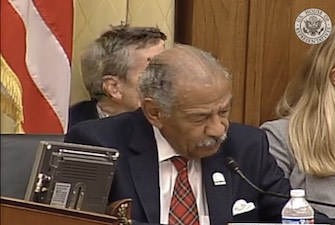
Congressman Conyers (D-MI).
Congressman Conyers (D-MI) spent the day arguing for pro-innovator improvements to the bill.
A manager’s amendment was proposed by Goodlatte which included language on stays of action against covered customers as well as venue restrictions. Other provisions of the manager’s amendment focused on joinder to ensure fee recovery, stay of discovery and prohibitions on double patenting. In a few areas of the bill, especially sections on stay of customer suits and attorney’s fees, the manager’s amendment changes the language of the Innovation Act to bring it closer into line with the Senate’s PATENT Act. The amendment found support among committee members including Congressman Darrell Issa (R-CA) and Congressman Jerrold Nadler (D-NY). Nadler in particular mentioned that the manager’s amendment addresses alleged abuses of the inter partes review system. Conyers, however, continued his opposition, citing among other concerns the fact that the IPR language in the amendment did not go far enough to address the parts of the process that are harming the biopharmaceutical industry.
A total of 19 amendments were read into the hearing’s proceedings, five of which were approved by a voice vote. One, offered by Congressman Thomas Marino (R-PA), wouldmandate a year-long joint study of discovery proceedings in patent litigation in order to find ways of curtailing abusive litigation. Discovery proceedings were also at the center of an approved amendment brought forward by Congressman Doug Collins (R-GA), which inserts language into the bill regarding a stay of discovery pending preliminary motions.
Various amendments that were either withdrawn or voted down indicated that many committee members feel that the Innovation Act still has a long way to go before it can be passed in the House. An Issa amendment would have extended covered business method review procedures six years past the program’s current 2020 sunset date. Multiple committee members were unsure why debate on extending a pilot program at the Patent Trial and Appeals Board was being debated five years before that program ends. Conyers was in favor of ending the CBM program, arguing that its scope has extended beyond what was intended by the America Invents Act, which established CBM.
A few of the proposed amendments were opposed based on the assertion that they represent legislative carve-outs which only benefit certain sectors of the economy; most of these assertions were made by Goodlatte. The topic of carveouts came up in response to an amendment offered by Congressman Hank Johnson (D-GA) regarding a shift in the burden of determining whether a suit was objectively reasonable to the prevailing party in cases of undue economic hardship to a non-prevailing party. A couple of withdrawn amendments, including one by Congressman Ted Deutch (D-FL) to amend the customer stay provision of H.R. 9 and another from Congresswoman Mimi Walters (R-CA) which would have restricted drug and biological product patents from IPR proceedings, were both contested by committee members on the same grounds. At a June 4th hearing of the U.S. Senate Committee on the Judiciary, a number of amendments to the PATENT Act were also decried as “carveouts” targeting specific industry groups, most vocally by Senator John Cornyn (R-TX).
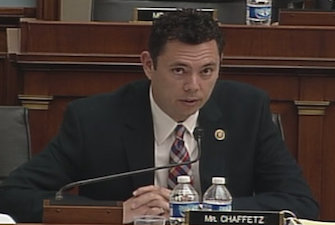
Congressman Jason Chaffetz (R-UT).
An amendment brought forth by Congressman Jason Chaffetz (R-UT) showed that there are still big interests at the table that are trying to shoehorn their views on patent reform into the Innovation Act. Chaffetz argued that his amendment would make retain the nature of both IPR and post-grant proceedings for patent review, both of which he felt were threatened by the recently introduced manager’s amendment. The amendment, however, would have struck the entirety of Section 9 of the bill, which includes a host of technical corrections to the Leahy-Smith America Invents Act. Both Conyers and Goodlatte opposed the amendment, Goodlatte specifically noting that the Chaffetz amendment would strike provisions that have been the result of years of discussions. Chaffetz cited support for his amendment from corporate stalwarts in the semiconductor and tech world, including Apple, Micron, Applied Materials and Dell. This statement seemed reminiscent of comment by Senator Sheldon Whitehouse (D-RI), again at the June 4th PATENT Act hearing, where he noted that whenever Congress attempts to handle an issue like abusive demand letters, larger industry players are very interested in having an outsized say in the patent reform debate.
Other amendments were withdrawn by committee members with assurances by committee chairman Goodlatte that more work would be done to refine the Innovation Act as it heads to the floor of the House. Congresswoman Zoe Lofgren (D-CA) withdrew an amendment on pleading requirements after Goodlatte said that he was “willing to entertain improvements to this provision of the bill.” Congresswoman Sheila Jackson Lee (D-TX) withdrew an amendment on reasonable specificity in claims, which she portrayed as a measure reducing costs for small businesses, but Goodlatte noted how this amendment stood in direct opposition to what other committee members are seeking in regards to claim structure. It seems fairly clear that consensus on what the Innovation Act is supposed to accomplish has not yet been reached among the members of the committee who approved it for debate on the House floor.
Many industry organizations representing a wide swath of stakeholders in the American patent system have also voiced their concerns about the potential effects of the Innovation Act if passed into law. A joint statement released June 10th by the Association of American Universities, the Association of Public & Land-Grant Universities, the Innovation Alliance, theMedical Device Manufacturers Association, the National Venture Capital Association and theAlliance of U.S. Startups and Inventors for Jobs expressed their opposition to the bill,representing a broad coalition of dissent from universities, inventors and business investors. In a separate statement published after judiciary committee approval of H.R. 9, the Innovation Alliance said that the day’s hearing “reinforced that the Innovation Act needs significant work before it should be allowed to move forward in the legislative process.” The group cited worries that overly broad provisions of the bill could increase the time and costs of litigation and make it more difficult to assert patent rights overseas.
Groups representing the software industry, however, continued their support of the Innovation Act. A press release distributed by the Software and Information Industry Association called the Innovation Act’s approval “an important step forward for patent reform and a positive sign that Congress can get patent litigation abuse legislation passed this year.” Software companies also supported the Innovation Act at a March 19th hearing on patent reform held by the U.S. Senate Committee on Small Business and Entrepreneurship, despite some vituperative remarks made about the proposed law by other members of that witness panel.
For more detailed analysis of certain aspects of the House Judiciary Committee hearing please see:

Monday, April 20, 2015

Peters, Conyers, Dingell Meet with Detroit Entrepreneurs at USPTO Patent and Innovation Forum

DETROIT, MI – On April 17, 2015, U.S. Senator Gary Peters (MI) and U.S. Reps. John Conyers (MI) and Debbie Dingell (MI) today met with local entrepreneurs and small business owners at a patent and innovation forum at the Elijah J. McCoy United States Patent and Trademark Office (USPTO) in Detroit. They were joined by Michelle Lee, Undersecretary of Commerce for Intellectual Property and USPTO Director, and A. Christal Sheppard, Director of the Elijah J. McCoy USPTO Office in Detroit.

During the forum, the participants highlighted the need to reduce the patent backlog at the USPTO and discussed ways to promote innovation and entrepreneurship across Michigan so that start-ups have access to resources they need to succeed. As of February 2015, the USPTO had a backlog of more than 600,000 patent applications with an average review time of more than two years before applications were granted patent protection.

U.S. Senator Gary Peters at
Detroit USPTO
“Southeast Michigan has more engineers per capita than anywhere else in the country, and I was glad to highlight innovation and entrepreneurship at the first USPTO satellite office outside of Washington, D.C.,” said Senator Peters.“Michigan has the innovative tradition, strong colleges and universities, and entrepreneurial spirit to become the startup capital of the Midwest, and we must do all we can to help ensure small businesses and inventors can develop their ideas and get them to market. I will continue focusing on ways to reduce the USPTO backlog so that innovation is not stifled and small businesses and startups have greater opportunities to succeed.”

Dean of the U.S. House of Representatives John Conyers (Right)
With Elijah McCoy (Grandson) and his wife at Detroit USPTO
“The opening of the Elijah J. McCoy United States Patent and Trademark Office in Detroit nearly three years ago sent a strong signal to businesses, innovators, and educators all over the Nation and the world that Detroit is a top notch technology destination,” said Rep. John Conyers, Jr. “The USPTO plays a critical role in the continued success of innovation in America.  Locally, the Detroit USPTO satellite office is bringing a much-needed jolt to the economy and serves as a hub for innovation and inspiration for entrepreneurs to come and stay here.  I look forward to continuing to work with the USPTO to ensure that this office becomes the model satellite office and the hub of innovation in the country.”
“Innovation has always been at the heart of the Michigan economy, and it will continue to form the backbone of our success,” said Rep. Debbie Dingell. “Our state is home to outstanding and innovative companies, one of the best and highly-educated workforces in the country, and world-class research universities that continue to train our future leaders and innovators. We have what it takes to lead the country in entrepreneurship and innovation, and today’s forum was an excellent opportunity to discuss the importance of protecting intellectual property.”

The historic USPTO satellite office in Detroit opened in 2012 and was the first satellite office opened outside of Washington, DC, highlighting Michigan’s strength as a hub for innovation and entrepreneurship. The Detroit USPTO works to increase outreach, improve retention and recruitment of patent examiners, decrease the patent application backlog and improve the quality of examination, while serving and assisting entrepreneurs across the region.


Voting is beautiful, be beautiful ~ vote.©

Thursday, April 16, 2015

Reps. John Conyers, Jr. and Debbie Dingell & Sen. Gary Peters to Meet with Detroit Entrepreneurs at USPTO Patent & Innovation Forum


DETROIT, MI –U.S. Reps. John Conyers (MI-13) and Debbie Dingell (MI-12) and U.S. Senator Gary Peters (D - MI) will meet with entrepreneurs and local small business owners at a patent and innovation forum TOMORROW, April 17th, at 4:00 PM at the Elijah J. McCoy United States Patent and Trademark Office (USPTO) in Detroit.  They will be joined by Michelle Lee, Undersecretary of Commerce for Intellectual Property and Director, USPTO, and A. Christal Sheppard, Director of the USPTO in Detroit.

WHAT:           Elected officials to meet with Detroit Entrepreneurs at USPTO Patent and Innovation Forum

WHO:             U.S. Senator Gary Peters (D-MI)
                        U.S. Representative John Conyers (MI-13)
                        U.S. Representative Debbie Dingell (MI- 12)
Michelle Lee, Undersecretary of Commerce for Intellectual Property and Director, USPTO
A.    Christal Sheppard, Director, USPTO in Detroit

WHEN:           TOMORROW, April 17, 2015  -  4:00 PM

WHERE:        The Stroh Atrium - Detroit USPTO Office
                        300 River Place, Detroit, MI (map)
Voting is beautiful, be beautiful ~ vote.©

Wednesday, March 25, 2015

House Judiciary Committee Ranking Member John Conyers, Jr. Opening Statement on Patent Reform

WASHINGTON - Today, during a House Judiciary Subcommittee on Courts, Intellectual Property, and the Internet hearing on “Patent Reform: Protecting American Innovators and Job Creators from Abusive Patent Litigation,” Ranking Member John Conyers, Jr. (D-MI) issued the following opening statement:

Dean of the U.S. House
of Representatives
John Conyers, Jr.
“Today’s hearing provides yet another opportunity to examine the issue of abusive patent litigation and why a targeted legislative approach is necessary.

“One of the first issues we must consider is how legislative proposals to stop abusive patent litigation can impact small businesses, the start-up ecosystem, and innovators. Small businesses and others who rely on patents require strong intellectual property protections. We must not weaken those rights.

“Our innovators – whether they create their inventions in their garages or basements or as a group in an incubation hub – recognize that their patents and the ability to protect them through enforcement in the courts is a critical factor in whether their businesses will be a success or a failure. Indeed, some angel investors and venture capitalists require ideas to be patented before investing.  But, they may very well be dissuaded from investing if there is a risk that a court will not uphold the validity of those patents or, at a minimum, there will be substantial litigation costs entailed.

“This means that fledgling entrepreneurs will never get off the ground and become a flourishing business employing thousands of Americans, such as Overstock, which is one of our witnesses today.

“Overly broad legislation could engender more rather than less litigation and weaken patent enforcement protections, thus discouraging investments in innovation.

“Instead, we should take a cautious approach and not push solutions – such as H.R. 9, the ‘Innovation Act’ – that may end up doing more harm than good to our start-up ecosystem. One way to stop abusive patent litigation is to address the problem of the extortionist use of demand letters.  So, I want the witnesses to discuss how we can curb the abusive problem of demand letters.

“Patent litigation opportunists exploit the patent process and patent litigation system.  In particular, they attack patents of weak quality in order to obtain quick settlements or to bleed the alleged infringers. Individual inventors and small businesses have to decide whether to risk incurring potentially overwhelming costs of litigation or enter into a settlement which could make them liable to attack by other abusive patent litigants.  We must find a way to stop this insidious problem that threatens the strong culture of innovation in our Nation.

“Finally, the Committee needs to conduct further hearings on the changing landscape affecting patents before we take any congressional action.

“While I applaud the Chair for holding a hearing last month on recent Supreme Court decisions in the patent arena, the Committee should also hold additional hearings on what actions other government stakeholders are taking in the patent arena.

“For instance, we should hear from Michelle Lee, the newly appointed Director of the United States Patent and Trademark Office to hear her views about how we should address abusive patent litigation. In addition, Director Lee could enlighten us about the conclusions from the Patent Quality Summit that her Office is hosting today and tomorrow. The Director could also update us on how her Office is implementing the America Invents Act.

“We should also hear an update from the Federal Trade Commission about its efforts to combat abusive patent litigation behavior.

“Further, the Judicial Conference could share its expertise at a hearing on the effectiveness of lower courts recently adopting model discovery orders or discovery guidelines that limit discovery in patent lawsuits.  The Conference could also inform us of the actions the Supreme Court is taking to eliminate Federal Rule of Civil Procedure Rule 84 and its Form 18, which will lead to the higher pleading requirements of Twombly and Iqbal. It could also update us on other proposed amendments to the Federal Rules of Civil Procedure aimed at achieving proportionality in discovery and promoting early and active judicial case management.

“These efforts may better address abusive patent litigation in a more targeted approach than the overly broad approach taken by the Innovation Act. Congress must respond to the problem of abusive patent litigation, but it should do so in a more balanced and effective approach that protects our Nation’s entrepreneurs and innovators.”
Voting is beautiful, be beautiful ~ vote.©

Friday, February 13, 2015

Senate, House Committee Leaders Push to Preserve IP Standards, Market Access for Products Around the Globe


In Letter, Bipartisan Leaders on Senate Finance, House Ways & Means, and Senate & House Judiciary Committees Call for Full Participation of WIPO Members In Negotiations to Amend Lisbon Agreement
WASHINGTON – Today, leaders on the international trade and judicial committees in the U.S. Senate and U.S. House of Representatives called on the Director General of the World Intellectual Property Organization (WIPO), Francis Gurry, to ensure all WIPO members have an equal voice in amending the Lisbon Agreement for the Protection of Appellations of Origin. The lawmakers want to ensure that any potential changes to the treaty preserve protections for users of common or generic names and for holders of established trademarks around the globe.
The Lisbon Agreement is a WIPO-administered treaty that allows parties to the agreement to simultaneously register Appellations of Origin with all parties to the agreement.  The proposed changes would substantially expand the scope of the Lisbon Agreement to allow for registration of Geographical Indications (GI’s) and could threaten market access for many common products, such as feta cheese, around the world.
Given that only 28 of the 188 WIPO members are parties to the Lisbon Agreement, lawmakers in Congress are concerned that departing from WIPO’s longstanding practice to allow this limited group of WIPO Members to amend the Agreement could result in unwanted changes that would ultimately harm workers and businesses in the United States and around the world.
“WIPO’s legitimacy as a global forum for the protection of intellectual property throughout the world could be called into question by departing from standard practice and allowing a limited group of WIPO Members to substantially amend the Lisbon Agreement in a way that harms market access and the intellectual property rights of stakeholders from other WIPO Members, including the United States,” wrote the lawmakers. “Such a step would be contrary to longstanding WIPO practice, which is to encourage broad participation because of the far-reaching effect of its decisions.  Therefore, we strongly urge you to do everything possible to ensure all WIPO Members have an equal voice in determining any revisions to the Lisbon Agreement.”

Signing the letter today were: Senate Finance Committee Chairman Orrin Hatch (R-Utah) and Ranking Member Ron Wyden (D-Ore.), Senate Judiciary Committee Chairman Chuck Grassley (R-Iowa) and Ranking Member Patrick Leahy (D-Vermont), House Ways and Means Committee Chairman Paul Ryan (R-Wis.) and Ranking Member Sander Levin (D-Mich.), and House Judiciary Committee Chairman Bob Goodlatte (R-Va.) and Ranking Member John Conyers, Jr. (D-Mich.)
The Senate Finance and House Ways & Means Committees have jurisdiction over international trade policy and the Senate and House Judiciary Committees have jurisdiction over intellectual property law and the U.S. Patent and Trademark Office. 
Voting is beautiful, be beautiful ~ vote.©

Thursday, November 21, 2013

Ranking Member Conyers Statement at Patent Markup

(WASHINGTON) – Today, the U.S. House Judiciary Committee held a full committee Markup of H.R. 3309, the “Innovation Act.” During his opening remarks, Ranking Member John Conyers, Jr. (D-Mich.) issued the following statement:

U.S. Representative
John Conyers, Jr.
“There are few economic issues our Committee or this Congress will face that are more important than our patent law system. Intellectual property is responsible for nearly half of our Nation’s gross domestic product and one third of all jobs in the U.S. economy.  Our patent system, while not perfect, is the envy of the world. As I have stated before, I believe the issues of non-practicing entities or so-called patent ‘trolls,’ present some unique problems that are worthy of congressional attention. There is a disconnect when shell corporations -- with little or no assets -- can systematically abuse the patent system. If we don’t know who these shell companies are, and – if they are able to unfairly threaten hundreds, if not thousands, of unsuspecting retailers –  we have a problem that requires a legislative solution. Unfortunately, the legislation before us overreacts to these issues and it would severely undermine the role of our federal judiciary in general and innovation in particular. 

“I have been working my entire career to help foster an independent judiciary that can resolve disputes between parties on a fair and dispassionate basis based on an evenhanded set of rules. As a matter of fact, that is exactly what is happening now. The federal circuit and the Supreme Court are in the midst of altering the rules for patent fee shifting, discovery, and pleadings, among other things. There is little doubt that the federal judiciary – as evidenced by its exceedingly deliberative rulemaking process – is in a far better position than 535 Members of Congress to set the proper rules for their own court rooms on these matters.

“Furthermore, by unbalancing the patent system we send a signal to inventors –  the very people doing the research and developing the cures that we benefit from every day – that their inventions are not worthy of full legal protection. This means that the next cure for cancer or technological break though may be stymied and never come, or may be developed abroad rather than in the U.S.

“And, by limiting the Committee to a single legislative hearing, by skipping subcommittee and moving to markup prematurely, we make it all the more difficult for Members and stakeholders to provide meaningful input into the process.

“There is a broad range of patent experts and stakeholders who agree with me, and have expressed significant concern if not outright opposition to the bill before us, including the:


                      Federal Judicial Conference,
                      the American Bar Association,
                      the American Intellectual Property Law Association,
                      the Patent Officers Professional Association,
                      the American Association of Universities,
                      the Biotechnology Industry Association,
                      the Twenty-First Century Patent Coalition,
                      the Innovation Alliance,
                      the American Association for Justice,
                      the Pharmaceutical Research and Manufacturers Association,
                      the Institute of Electrical and Electronics Engineers,
                      the National Association of Patent Practitioners, and
                      the National Bankruptcy Conference.

“Because I feel so strongly that Congress must get this issue right, Ranking Subcommittee Member Watt and I will offer a substitute that responds to the real and identifiable problems of patent abuse without upsetting the entire patent law system. Our substitute will also take the single most viable step we can take towards improving patent quality – ending fee diversion so that poor quality patents are not issued to begin with. 

“I am willing to roll up my sleeves and work with all of the Members of this Committee in developing a fair, reasonable and measured approach to patent reform. This Committee has a long history of cooperation between the Chair and Ranking Member on intellectual property matters.  And while in my judgment that cooperation has been lacking thus far, I am hopeful we can work together to improve the legislation so that it can pass the House and Senate and be signed into law.”

Voting is beautiful, be beautiful ~ vote.©

Wednesday, November 20, 2013

Conyers & Watt: Goodlatte’s Manager’s Amendment Will Harm the Patent System

House Judiciary Ranking Members Support Senate Judiciary Chairman Leahy’s Nuanced Approach to Addressing Patent Abuse

(WASHINGTON) – Today, U.S. House Judiciary Chairman Bob Goodlatte announced the Markup of H.R. 3309, the “Innovation Act,” this Wednesday, November 20th. In announcing the Markup, Chairman Goodlatte released a Manager’s Amendment making changes to H.R. 3309. In addition, this afternoon Senate Judiciary Chairman Patrick Leahy (D-Vt.) and Senator Mike Lee (R-Utah) introduced the “Patent Transparency and Improvements Act of 2013” to curb patent abuse, without infringing the independence of the federal judiciary and harming small inventors. In response to these developments, U.S. House Judiciary Committee Ranking Member John Conyers, Jr. (D-Mich.) and Congressman Melvin L. Watt (D-N.C.), Ranking Member of the Subcommittee on Courts, Intellectual Property, and the Internet issued the following statement:

U.S. Representative
John Conyers, Jr.
“While Chairman Goodlatte’s Manager’s Amendment made some improvements to H.R. 3309, the ‘Innovation Act,’ as currently drafted we continue to oppose this legislation that would make sweeping and unnecessary changes to patent litigation and encroach on the independence of the federal judiciary.  While we support measured and balanced changes to respond to the most egregious practices involving patents, we do not believe that this legislation should become a vehicle to pass far ranging changes to the litigation system, such as limits on pleadings and discovery, and intrusive mandates on the court system.  At the same time, we applaud Chairman Leahy and Senator Lee for their introduction of the Patent Transparency and Improvements Act which based on our initial review appears to offer a more balanced and targeted approach to the abusive tactics of some patent litigants.”
Voting is beautiful, be beautiful ~ vote.©

Tuesday, October 29, 2013

Ranking Member Conyers Opening Statement at Full Committee Patent Reform Hearing


(WASHINGTON) – Today, the U.S. House Judiciary Committee held a full committee hearing on, “H.R. 3309: Improving the Patent System to Promote American Innovation and Competitiveness.” This hearing comes on the heels of the introduction of H.R. 3349, the “Innovation Protection Act,” by Ranking Member John Conyers, Jr. (D-Mich.), Congressman Melvin L. Watt (D-N.C.), Ranking Member of the Subcommittee on Courts, Intellectual Property and the Internet, and Congressman Doug Collins (R-Ga.) This legislation ends future diversion of Patent and Trademark Office (PTO) fees, allowing the PTO to employ all of the user fees it receives. During his opening remarks, Rep. Conyers delivered the following statement:

U.S. Representative
John Conyers, Jr.
“There are few economic issues our Committee or this Congress will face that are more important than whether and how to reform our patent laws.  Intellectual property – principally patents – are responsible for nearly one third of all jobs in the U.S. economy.  Our patent system, while not perfect, is the envy of the world and perhaps the most significant driver of growth in our economy. 

“As we consider patent legislation, I would like to offer three points for consideration.  First, I believe the issues of non- practicing entities or so-called patent ‘trolls’ present some unique problems that are worthy of congressional attention.  There is a disconnect when shell corporations -- with little or no assets -- can threaten thousands of small end users with ill-conceived patent litigation over ordinary business practices.  If we don’t know who these shell companies are; if the shell companies have no operating businesses or assets; and if they are given free license to engage in endless and costly discovery, we have a problem that requires legislation.

“But at the same time, we need to be careful in addressing these problems.  Our first rule should be to make sure we do no harm to our patent system or take any actions which unintentionally discourage innovation or increase litigation.  As the former Director of the Patent and Trademark Office David Kappos reminds us, ‘we are not just tinkering with any system here; we are reworking the greatest innovation engine the world has ever known, almost instantly after it has been significantly overhauled.  If there were ever a case where caution is called for, this is it.’

“In this regard, I don’t see any reason we should be considering amending the fee shifting statute when the Supreme Court has just agreed to take up this very issue.  Similarly, I see no rush to expand the use of ‘business method patents’ when the PTO and the courts are just now beginning to review cases brought under the law we just passed.

“Second, any changes we make must be carefully balanced and consistent with our principles and constitutional imperatives.   For 80 years we have asked our federal judges – the experts on litigation – to develop rules for their own court rooms.  That system has worked well and I see no reason to abrogate the principle of separation of powers now.

“And if we are going to consider crafting new rules on discovery, stays, and joinder, we should insist that the rules work the same for all parties – plaintiffs and defendants. Nor should we be crafting a series of special carve outs from the legislation for the pharmaceutical industry.  The last thing we need to do is create two systems of patent law – one for pharmaceuticals and one for everybody else.

“Third, we cannot lose sight of the single most important problem facing our patent system today – the continuing diversion of patent fees.   The most effective step we can take in responding to abusive patent litigation is making sure poor quality patents are not issued to begin with.  To do that we need to give our examiners the resources they need to review and analyze the hundreds of thousands of complex and interrelated patent applications they receive every year.   That is why yesterday, I along with Representatives Watt, Issa and Collins, introduced bipartisan legislation – the Innovation Protection Act – which does exactly that on a permanent, statutory basis.  This will apply regardless of the sequester or any future shut downs. 

“I stand ready, able and willing to work with members on both sides of aisle in tackling these problems.  But I would urge the Chairman to move cautiously, carefully and deliberately.”
Voting is beautiful, be beautiful ~ vote.©

Saturday, October 1, 2011

Detroit to get first U.S. patent satellite office

Detroit to get first U.S. patent satellite office


The first satellite office of the United States Patent and Trademark Office is set to open in Detroit in early spring 2011, opening up jobs for 100 patent examiners plus support staff.
U.S. Commerce Secretary Gary Locke made the announcement today in a conference call. He was joined by Gov. Jennifer Granholm and David Kappos, Commerce’s undersecretary for intellectual property and director of the patent office.
The office will monitor the results of the Detroit office in preparation for more regional offices around the country.
“Perhaps two more will open within a year after Detroit,” Locke said.
The decision on the location has not been made, Kappos said. The Patent Office is planning to sign an occupancy agreement this month, with a lease to follow in February. Job offers would start going out soon after that in preparation for an early spring or possibly late winter opening, he said.
The new office and the hiring of 100 examiners will give patent applicants more time to meet for examiner interviews and in turn speed up the patent approval process.
The Patent Office currently has about 710,000 patent applications in its backlog, Kappos said. That’s down from 750,000 at the beginning of the year, amid an increased number of applications, but that’s still not close to being good enough, Locke said.
The goal is to reduce average patent waiting times from three years to one.
Calling the three-year wait time “unacceptable,” Locke compared it to asking a bank for a loan to expand a factory that the applicant won’t have the title to for another three years.
Locke first mentioned the possibility of Detroit getting a patent office in October during a visit to the Detroit Regional Chamber.
The move to set up regional patent offices is also intended to improve recruitment and retention of the patent examiners, who decide which applications get approved. Recruitment is challenging because examiners must possess advanced technical knowledge, a quality that makes them employable elsewhere.
Setting up regional offices will allow the main patent office to no longer ask qualified candidates to move to the Washington, D.C., area.
It also would give the office access to pockets of specialized skilled workers. That’s where Detroit comes in. The region’s abundance of advanced — and unemployed — engineers makes it a perfect fit for the pilot satellite office, Locke, Kappos and Granholm all said.
The Department of Commerce also chose Michigan to set up its first CommerceConnect office. The one-stop access point to all of the department's services for businesses opened in October 2009, and more offices are planned in other regions of the country.
The Pontiac office was a factor in choosing the Detroit area, as was low building costs, access to local research universities and a high number of patent applications coming out of Michigan.
“This city fulfills a number of critical criteria,” Kappos said.
Granholm said the University of Michigan “pushed to have this office come here.”
The presence of schools such as UM and Wayne State University brings diversity to the local technology, said James Stevens, president of the Michigan Intellectual Property Law Association and managing shareholder at Reising Ethington P.C. in Troy.
“Any area has a flavor to its technology,” Stevens said.
He said the hiring of 100 examiners is a serious number. Unlike in past downturns when automotive engineers tended to be untouched, the recent recession has brought layoffs to their doorsteps, as well, he said.
“A lot of them are still in town looking for work,” Stevens said.

Bill signing revives plans for Detroit patent office

Bill signing revives plans for Detroit patent office

Congress passed the "America Invents Act." President Obama signed it into law today. The Act could lead to a satellite patent office in Detroit.
user wallyg / Flickr
Patent legislation that had a big push from Michigan’s research universities and the Detroit automakers has been signed into law.
The “America Invents Act” promises to speed up the patent process, and help reduce a backlog of some 700,000 patent applications in Washington D.C.
Part of that includes opening a satellite patent office in Detroit and two other locations.  
"It really puts the patent office in one of the invention centers of the nation, which is the Detroit area," said Steve Forrest, vice president for research at the University of Michigan.
Research schools like U of M say the changes will help them get ideas from academia to the marketplace more quickly.
"The delays have caused some uncertainty in the system. And uncertainty is bad for us because what we’re looking for is either existing companies or new start-ups to open new lines of business or entirely new businesses – so they’re looking for funding, for example, and management," said Rick Brandon, a patent attorney with the University of Michigan.
Brandon says he expects the new law will mean quicker turnaround on patent decisions so people know whether to put time, money and effort into developing new products.
Some independent inventors have complained that the changes favor large institutions and could put them at a disadvantage.
To hear an earlier story about the U.S. Patent Office's plans (later postponed) to open a Detroit patent office, click here.
DESIGNATION.—The satellite office of the United States Patent and Trademark Office to be located in Detroit, Michigan, shall be known and designated as the ‘‘Elijah J. McCoy United States Patent and Trademark Office’’.
The Detroit Free Press reports that U.S. Senator Debbie Stabenow (D-Michigan) added the provision to name a future Detroit patent office after McCoy:
Elijah J. McCoy [was] an African-American inventor born in Canada and raised in Ypsilanti. After studying as an engineer in Scotland, McCoy, a son of former slaves, got a job as a fireman for the Michigan Central Railroad and patented several inventions, including a cup that continuously fed oil to bearings in steam engines.
Some claim his process was deemed “the real McCoy,” compared to imitators, though there are other claimants to originating the phrase. By McCoy’s death in 1929, he had secured more than 50 patents.
The legislation calls on the Director of the U.S. Patent and Trademark Office to open the satellite offices within three years "subject to available resources."
The Detroit Free Press reports the satellite office would be paid for by patent fees.
CNET reports on the big changes to the patent process as a result the America Invents Act:
Among the major changes in the legislation is turning the U.S. patent system into a first-to-file patent system as opposed to a first-to-invent system. The U.S. Patent and Trademark Office's current use of the first-to-invent system awards a patent based on the conception of the invention, not necessarily when it's filed. The first-to-file system, as the name suggests, awards a patent to the first person who files for it.