Voting is beautiful, be beautiful ~ vote.©

Showing posts with label intelligence. Show all posts
Showing posts with label intelligence. Show all posts
Friday, December 8, 2017

Thursday, December 7, 2017
Day 47.4. John Wilkes Phone Booth - Simple Daily Bag Drop Interrupted By DHS Hack Flight?
DOJ failed to interview FBI informant before it filed charges in Russian nuclear bribery case
While he was Maryland’s chief federal prosecutor, Deputy Attorney General Rod Rosenstein’s office failed to interview the undercover informant in the FBI’s Russian nuclear bribery case before it filed criminal charges in the case in 2014, officials told The Hill.
And the prosecutors did not let a grand jury hear from the paid informant before it handed up an indictment portraying him as a “victim” of the Russian corruption scheme or fully review his extensive trove of documents until months later, the officials confirmed.
The decisions backfired after prosecutors conducted more extensive debriefings of William Campbell in 2015, learning much more about the extent of his undercover activities and the transactions he engaged in while under the FBI’s direction, the officials said.
The debriefings forced prosecutors to recast their entire criminal case against former Russian uranium industry executive Vadim Mikerinn — removing the informant as a star witness and main victim for the prosecution, the officials added.
Justice Department officials began briefing Congress last week, divulging missteps in a case that nonetheless proved the Russian state-owned Rosatom was engaged in criminal activity through its top American executive beginning in 2009, well before the Obama administration made a series of favorable decisions benefitting Moscow’s nuclear giant.
Multiple House and Senate committees already are investigating whether the FBI alerted President Obama or his top aides to the Russian criminal activity and plan to interview the undercover informant soon.
The new revelations, however, could tip some scrutiny toward federal prosecutors’ own conduct in the case, a sensitive topic since Rosenstein is now Justice’s No. 2 official and the supervisor of the special counsel investigation into Russian election tampering.
Harvard law professor Alan Dershowitz said it was troubling that prosecutors would ever bring a case without talking first to a person they portrayed in court as a victim, especially when that person was an FBI informant available to them.
“I’ve never heard of such a case unless the victim is dead. I’ve never heard of prosecutors making a major case and not talking to the victim before you made it, especially when he was available to them through the FBI,” Dershowitz said.
“It is negligence, and I’m sure there will be internal issues with the Justice Department and U.S. attorney for making such an obvious mistake,” he said.
Officials told The Hill that prosecutors working for Rosenstein first interviewed Campbell, the informant, after they had already filed a sealed criminal complaint against Mikerin in July 2014.
Campbell got one debriefing after the criminal charges were filed, but was never brought before the grand jury that indicted the Russian figure in November 2014 even though the informer was portrayed as “Victim One” in that indictment, the officials confirmed
When prosecutors finally interviewed Campbell more extensively in early 2015 and reviewed all of the records he had gathered for the FBI, they learned new information about the sequence of transactions he conducted while under the FBI’s supervision, as well as the extensive nature of his counterintelligence work for the U.S. government that went far beyond the Mikerin case and dated to at least 2006, the officials said.
“Based on what was learned, we decided to change the theory of the case. … A plea deal became our goal so we wouldn’t have to litigate or make an issue of some of the stuff he had done for [counterintelligence] purposes,” a source directly familiar with the case said.
Campbell’s lawyer, Victoria Toensing, confirmed the Justice officials’ account. “The first time Mr. Campbell was interviewed by the U.S. Attorney’s office was after the criminal complaint was filed, and he was never brought before the grand jury before the indictment,” she told The Hill.
Justice officials said they knew when they first brought the case that Campbell had been part of a controlled, FBI-authorized bribery scheme, meaning he had permission to make payments to the Russians as kickbacks to further the investigation.
They declined to say why, with that knowledge, they initially portrayed Campbell in the indictment as a “victim” of an extortion scheme that began in November 2009 when the FBI had authorized him to make regular kickback payments of $50,000 in order to keep his consulting work for the Russians.
They said, however, they decided to pivot the case from extortion to money laundering after the more extensive 2015 debriefings revealed other transactions that pre-dated the extortion charges.
One source familiar with the case said extortion felt like a weaker charge when Campbell was acting with the FBI’s blessing and that the evidence of money laundering that Campbell documented through secret accounts in Latvia and Cyprus was irrefutable.
Campbell, who now has leukemia, also suffered an earlier bout with cancer in the middle of the case when a lesion was detected on his brain. He survived, all the while working undercover, but he developed some memory issues after treatment, sources said.
To compensate, he developed a system of extensive note taking and documentation with his FBI handlers through email to ensure facts were captured before his memory became hazy. A lot of those notes did not get reviewed by prosecutors until 2015, well after charges were filed, the sources said.
The documentation shows Campbell’s work had exposed wide-ranging details about Russia’s nuclear activities across the globe, including efforts to corner the global uranium market, assist Iranian nuclear ambitions and to criminally compromise a U.S. trucking firm that transported Russia’s nuclear fuel, they said.
Officials said the investigation and Campbell’s work from 2006 to 2013 fell under the FBI’s counterintelligence arm and Justice’s national security division, and officials originally did not intend for it to become a criminal case.
Justice officials originally hoped they simply could use the threat of criminal prosecution to “flip” Mikerin as a cooperating asset, but their confrontation with him at an office building in 2014 failed to persuade him to cooperate, sources said.
Prosecutors in the U.S. attorney’s office in Maryland then assembled charges and an indictment, using mostly information from the FBI’s counterintelligence files and interviews of Campbell done by an Energy Department investigative agent, officials said
Mikerin was an icon in the Russian nuclear industry, a top executive of the state-controlled Rosatom firm and its Tenex subsidiary and the man Moscow sent to Washington in 2010 to oversee Russian President Vladimir Putin’s plan to grow uranium sales inside the United States under the Obama administration.
The November 2014 indictment, bearing Rosenstein’s name, charged Mikerin with felony conspiracy to interfere with interstate commerce through extortion.
Court documents alleged Mikerin was part of a larger racketeering scheme that also involved bribery, kickbacks and money laundering and that he demanded $50,000 in regular kickbacks from Campbell starting in November 2009 in order for Campbell to keep his consulting work for the Russians.
The court documents portrayed Campbell alternatively as “Victim One” or “Confidential Witness 1” who came forward to report Mikerin’s wrongdoing and cooperate with the FBI.
In fact, Campbell had been under the FBI’s control informing on the Russian nuclear industry since 2006, had signed a formal nondisclosure agreement with the FBI in 2008 and eventually was rewarded in 2016 with a $51,000 check for his extensive counterintelligence work.
Mikerin eventually pleaded guilty to a money laundering conspiracy charge and was sentenced in December 2015 to 48 months in prison.
A month later, the FBI paid Campbell compensation of more than $51,000, a transaction prosecutors did not learn about until The Hill published a copy of the check last month, officials said.
Congress is now investigating the entire Russian nuclear bribery case after The Hill disclosed Campbell’s work, with multiple committees demanding to know whether the FBI told the Obama administration about Mikerin’s criminality before the administration made favorable decisions that rewarded Rosatom with billions of dollars in new American nuclear fuel contracts.
Justice officials began briefing congressional officials this week, starting with the Senate Judiciary Committee. After the briefings end, congressional investigators plan to interview Campbell.
After Campbell’s name and work surfaced, anonymous allegations surfaced in stories by Yahoo and Reuters suggesting the Justice Department had grave reservations about Campbell’s credibility, in part because he had three misdemeanor alcohol arrests.
But officials told The Hill those leaks were not authorized by the Justice Department and did not reflect accurately the official thinking of the department.
For instance, they said prosecutors had no concerns about Campbell’s three misdemeanor alcohol arrests and that the FBI held the informant in enough esteem to pay him the check after the case ended. And after prosecutors completed three debriefings with Campbell, they approved the payment in 2015 of the last of his expenses as an undercover.
Prosecutors’ concerns primarily dealt with the sequence of events and transactions surrounding Campbell’s undercover work during the counterintelligence part of the probe before criminal prosecutors got involved, officials said.
Saturday, October 7, 2017
CONYERS, GOODLATTE and Judiciary Committee Members Introduce the USA Liberty Act

Washington, D.C. – House Judiciary Committee Ranking Member John Conyers, Jr. (D-Mich.)Ranking Member John Conyers, Jr. (D-Mich.), Chairman Bob Goodlatte (R-Va.), Crime, Terrorism, Homeland Security, and Investigations Subcommittee Chairman Jim Sensenbrenner (R-Wis.), Crime, Terrorism, Homeland Security, and Investigations Subcommittee Ranking Member Sheila Jackson Lee (D-Texas), and Courts, Intellectual Property and the Internet Subcommittee Ranking Member Jerrold Nadler (D-N.Y.) today introduced the USA Liberty Act (H.R. 3989). This bipartisan bill reforms and reauthorizes Section 702 of the Foreign Intelligence Surveillance Act (FISA), which is set to expire at the end of this year, to protect both national security and Americans’ civil liberties.
The USA Liberty Act preserves the core purpose of Section 702: the collection of communications by targeting non-U.S. persons located outside the U.S. in order to identify and thwart terrorist plots against our nation and our citizens. The bill also creates a new framework of protections and transparency requirements to ensure that the government’s use of Section 702 accords with principles enshrined in our Constitution that protect individual liberty. It provides new accountability measures to address the unmasking of U.S. persons’ identities and new reporting requirements on the number of U.S. persons who have been swept up in Section 702 collection. The bill also enhances national security by increasing penalties for those who leak classified information and calling on the intelligence agencies to share information with each other and with our allies to combat terrorism.
Below are statements from Judiciary Committee leaders on the introduction of the USA Liberty Act.
Ranking Member Conyers: “Section 702 of the Foreign Intelligence Surveillance Act is essential to the intelligence community’s gathering of foreign intelligence and detecting threats to the homeland. Its reauthorization should include reforms that bring this authority better in line with our sense of privacy and due process. Indeed, we believe that it will only be possible to reauthorize Section 702 with such reforms in place. The bipartisan USA Liberty Act is designed to accomplish this goal.”
Ranking Member Conyers: “Section 702 of the Foreign Intelligence Surveillance Act is essential to the intelligence community’s gathering of foreign intelligence and detecting threats to the homeland. Its reauthorization should include reforms that bring this authority better in line with our sense of privacy and due process. Indeed, we believe that it will only be possible to reauthorize Section 702 with such reforms in place. The bipartisan USA Liberty Act is designed to accomplish this goal.”
Chairman Goodlatte: “The USA Liberty Act protects Americans’ lives and their civil liberties. This bipartisan bill reauthorizes a critical national security tool that keeps Americans safe but also reforms it to protect Americans’ constitutional rights. It contains more accountability, transparency, and oversight so that the American people have confidence that our cherished liberties continue to be protected as the intelligence community keeps us safe from foreign enemies wishing to harm our nation and citizens. The bill also contains a number of measures to further enhance national security so that our country remains free and safe. I thank the many members who have worked on this bill for months and look forward to bringing it up in the House Judiciary Committee soon.”
Crime Subcommittee Chairman Sensenbrenner: “The USA Liberty Act is carefully crafted, bipartisan legislation that represents the type of common sense compromise that we desperately need in this country. It balances privacy and security concerns by requiring greater oversight, transparency, and accountability of the government’s surveillance powers while limiting the incidental collection of Americans’ communications and requiring a court order to query data. It also puts in place a critical six-year sunset provision, allowing Congress to respond appropriately to the ever-changing threats facing our nation. This is smart, forward-leaning legislation that I urge my colleagues to get behind.”
Crime Subcommittee Ranking Member Jackson Lee: “Collectively, what Democrats and Republicans have agreed on is a strategy that secures the homeland, while preserving cherished liberties that still make America the envy of the world.”
IP Subcommittee Ranking Member Nadler: “The USA Liberty Act is an attempt to strike the appropriate balance, as we did in the USA Freedom Act, of giving our intelligence agencies the tools they need to keep us safe while making sure individual liberty and privacy rights are better protected. For the first time, the bill institutes a requirement for a warrant—based on probable cause—for criminal investigators to query the information obtained by the 702 program. In addition, this legislation significantly curbs the amount of incidental information that can be searched, and, most importantly, institutes critical operational norms for the 702 program that make it more accountable, more transparent, and ultimately more effective in striking the critical balance between national security needs and the individual’s constitutional rights. I want to thank Chairman Goodlatte and Ranking Member Conyers for working in good faith on the USA Liberty Act, which goes a long way in reforming government surveillance under Section 702.”
Additional original cosponsors of the bill include Representatives Lamar Smith (R-Texas), Steve Chabot (R-Ohio), Doug Collins (R-Ga.), Mike Johnson (R-La.), John Rutherford (R-Fla.) Hank Johnson (D-Ga.), Ted Deutch (D-Fla.), and Jamie Raskin (D-Md.).
Background: FISA Section 702, which will expire on December 31, 2017, authorizes surveillance of the communications of non-U.S. persons located outside of the United States in order to protect national security. It reportedly contributes to a quarter of all National Security Agency surveillance and has been used on multiple occasions to detect and prevent horrific terrorist plots against our country. Although Congress designed this authority to target non-U.S. persons located outside of the United States, it is clear that Section 702 surveillance programs can and do incidentally collect information about U.S. persons when U.S. persons communicate with the foreign targets of Section 702 surveillance.
House Judiciary Summary of USA Liberty Act To Reform and Reauthorize Section FISA Section 702 by Beverly Tran on Scribd
House Introduced USA Liberty Act Bill Text by Beverly Tran on Scribd
Voting is beautiful, be beautiful ~ vote.©
Tuesday, June 27, 2017
CONYERS & GOODLATTE Renew Call For Surveillance Data And Information On Methodology
Washington, D.C. – House Judiciary Ranking Member John Conyers, Jr. (D-Mich.) and Committee Chairman Bob Goodlatte (R-Va.) today sent a letter to Director of National Intelligence Dan Coats to renew their call for the number of U.S. persons included in Section 702 collections. The members also called for statistics on the methodologies used in developing the project as well as information on the resources that would need to be diverted in order to complete the project.
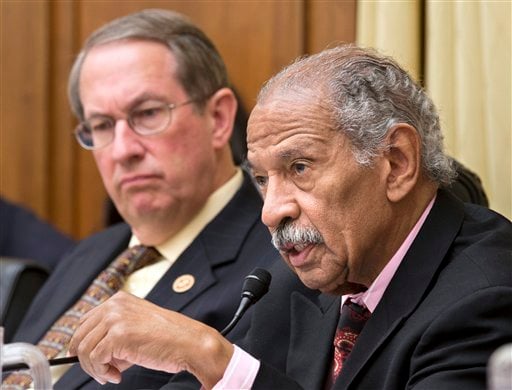 On April 7, 2017, Ranking Member Conyers and Chairman Goodlatte wrote to Director Coats to request a public estimate of the number of communications involving U.S. persons incidentally swept up under FISA Section 702. On June 7, 2017, in testimony before the Senate, Director Coats stated that the production of that estimate would be “infeasible.”
FISA Section 702, which targets the communications of non-U.S. persons outside of the United States in order to protect national security, reportedly contributes to more than a quarter of all National Security Agency surveillance and has been used on multiple occasions to detect and prevent horrific terrorist plots against our country. Although Congress designed this authority to target non-U.S. persons located outside of the United States, it is clear that Section 702 surveillance programs can and do incidentally collect information about U.S. persons when U.S. persons communicate with the foreign targets of Section 702 surveillance.
Voting is beautiful, be beautiful ~ vote.©
Wednesday, June 7, 2017
CONYERS To Intelligence Community: "Breaking Your Promise On Section 702 Is Unacceptanle
Washington, D.C. - In April and December of last year, a bipartisan group from the House Judiciary Committee wrote to the Office of the Director of National Intelligence to ask for “a public estimate of the number of communications or transactions involving United States persons that may be captured by Section 702 surveillance on an annual basis.” On April 7, 2017, Chairman Bob Goodlatte (R-VA) and Ranking Member John Conyers, Jr., wrote to Director of National Intelligence Dan Coats to renew that request.
Today, in testimony before the Senate, Director Coats reversed the position of the intelligence community and announced that the production of that estimate would be “infeasible.”
House Judiciary Committee Ranking Member Conyers issued the following statement in response:
 |
| Dean of the U.S. House of Representatives John Conyers, Jr. |
“Today, Director Coats announced that the estimate is ‘infeasible’ and will not be forthcoming. I find that outcome unacceptable.
“Over the course of the last year, we believed we had worked past the excuses we are offered today. The nation’s leading civil liberties organizations see no threat to privacy in this project, and have said so publicly. The agencies demonstrated to us how they might perform this analysis without significant diversion of resources. I am deeply disappointed in a return to these old talking points.
“Section 702 is built on trust. It will be more difficult to find that trust as we move forward with the debate.”
Voting is beautiful, be beautiful ~ vote.©
Friday, April 7, 2017
CONYERS & GOODLATTE Seek Answers On Americans Swept Up Under Foreign Intelligence Programs
Washington, D.C. – House Judiciary Committee Ranking Member John Conyers (D-Mich.) and Chairman Bob Goodlatte (R-Va.) today requested that the Office of the Director of National Intelligence provide a public estimate of the number of communications involving U.S. persons incidentally swept up under FISA Section 702.FISA Section 702, which targets the communications of non-U.S. persons outside of the United States in order to protect national security, reportedly contributes to more than a quarter of all National Security Agency surveillance and has been used on multiple occasions to detect and prevent horrific terrorist plots against our country. Although Congress designed this authority to target non-U.S. persons located outside of the United States, it is clear that Section 702 surveillance programs can and do incidentally collect information about U.S. persons when U.S. persons communicate with the foreign targets of Section 702 surveillance.
In their letter to Director of National Intelligence Dan Coats, Goodlatte and Conyers state it is crucial that members of the House Judiciary Committee understand the impact of Section 702 on U.S. persons as the Committee proceeds with the debate regarding the reauthorization of this surveillance authority. They request that Director Coats provide a public estimate of the number of communications involving U.S. persons subject to Section 702 surveillance as soon as possible in order to inform public debate on the law.
Subscribe to:
Posts (Atom)