Showing posts with label Al Fraken. Show all posts

Friday, March 3, 2017

CONYERS: We need an Independent, Non-Partisan Commission To Investigate Trump and Russia Ties

 
Dean of the U.S. House
of Representatives
John Conyers, Jr.
Attorney General Jeff Sessions announced that he would recuse himself from Trump Campaign related investigations. However, his recusal should not be limited to only investigations involving the Trump Campaign. Under 28 CFR § 45.2, the Attorney General is required to recuse himself from a criminal investigation when he has a “personal or political relationship with any person or organization substantially involved in the conduct that is the subject of the investigation or prosecution,” and must also recuse himself from any investigation where his participation would “create an appearance of a conflict of interest likely to affect the public perception of the integrity of the investigation or prosecution.”

Serious allegations of misconduct involving President Trump and his associates occurred subsequent to the presidential election—including but not limited to communications between General Flynn and the Russian government, potentially improper contact between White House aides and officials within the Justice Department, and misstatements by the Attorney General himself.

Just as importantly, we need to ensure that any investigation involving issues which overlap between the campaign and the Administration are fully and fairly investigated, including what influence the Russian government, Russian intelligence and Russian financial interests may have with regard to Mr. Trump and his Administration, and whether there have been any efforts to cover-up the same.

As such, the Attorney General must recuse himself from any and all investigations involving the campaign, the transition, and the Trump Administration. He must obviously step aside from any investigation in which he himself may be a target.

I am not persuaded by the Attorney General’s effort to explain his misstatements to the Senate Judiciary Committee, in response to questions asked verbally by Senator Franken and in writing by Senator Leahy, and it is not at all clear that an after-the-fact clarification to the Committee will resolve this matter. As every Democrat on the House Judiciary Committee wrote, the question of whether or not the Attorney General’s statement constitutes perjury should be reviewed by the FBI and the U.S. Attorney for the District of Columbia.

I am troubled by President Trump’s statement that he does not think Attorney General Sessions should recuse himself from any Russia-related investigations. It was wholly inappropriate for the President to discourage the Attorney General or anyone else from recusing themselves from any ongoing criminal investigation—let alone an investigation in which he and members of his Administration are potential suspects. Such statements fly in the face of applicable DOJ guidelines. They also smack of an attempted cover-up.

These events and statements also make abundantly clear, as I and many other Members of Congress have stated previously, that we need an independent, non-partisan commission to review the entire matter.


Voting is beautiful, be beautiful ~ vote.©

Thursday, November 17, 2016

Bipartisan, bicameral bill would delay changes to government hacking powers

File:Seal of the United States Congress.svg

Proposed Amendments to Rule 41 of the Federal Rules of Criminal Procedure would expand the government’s ability to search Americans’ computers and other digital devices
WASHINGTON – U.S. Senators Chris Coons (D-Del.), Steve Daines (R-Mont.), Mike Lee (R-Utah), Ron Wyden (D-Ore.), and Al Franken (D-Minn.), together with Reps. John Conyers, Jr. (D-Mich.) and Ted Poe (R-Texas), introduced legislation to provide Congress the time necessary to seriously consider and debate the proposed changes to Rule 41 that would expand the government's ability to search computers and other digital devices. The Review the Rule Actwould delay the proposed changes to Federal Rule of Criminal Procedure 41 from going into force until July 1, 2017. Without congressional action, the proposed changes will go into effect on December 1, 2016.

Federal Rule of Criminal Procedure 41 governs the procedures and parameters for issuing search warrants.  Under current law, a federal judge may issue a warrant to search property located within a specific judicial district.  At the urging of the Department of Justice, the Supreme Court ultimately approved two sweeping amendments to Rule 41:

1.       A judge may issue a warrant to remotely search, copy, and seize information from a device that does not have a known location (and may not be in the district) because the location has been concealed through technological means; and
2.       A single judge may issue a warrant to remotely search and copy information from suspected devices across five or more districts.
Dean of the U.S. House
of Representatives
John Conyers, Jr.
“I remain deeply concerned about the intended and unintended consequences of the expanded authorities contemplated in the proposed changes to Rule 41,” said John Conyers, Jr. (D-MI), House Judiciary Committee Ranking Member. “The bill we offer today will delay implementation until Congress has had a meaningful opportunity to examine the proposal in detail.  Until we have adequately addressed the privacy concerns raised by my colleagues, this rule change should not take effect.”     

“The proposed changes are serious, and present significant privacy concerns that warrant careful consideration and debate,” said Senator Coons, a member of the Senate Judiciary Committee. “Our bicameral, bipartisan legislation will give Congress time to do our job and carefully consider and evaluate the merits of these proposed changes to the government’s ability to search personal computers and other digital devices. It is essential that these rules strike a careful balance: giving law enforcement the tools it needs to keep us safe, while also protecting Americans’ constitutional rights to privacy and freedom from unreasonable searches.”

“We cannot give the federal government a blank check to infringe on Americans’ civil liberties,” said Senator Daines.“Congress needs the appropriate time to investigate the implications of this rule on Americans’ Fourth Amendment rights.”

“A single prosecutor should not have the power to hack into the phone or computer of virtually anyone in the United States,” said Senator Lee, a member of the Senate Judiciary Committee. “Yes, federal law enforcement does need new tools to stop and prosecute botnets, but the proposed Rule 41 rule change goes too far. The sensible thing to do is delay the implementation of this rule and allow Congress to investigate further."

“This rule change would give the government unprecedented power to hack into Americans’ personal devices,”Senator Wyden said. “This was an alarming proposition before the election. Today, Congress needs to think long and hard about whether to hand this power to James Comey and the administration of someone who openly said he wants the power to hack his political opponents the same way Russia does.”      

“Government does not have the authority to unilaterally legalize widespread abusive hacking,” said Rep. Poe.  “It is Congress’ responsibility to safeguard the constitutional rights of the people they represent from a power hungry Executive Branch. A delay in the proposed changes to Rule 41 is necessary to ensure that the newly elected Congress, and Administration, have the ability to carefully evaluate this rule change before it goes into effect to ensure that it is constitutional and in the best interests of the American people. Rushing to put the changes in place in the middle of the lame duck session is irresponsible. Too much is at stake to not get this right.”

Voting is beautiful, be beautiful ~ vote.©
Thursday, December 17, 2015

CONYERS: Lighten the Load on Our Nurses for Better Health Care

Forty-five years ago today, I cast my vote in favor of one of the most important pieces of legislation ever: the Occupational Safety and Health Act of 1970. Passed by a Democratic U.S. Congress and signed by a Republican President, the "OSH Act" as it is known, stood for a radical proposition: workers should not have to choose between their livelihoods and their lives.
Prior to the OSH Act, workplace safety was a concept only familiar to those with a good union or an unusually goodhearted boss. There was no law saying your employer had to send you home every day in one piece.
The OSH Act changed that.
It made the Secretary of Labor legally responsible for confronting the dangerous, preventable hazards that affected the 55 million people in the workforce in 1970. America's workers finally had someone powerful who could fight for their safety--and that has made a world of difference.
Since 1970, America's workplace death rate has dropped from nearly 12,000 when the OSH Act passed to around 4,000 today. And our injury rate per worker dropped as well, from around 11 in a hundred workers to under 4 in a hundred.
But while saving almost 8,000 lives and the health of about one in 13 workers is a tremendous accomplishment -- there are still more than 4,000 lives lost every year and another one in 30 workers to protect. We still have too many dangers left to confront for us to rest.
Protecting our nurses and other health care workers is a great place to make an immediate impact.
Every day, nurses, nursing assistants, and other health care workers suffer injuries due to the strain of manually lifting their patients. The damage to these caregivers' backs, necks, arms, shoulders, and hips -- medically referred to as musculoskeletal disorders -- drives them from the jobs they love and changes the course of their lives. It also makes medical care more expensive because consumers end up paying for workers' compensation, training replacement nurses, and longer hospital stays due to patient falls.
The simple fact is that human beings are not very good at lifting heavy things. One comprehensive study of automotive workers found the maximum safe amount to lift on a regular basis is 35 lbs., or the weight of an average four-year old boy. But nurses are lifting far more than that--sometimes hundreds of pounds. And the cumulative strain they are under, around 1.8 tons per shift, is literally breaking their backs -- causing more than 20,000 missed days for nursing assistants last year and over 11,000 for registered nurses.
These injuries are foreseeable, preventable, and expensive. They are driving up costs and drive down patients' and caregivers' quality of life. Forty-five years after the U.S. Congress told the American public that you do not have to sacrifice your health to make a living, it is time for us to address this flagrant hazard.
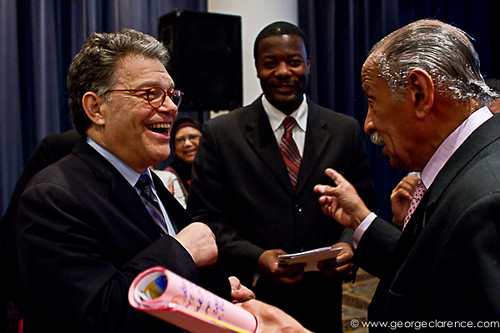
U.S. Senator Al Franken and U.S.Representative John Conyers, Jr.
That is why I, along with Senator Al Franken, recently reintroduced legislation to protect our nurses: The Nurse and Health Care Worker Protection Act (H.R. 4266/S.2408).
This simple bill directs the Secretary of Labor to issue a health and safety standard under the OSH Act that eliminates the unsafe and unnecessary practice of manual patient lifting. It would prevent thousands of injuries to nurses, protect patients from falls, and make our health care system more efficient because nurses are focused and pain-free.
This legislation borrows heavily from the work of tireless advocates for nurses and other health care workers. The American Nurses Association has been fiercely supportive of their members on this issue and convened a working-group of world-class experts to design a safe patient handling standard. The American Federation of Teachers has fought for their union-members, many of whom are nurses and other healthcare workers, who sacrifice their bodies for their patients. Public Citizen has laid out the financial and technological case for this standard. And we are especially indebted to the hospitals who have already adopted safe patient lifting standards, and who have shown what happens when health care facilities put workers and patients first.
Forty-five years ago, I helped write a promise into the American Dream: you do not have to risk your life or health to provide for yourself and your family. But that promise remains unfulfilled. The Nurse and Health Care Worker Protection Act will help us change that by ensuring nurses are no longer asked to exchange their health for their patients' health.

Voting is beautiful, be beautiful ~ vote.©

Wednesday, December 16, 2015

Conyers, Franken Reintroduce Bill to Protect Nurses and Health Care Workers from Workplace Injuries


U.S. Senator Al Franken and Representative John Conyers, Jr.
Washington, D.C. - Today, Representatives John Conyers (D-MI), Bobby Scott (D-VA) and Frederica Wilson (D-FL) and Senator Al Franken (D-Minn.) reintroduced the Nurse and Health Care Worker Protection Act of 2015, a bill dedicated to addressing the hazards nurses and health care workers face from manually lifting patients. The legislation acts upon the increasingly clear fact that nurses are suffering too many serious, preventable injuries due to unsafe lifting practices.

“We reintroduced this legislation because of the dangers that the women and men who care for us in our most trying times face on a daily basis,” said Rep. John Conyers. “H.R. 4266, the Nurse and Health Care Worker Protection Act would ensure that those men and women are adequately protected from injuries caused by lifting and moving patients and other related job hazards.  By literally lightening the burden on nurses, we can lessen the nursing shortage that is driving up health care costs across the country and denying patients the experienced caregivers they deserve.”

“Our nurses and health care workers provide essential care to millions of Americans, and they shouldn’t have to sacrifice their safety or their livelihood to do so,” Sen. Franken said. “Every year, thousands of these caregivers sustain serious injuries as a result of manually lifting patients. These injuries can cause a lifetime of chronic pain and even force nurses to leave the profession permanently. Our bill would ensure that nurses and health care workers have the tools they need to do their jobs safely, which would prevent injuries, increase patient safety, and reduce costs.”

“Too often we take nurses for granted, but we rely on the invaluable services they provide. Nurses literally do the heavy lifting when it comes to patient care and deserve systems designed to protect their health and safety. This legislation would help reduce the sometimes career-ending injuries that are completely avoidable,” said Rep. Wilson.

The Nurse and Health Care Worker Protection Act of 2015 addresses the problems confronting nurses by requiring the Occupational Safety and Health Administration (OSHA) to promulgate a health and safety standard.  That standard would require the use of mechanical lifts and safe lifting practices to minimize the risk of injury. 
   
Presently, nurses and health care workers suffer from work-related musculoskeletal disorders (MSDs) at a rate much higher than the average American worker.  In 2014, registered nurses ranked sixth in the number of days away from work because of such injuries, with more than 11,300 total cases; nursing assistants ranked second, with over 20,000.  While alarming, these numbers actually reflect the innovative efforts of states that already regulate patient lifting and the hospitals that recognize the cost-effective returns of investing in safe patient lifting programs.

Despite some progress, there are still far too many nurses injured on the job while lifting patients.  Those injuries lead to nurses exiting the profession, upending their lives because they can no longer perform their job.  Those injuries can also generate increased costs for the health care industry, which must cover lost wages and medical fees for injured health care workers, and train replacements who lack the institutional knowledge lost with each injury.
  
This proposed standard would build upon the success of similar reforms adopted at the state and individual health care facility level, which has already demonstrated the technological and economic feasibility of such approaches.  Hospitals and other health care providers have repeatedly demonstrated a quick return when they invest in safe patient handling programs, recovering their investment through decreased workers’ compensation costs, employee retention savings, and reduced patient care expenses.  By standardizing this policy across the nation, the Nurse and Health Care Worker Protection Act will alleviate burdens on health care facilities, nursing training programs, and worker’s compensation agencies.

This bill has the support of key organizations that have long-sought reforms for nurses and health care workers. Randi Weingarten, President of the American Federation of Teachers (AFT), said, “Nurses and other healthcare workers put their patients first. Sometimes, these workers get physically hurt by helping the people they care for. This bill provides a wonderful solution for patients, nurses and other healthcare workers by creating a federal standard on safe patient handling, mobility and injury prevention. As the nation’s second-largest nurses union, the AFT supports Sen. Franken and Rep. Conyers’ efforts to give our members a safe healthcare environment in which they can do what they do best—provide the highest-quality of care for their patients.”

The American Nurses Association (ANA) President Pamela F. Cipriano, PhD, RN, NEA-BC, FAAN commends Rep. Conyers and Sen. Franken for the introduction of the Nurse and Health Care Worker Protection Act. “Every day, nurses and other health care workers suffer debilitating and often career-ending musculoskeletal disorders when they manually lift or move patients, and work in pain. Manual lifting is an unacceptable risk and practice when we have the technology and knowledge to significantly reduce injuries. This bill signals that workers are not expendable and injuries are not tolerable as just ‘part of the job.’ It is a much needed step in the right direction to implementing safer programs that will help tosave and extend the careers of thousands of registered nurses,” said Cipriano, noting that safe lifting technology and simple devices also prevent injuries to patients and preserve their dignity.

Sen. Franken—who serves as ranking member of the Subcommittee on Employment and Workplace Safety—has fought to improve safety for American workers since joining the Senate. He first introduced legislation to implement safe patient handling procedures in 2009, and earlier this year he introduced the Protecting American Workers Act to expand the number of safe workplaces and make it harder to violate workplace safety laws.

Voting is beautiful, be beautiful ~ vote.©