Washington, D.C. (Dec. 14, 2017)—Today, Rep. Elijah E. Cummings, the Ranking Member of the House Committee on Oversight and Government Reform, and Rep. Jerrold Nadler, the Ranking Member of the House Committee on the Judiciary, sent a letter, below, asking their respective Chairmen, Reps. Trey Gowdy and Bob Goodlatte, to issue subpoenas for documents from two Trump Campaign data consultants—Cambridge Analytica and Giles-Parscale—after they refused to deny any communications with foreign actors during the 2016 presidential campaign.
“We understand that you declined to join the original request for documents from these companies, but this is a matter that directly affects our citizens and their exercise of their right to vote,” Cummings and Nadler wrote. “We owe the American people robust and meaningful oversight of matters affecting the integrity of our electoral process.”
On October 26, 2017, Ranking Members Conyers and Cummings sent a letter to five data consultants—Cambridge Analytica, Giles-Parscale, Target Point, Deep Root, and Data Trust—requesting documents relating to their possible engagement with foreign actors such as WikiLeaks, communication with foreign governments, or the use of misappropriated data.
Cummings and Nadler disclosed today that three of these companies—TargetPoint, Deep Root, and Data Trust,below,—sent responses on the same day, using language that was nearly identical and apparently coordinated, denying any foreign contacts.
In contrast, a letterfrom Brad Parscale of Giles-Parscale notably failed to deny that his company had contacts with or received information from foreign actors or governments during the 2016 campaign. Recent press accounts have reported that Donald Trump, Jr. emailed Parscale about his correspondence with WikiLeaks.
In addition, Cambridge Analytica refused to respond at all and thus did not deny that the company had contacts and communications with foreign actors or received any stolen or misappropriated data. WikiLeaks founder Julian Assange confirmedthat Cambridge Analytica approached WikiLeaks during the campaign to coordinate the release of former Secretary of State Hillary Clinton’s emails. Alexander Nix, CEO of Cambridge Analytics, also confirmedthis outreach.
“Because the first three companies have asserted unequivocally that none of their employees had contacts with any foreign agents during the presidential campaign, we are willing to delay any further inquiry unless or until evidence to the contrary emerges,” Cummings and Nadler wrote. “However, neither Giles Parscale nor Cambridge Analytica have denied these contacts. We therefore request that our committees issue subpoenas to these companies to compel the production of the information they are withholding from Congress.”
If the Chairmen decline to issue these subpoenas, then Cummings and Nadler request they place this matter on the agenda for the next regularly scheduled business meeting so Committee Members may vote on motions to subpoena these documents.
Today, CNN reports that candidate Donald Trump, his son Donald Trump, Jr., and others inside the Trump Organization received an email in September 2016 offering a decryption key and website address for hacked documents—weeks before WikiLeaks began publishing the contents of those documents online. Ranking Member Jerrold Nadler (D-NY) of the House Judiciary Committee issued the following statement in response:
“This email is yet another sign that senior Trump campaign officials—including Donald Trump, Jr., and perhaps the President himself—may have accepted assistance and valuable information from the Russian government and its partners. It is, of course, a crime to participate in a conspiracy to influence an election through the illegal misuse of various computer systems. It is also a crime for a foreign national to give anything of value to a campaign for federal office. At the very least, this email shows us that the Trump Campaign understood enough about these stolen documents to have immediately reported a crime to the FBI. They did not, and now Donald Jr. refuses to answer questions about his extensive back-and-forth with WikiLeaks.
“It is unconscionable that that House Judiciary Republicans want to relitigate long-debunked Hillary Clinton conspiracy theories instead of this direct threat to our election system. This is part of a coordinated effort—spearheaded by the White House—to undermine and discredit individuals and institutions, such as Special Counsel Mueller and the FBI, which are investigating the President and his associates. I once again call on Chairman Goodlatte to begin the committee’s oversight work in this space without delay.”
House Judiciary Democrats have sent more than 20 letters to the Committee and GOP Leadership, and more than 40 letters to the White House and Department of Justice seeking oversight of Trump Administration misconduct, without any meaningful response. It is high time the House Judiciary Republicans join us in investigating obstruction of justice and related charges.
While sexual harassment in the workplace is a repulsive, arcane social norm that needs to seriously be addressed, so is the rampant fraud and public corruption that takes place in the Congress, the States, County and City governments.
Consider this an introduction because there is much, much more to this story.
So, sit back, relax, and let the dirt come out, because it is not going to be what you think.
The back story is going to be of epic proportions.
Dean of the U.S. House
of Representatives
John Conyers, Jr.
“When you make private settlements, it doesn’t warn the next woman or the next person going into that situation.”
Michigan Rep. John Conyers, a Democrat and the longest-serving member of the House of Representatives, settled a wrongful dismissal complaint in 2015 with a former employee who alleged she was fired because she would not “succumb to [his] sexual advances.”
Documents from the complaint obtained by BuzzFeed News include four signed affidavits, three of which are notarized, from former staff members who allege that Conyers, the ranking Democrat on the powerful House Judiciary Committee, repeatedly made sexual advances to female staff that included requests for sexual favors, contacting and transporting other women with whom they believed Conyers was having affairs, caressing their hands sexually, and rubbing their legs and backs in public. Four people involved with the case verified the documents are authentic.
And the documents also reveal the secret mechanism by which Congress has kept an unknown number of sexual harassment allegations secret: A grinding, closely held process that left the alleged victim feeling, she told BuzzFeed News, that she had no option other than to stay quiet and accept a settlement offered to her.
“I was basically blackballed. There was nowhere I could go,” she said in a phone interview. BuzzFeed News is withholding the woman’s name at her request, because she said she fears retribution.
Last week the Washington Post reported that the office paid out $17 million for 264 settlements with federal employees over 20 years for various violations, including sexual harassment. The Conyers documents, however, give a glimpse into the inner workings of the Office of Compliance, which has for decades concealed episodes of sexual abuse by powerful political figures.
“I was basically blackballed. There was nowhere I could go."
The woman who settled with Conyers launched the complaint in 2014 with Congress’s Office of Compliance alleging that she was fired for refusing his sexual advances and ended up facing a daunting process that ended with a confidentiality agreement in exchange for a settlement of more than $27,000. Her settlement, however, came from Conyers’ office budget rather than the designated fund for settlements.
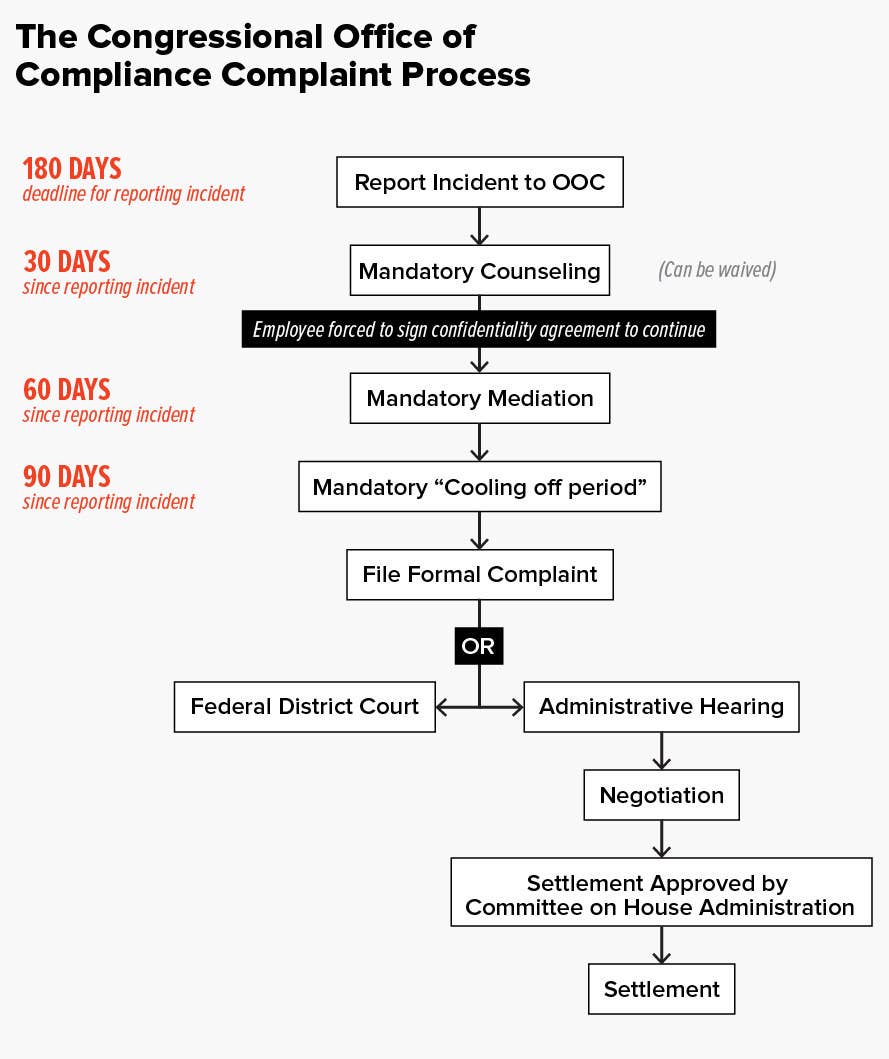
Congress has no human resources department. Instead, congressional employees have 180 days to report a sexual harassment incident to the Office of Compliance, which then leads to a lengthy process involves counseling, mediation, and requires the signing of a confidentiality agreement before a complaint can go forward.
After this, an employee can choose to take the matter to federal district court, but another avenue is available: an administrative hearing, after which a negotiation and settlement may follow.
Some members of Congress have raised major concerns with the current system over the years, but the calls for an overhaul have grown louder in the post-Weinstein era. Members have argued that 90 days is too long to make a person continue working in the same environment with their harasser; that interns and fellows should be eligible to pursue complaints through this process; and that it is unfair for a victim to have to pay for legal representation while the office of the harasser is represented for free by the House's counsel.
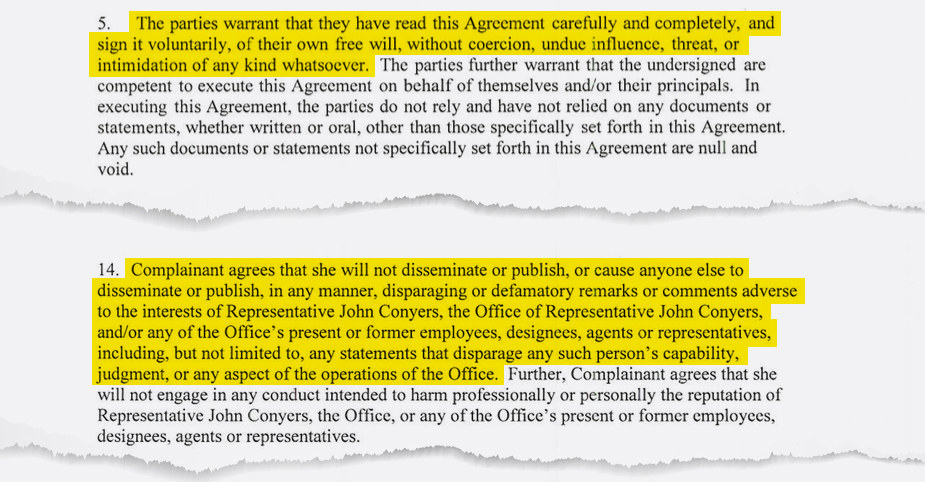
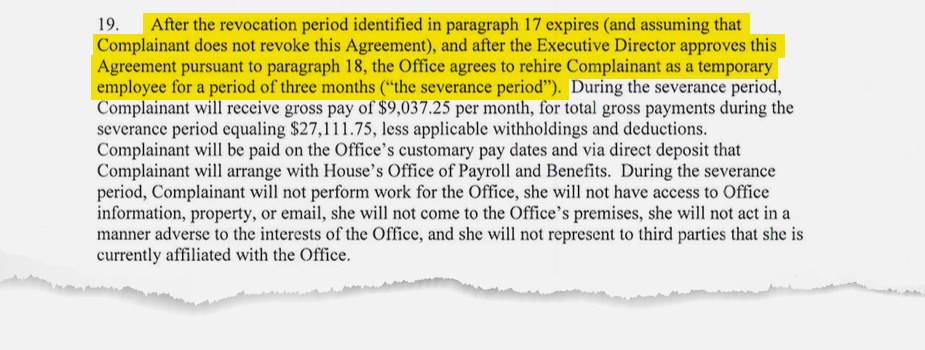
In this case, one of Conyers’ former employees was offered a settlement, in exchange for her silence, that would be paid out of Conyers’ taxpayer-funded office budget. His office would “rehire” the woman as a “temporary employee” despite her being directed not to come into the office or do any actual work, according to the document. The complainant would receive a total payment of $27,111.75 over the three months, after which point she would be removed from the payroll, according to the document.
The draft agreement, below, viewed by BuzzFeed News was unsigned, but congressional employment records match the timing and amounts outlined in the document. The woman left the office and never went public with her story.
The process was “disgusting,” said Matthew Peterson, who worked as a law clerk representing the complainant, and who listed as a signatory to some of the documents.
“It is a designed cover-up,” said Peterson, who declined to discuss details of the case but agreed to characterize it in general terms. “You feel like they were betrayed by their government just for coming forward. It’s like being abused twice.”
Other lawyers named as representing the accuser could not be reached for comment. The Office of Compliance did not confirm or deny that they had dealt with the case.
“You feel like they were betrayed by their government just for coming forward. It’s like being abused twice.”
“Pursuant to the Congressional Accountability Act, the OOC cannot comment on whether matters have or have not been filed with the office,” Laura Cech, publications and outreach manager of the Office of Compliance, told BuzzFeed News in an email when asked to comment on this case.
Two staffers alleged in their signed affidavits that Conyers used congressional resources to fly in women they believed he was having affairs with. Another said she was tasked with driving women to and from Conyers’ apartment and hotel rooms.
Rep. Conyers did not admit fault as part of the settlement. His office did not respond to multiple requests for comment on Monday.
The documents were first provided to BuzzFeed News by Mike Cernovich, the men's rights figure turned pro-Trump media activist who propagated a number of false conspiracy theories including the “Pizzagate” conspiracy. Cernovich said he gave the documents to BuzzFeed News for vetting and further reporting, and because he said if he published them himself, Democrats and congressional leaders would “try to discredit the story by attacking the messenger.” He provided them without conditions. BuzzFeed News independently confirmed the authenticity of the documents with four people directly involved with the case, including the accuser.
In her complaint, the former employee said Conyers repeatedly asked her for sexual favors and often asked her to join him in a hotel room. On one occasion, she alleges that Conyers asked her to work out of his room for the evening, but when she arrived the congressman started talking about his sexual desires. She alleged he then told her she needed to “touch it,” in reference to his penis, or find him a woman who would meet his sexual demands.
She alleged Conyers made her work nights, evenings, and holidays to keep him company.
In another incident, the former employee alleged the congressman insisted she stay in his room while they traveled together for a fundraising event. When she told him that she would not stay with him, she alleged he told her to “just cuddle up with me and caress me before you go.”
“Rep. Conyers strongly postulated that the performing of personal service or favors would be looked upon favorably and lead to salary increases or promotions,” the former employee said in the documents.
Three other staff members provided affidavits submitted to the Office Of Compliance that outlined a pattern of behavior from Conyers that included touching the woman in a sexual manner and growing angry when she brought her husband around.
One affidavit from a former female employee states that she was tasked with flying in women for the congressman. “One of my duties while working for Rep. Conyers was to keep a list of women that I assumed he was having affairs with and call them at his request and, if necessary, have them flown in using Congressional resources,” said her affidavit. (A second staffer alleged in an interview that Conyers used taxpayer resources to fly women to him.)
The employee said in her affidavit that Conyers also made sexual advances toward her: “I was driving the Congressman in my personal car and was resting my hand on the stick shift. Rep. Conyers reached over and began to caress my hand in a sexual manner.”
The woman said she told Conyers she was married and not interested in pursuing a sexual relationship, according to the affidavit. She said she was told many times by constituents that it was well-known that Conyers had sexual relationships with his staff, and said she and other female staffers felt this undermined their credibility.
“I am personally aware of several women who have experienced the same or similar sexual advances made towards them by Rep[.] John Conyers,” she said in her affidavit. A male employee wrote that he witnessed Rep. Conyers rub the legs and other body parts of the complainant “in what appeared to be a sexual manner” and saw the congressman rub and touch other women “in an inappropriate manner.” The employee said he confronted Conyers about this behavior.
“Rep. Conyers said he needed to be ‘more careful’ because bad publicity would not be helpful as he runs for re-election. He ended the conversation with me by saying he would ‘work on’ his behavior,” the male staffer said in his affidavit.
“I don’t think any allegations should be buried...and that’s for anyone, not just for this particular office".
The male employee said that in 2011 Conyers complained a female staffer was “too old” and said he wanted to let her go.
The employee said he set up a meeting in December 2011 to discuss “mistreatment of staff and his misuse of federal resources.”
The affidavit says that Conyers “agreed that he would work on making improvements as long as I worked directly with him and stopped writing memos and emails about concerns.”
Another female employee also attested that she witnessed Conyer’s advances, and said she was asked to transport women to him. “I was asked on multiple occasions to pick up women and bring them to Mr. Conyers[‘] apartment, hotel rooms, etc.”
BuzzFeed News reached out to several former Conyers staffers, all of whom did not want to speak on the record. One former staffer, who did not want to be named, said she was frustrated by the secretive complaint process.
“I don’t think any allegations should be buried...and that’s for anyone, not just for this particular office, because it doesn’t really allow other people to see who these individuals are,” said the former staffer. “When you make private settlements, it doesn’t warn the next woman or the next person going into that situation.”
Another staffer said that Conyers’ reputation made people fearful to speak out against him.
Aside from being the longest-serving House member and the ranking member of a powerful committee, Conyers is a civil rights icon. He was lauded by Martin Luther King Jr. and is a founding member of the Congressional Black Caucus.
“Your story won’t do shit to him,” said the staffer. “He’s untouchable.”
In a statement to BuzzFeed News, House Democratic Leader Nancy Pelosi said she was not aware of the settlement.
“The current process includes the signing of non-disclosure agreements by the parties involved. Congresswoman Jackie Speier has introduced legislation that will provide much-needed transparency on these agreements and make other critical reforms,” Pelosi said in the statement. “I strongly support her efforts.”
A spokesperson for John Boehner, who was the speaker of the House when the settlement was made, did not respond to a BuzzFeed News request for comment on Monday.
The documents also show that there was a belief among at least some staffers that the office was a jealous environment. Some of the documents allege Conyers offered his protection when staff would complain to him about management in the office.
California Democrat Rep. Speier and colleagues in the House and Senate have introduced legislation that would overhaul the complaint process, including requiring OOC to publicly name the office of any member who enters into a settlement.
The bill would also allow complainants to waive mediation and counseling, set up a victims' counsel, and require all congressional offices to go through harassment training every year.
Conyers’ office has a history of ethical run-ins. In 2016, his former chief of staff Cynthia Martin pleaded guilty to receiving stolen property after she refused to reimburse $16,500 that was mistakenly deposited in her account.
A preliminary investigation by the Office of Congressional Ethics found that Conyers continued to pay Martin more than $13,000 per month when she was supposedly on unpaid leave.
In 2006, two former aides complained that Conyers made them babysit his children, run errands, and work on his reelection campaign while drawing their congressional salaries. There was also a bizarre incident in 2005 when 60 Thanksgiving turkeys, given to his staff to disperse to people, may have gone missing.
Conyers’ wife, former Detroit city councilor Monica Conyers, was sentenced to three years in prison over bribery charges in 2010. (One of the documents alleged Conyers began “aggressively acting out his sexual harassment behavior” following this.) Last year the couple renewed their vows.
Washington, D.C. – Top House Democrats, Rep. John Conyers, Jr. (D-MI), Ranking Member on the House Judiciary Committee, and Rep. Elijah E. Cummings (D-MD), Ranking Member on the House Committee on Oversight and Government Reform, sent a letter, below, to several Trump campaign consultants to demand information regarding their campaign operations, whether they engaged with known hostile foreign actors such as Wikileaks, cooperated with foreign governments, or used misappropriated data during the 2016 election.
The letter is addressed to Cambridge Analytica, Giles-Parscale, TargetPoint Consulting, The Data Trust (aka GOP Data Trust) and Deep Root Analytics, which provided data analytics and voter analysis to the Trump campaign under a data operations team managed by Jared Kushner. The letter notes that “The campaign hired Giles-Parscale to run its San Antonio-based internet operation to maximize merchandise sales, heighten voter outrage, and discourage voter turnout in certain segments of the population. Cambridge Analytica provided the analysis to help choose the right targets for directed advertisements and other online media. The republican data firms Deep Root Analytics, TargetPoint, and Data Trust ‘were among the RNC-hired outfits working as the core of the Trump campaign’s 2016 general election data team.’”
Recent reports have stated that Cambridge Analytica and possibly other members of the Trump data operations team actively solicited Wikileaks -- a known hostile foreign intelligence actor -- to acquire stolen information.
In their letter, the Members wrote, “It is now clear that Russian interference with the 2016 presidential election involved the careful targeting of certain voters through social media and other online platforms. This targeting appears to have been executed with an extraordinary level of precision that suggests a deep familiarity with American voter preferences and habits and exceeds the reported capabilities of foreign cyber operations. As we assess legislation that addresses whether American businesses directly engaged with known hostile foreign actors such as Wikileaks, cooperated with foreign governments, or used misappropriated data, it is important we understand what happened…The prospect that any American company may have aided a foreign government, worked with hostile foreign actors, or benefited from unlawfully accessed information is concerning and could impact the consideration of ongoing legislation.”
WASHINGTON, DC – House Judiciary Committee Ranking Member John Conyers, Jr. joined Democratic Whip Steny Hoyer, Foreign Affairs Committee Ranking Member Eliot Engel, Homeland Security Committee Ranking Member Bennie G. Thompson, Oversight and Government Reform Committee Ranking Member Elijah Cummings, Armed Services Committee Ranking Member Adam Smith, and Intelligence Committee Ranking Member Adam Schiff sent a letter today to President Obama asking for Administration officials to brief all Members of Congress on Russian efforts to influence or interfere in the recent federal election.
Dean of the U.S. House of Representatives John Conyers, Jr.
Citing concerns that “Russia may have succeeded in weakening Americans’ trust” in our democratic institutions through its actions, the authors of the letter call attention to the hacking of American organizations, publication of private emails sent to or from campaign officials, as well as disclosures by WikiLeaks and fabricated news stories.
“By eroding Americans’ and foreigners’ trust in U.S. institutions,” the letter states, “Russia both weakens our country and sows global instability and uncertainty. …To evaluate Congress’s response appropriately, we would like all Members to have a comprehensive understanding of what the U.S. Intelligence Community knows regarding Russia’s involvement in these actions and attempts to interfere in our election.”
Washington, D.C. (Oct. 14, 2016)—Today, Reps. Elijah E. Cummings, John Conyers, Jr., Elliot L. Engel, and Bennie G. Thompson, the Ranking Members of the House Committees on Oversight and Government Reform, Judiciary, Foreign Affairs, and Homeland Security, issued the following statement in response to evidence that the Trump campaign apparently knew months beforehand about the hacking of emails from the account of Democratic presidential candidate Hillary Clinton’s campaign chairman, John Podesta:
“Troubling new evidence appears to show that the Trump campaign not only was aware of cyber attacks against Secretary Clinton’s campaign chairman, but was openly bragging about it as far back as August. For months, we have been asking the FBI to examine links between the Trump campaign and illegal Russian efforts to affect our election, including interviewing Trump advisor Roger Stone. In light of this new evidence—and these exceptional circumstances—we call on the FBI to fully investigate and explain to the American people what steps it is taking to disrupt this ongoing criminal activity. Elections are the bedrock of our nation’s democracy and a model we hold out to the world, so we must counter any foreign or domestic efforts to threaten the integrity of our electoral process.”
Roger Stone’s Public Statements About Upcoming Podesta Attacks
This past August, Trump adviser Roger Stone sent out messages on Twitter indicating that he had been informed personally about upcoming cyber attacks on campaign chairman John Podesta.
Trust me, it will soon the Podesta's time in the barrel. #CrookedHillary
Four days later, October 7, 2016, WikiLeaks publicly released emails illegally hacked from Podesta’s email account.
Roger Stone’s Public Statements About Backchannel Communications with WikiLeaks
Stone has stated repeatedly in public appearances that he communicates directly and through back channels with WikiLeaks founder Julian Assange.
On August 8, 2016, Stone stated publicly that he “communicated with”Assange about the upcoming release of illegally-hacked emails. Stone made these statements during a Republican campaign event while answering a question about a potential “October surprise.”
On August 13, 2016, Stone stated publicly that his own email accounts had been hacked “as soon as it became publicly known that I was in communication with Julian Assange.”
On October 12, 2016, Stone stated publicly: “I do have a back-channelcommunication with Assange.”
Previous Letter to FBI About Allegations of Coordination Between Trump Campaign and Russians
On August 30, 2016, Reps. Cummings, Conyers, Engel, and Thompson sent a letter to FBI Director James Comey requesting that the FBI assess whether connections between the Trump campaign and Russian interests contributed to cyber attacks against the Democratic campaign organizations to interfere with the election. The letter stated: “It is unclear whether U.S. law enforcement authorities have interviewed Mr. Stone about his communications with Mr. Assange or about his knowledge of how WikiLeaks obtained the illegally-hacked documents.”
On September 28, 2016, FBI Director James Comey testified before the House Judiciary Committee, but would not directly answer questions about any investigation regarding these matters. Instead, he statedthat the FBI is examining “just what mischief is Russia up to in connection with our election.”
On October 7, 2016, the Office of the Director of National Intelligence and the Department of Homeland Security issued a joint statementconcluding:
“The U.S. Intelligence Community (USIC) is confident that the Russian Government directed the recent compromises of e-mails from US persons and institutions, including from US political organizations. The recent disclosures of alleged hacked e-mails on sites like DCLeaks.com and WikiLeaks and by the Guccifer 2.0 online persona are consistent with the methods and motivations of Russian-directed efforts. These thefts and disclosures are intended to interfere with the US election process. Such activity is not new to Moscow—the Russians have used similar tactics and techniques across Europe and Eurasia, for example, to influence public opinion there. We believe, based on the scope and sensitivity of these efforts, that only Russia's senior-most officials could have authorized these activities.”
At a hearing on the legal implications of potentially prosecuting WikiLeaks, panel Chairman John Conyers (D-Mich.) said the group’s recent dissemination of classified diplomatic cables might have been embarrassing for the government but that the real-world consequences have been fairly modest.
He labeled calls for criminal charges against site founder Julian Assange "extreme measures" and said the widespread outrage in Washington is a sign that caution is needed before proceeding.




 AP
AP