Showing posts with label jazz. Show all posts

Friday, October 20, 2017

CONYERS: The Smithsonian Honors VHS Grad John Hasse


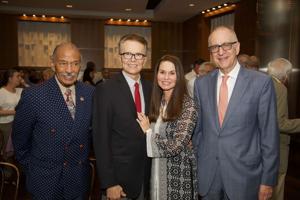
Honored By SmithsonianTop officials of the Smithsonian Institution – and Rep. John Conyers, dean of the House of Representative – saluted music curator John Edward Hasse upon his retirement from the Smithsonian on June 30, bringing to a close 32 years of distinguished accomplishments. Hasse was hailed by David J. Skorton, secretary of the Smithsonian, John L. Gray, director of the National Museum of American History, and Rep. Conyers, who inserted a tribute into the Congressional Record. Video of the ceremony can be seen at https://goo.gl/aFPpoV.

Hasse, a 1967 graduate of Vermillion High School, was hired as Curator of American Music by the Smithsonian’s National Museum of American History in 1984. In that capacity, he founded national Jazz Appreciation Month and the Smithsonian Jazz Masterworks Orchestra; curated exhibitions on Duke Ellington, Ella Fitzgerald, Ray Charles, Frank Sinatra, and jazz photography; led the museum’s successful drive to acquire the vast Duke Ellington Collection – 100,000 pages of unpublished music and another hundred thousand pages of documents, as well as objects and/or archival materials from Louis Armstrong, Benny Goodman, Jimmie Lunceford, Artie Shaw, Ella Fitzgerald, Woody Herman, Dizzy Gillespie, Miles Davis, Thelonious Monk, Herbie Hancock, Paquito d’Rivera, Randy Weston, Steve Cropper of Booker T & and the MGs, and the 12,000-photo Duncan Schiedt Collection. A highlight was Hasse’s acquisition of John Coltrane’s Selmer tenor sax and his handwritten manuscript of A Love Supreme, his most celebrated work.
Hasse’s books include Beyond Category: The Life and Genius of Duke Ellington; Jazz: The First Century; and Discover Jazz (with Tad Lathrop). He co-produced/co-authored Jazz: The Smithsonian Anthology. He has been awarded two honorary doctorates, two Grammy Award nominations, two ASCAP-Deems Taylor Awards for excellence in writing, and the Nica’s Dream Achievement Award. He has contributed articles to The Washington Post, The Wall Street Journal, and eight encyclopedias. Often at the request of the US State Department, Hasse has lectured on jazz, the arts, and leadership in 25 countries on five continents.
John Hasse is the brother of long-time Vermillion resident Paul Hasse, and the son of the late USD professors Gladys and Merten Hasse, whose ashes are interred at Bluff View Cemetery. All five of John Hasse’s siblings attended the University of South Dakota: Paul, Trudy, Ann, Ellen, and younger sister Margaret. While attending USD, the three older Hasse sisters were each elected Miss Dakota, breaking records and generating newspaper publicity from coast to coast.

http://www.plaintalk.net/local_news/article_a39662a4-b5cf-11e7-a853-83f7ab40bad0.html

Voting is beautiful, be beautiful ~ vote.©

Wednesday, February 22, 2017

CONYERS Announces 2017 Rhythm & Blues Hall of Fame Nominees

Image may contain: 6 people, people standing
U.S. Representative John Conyers, Jr. announces induction nominees for the 2017 Rhythm & Blues Hall of Fame press conference, February 21, 2017.

2017 Rhythm & Blues Hall of Fame inductees announced in Detroit

DETROIT - The 2017 Rhythm & Blues Hall of Fame inductees were announced Tuesday in Detroit. 
The news conference was at 2 p.m. at Bert's Entertainment Complex on Russell Street.

The Rhythm and Blues Hall of Fame have named 25 artists and industry leaders for possible induction in 2017.

Here's the news release ahead of the announcement:

Among the major artists nominated are Mitch Ryder, New Edition, Stevie Wonder, Gladys Knight & The Pips, Patti LaBelle, Sam & Dave, James Brown, and The Impressions, while non-artists included TV Host and entrepreneur Dick Clark, executives Berry Gordy from Motown, Gamble & Huff of Philadelphia International Records, Clive Davis of Columbia and Arista, and both radio personalities Ernie Durham and Martha the Jean Queen.

Ten(10) music icons from this year's 2017 list will emerge from the voting that will be announced on February 21, at Bert's Entertainment and will be inducted into the Hall on June 11, at The Music Hall in Detroit, Michigan. Tickets will go on sale at the Music Hall box office on February 22, you can order your tickets by calling (313) 887-8500. The new inductees will bring the total for the Hall to 160. Last year's 2016 induction ceremony saw the likes of TV-One founder Cathy Hughes, Dionne Warwick, Eddie Floyd, Wilson Pickett, Mack Rice, The Supremes.

The Rhythm and Blues Hall of Fame was founded in 2010 by former pro basketball player and R&B music activist and historian  LaMont "Showboat" Robinson for his love of R&B music and his large collection of memorabilia. When he decided he wanted to donate some of his rare artifacts to a worthy organization, he found that none existed hall of fame for rhythm and blues artist(s) so he started the organization to recognize the accomplishments of artists in R&B, Jazz, Gospel and Blues.
The Hall of Fame is currently in major discussing with a well know entertainment, music bushiness group in Detroit to build this state-of-the-arts institution.

This year's nominees:

Bobby "Blue" Bland
Dick Clark
Clive Davis
Gamble & Huff
Berry Gordy
Isaac Hayes
Bob Seger
Stevie Wonder
Mitch Ryder
Ernie Durham
Martha Jean the Queen
The Impressions
The Valadiers
Patti LaBelle
Frankie Lymon & the Teenagers
Billy Paul
Gladys Knight & The Pips
Carolyn Crawford
Mary Wells
James Brown
Joe Tex
Carl Carlton
Berry White
Sam & Dave
New Edition

http://www.clickondetroit.com/entertainment/2017-rhythm-blues-hall-of-fame-inductees-to-be-announced-today-in-detroit

Voting is beautiful, be beautiful ~ vote.©

Saturday, September 10, 2016

Congressional Black Caucus Foundation Annual Legislative Conference 2016 Jazz Issue Forum and Concert -- September 15th


The Jazzmobile All-Stars , featuring Winard Harper, Jimmy Owens, and Larry Ridley, and the Washington Renaissance Orchestra, with special guest, Joe Ford, will perform at the 31st Annual CBCF ALC Jazz concert celebrating 50 years of Jazzmobile and the 90th birthday of John Coltrane. 
Dean of the U.S. House
of Representatives
John Conyers, Jr.

U.S. Representative John Conyers, Jr . will present the 2016 CBCF Jazz Legacy Awards.


#CBCFALC16

Voting is beautiful, be beautiful ~ vote.©

Friday, May 13, 2016

CONYERS Urges Congress to Support FAIR PAY FOR ARTISTS & MUSICIANS


Conyers & Four Tops Founding Member Duke Fakir Call on Congress to Pass Fair Play Fair Pay Act


Washington, D.C. – House Judiciary Committee Ranking Member John Conyers, Jr. (D-MI) joined U.S. Representatives Jerrold Nadler (D-NY), Marsha Blackburn (R-TN) and Darrell Issa (R-CA) as well as legendary Four Tops founding member, Duke Fakir, T Bone Burnett, Roseanne Cash, and more than three dozen artists and musicians at a press conference in support of H.R. 1733, the Fair Play Fair Pay Act. The legislation would harmonize and modernize the outdated rules that currently govern music licensing for digital and terrestrial radio broadcasts.

Dean of the U..S. House
of Representatives
John Conyers, Jr.
“Detroit has many legacy artists who have never received fair compensation for their groundbreaking contributions to the music industry,” said Ranking Member John Conyers. “Failing to adequately pay artists and musicians, undermines their potential to create music. The Fair Play Fair Pay Act would provide long-overdue fairness for artists regardless of when their music was recorded or where it is played.” 

Key components of the Fair Play Fair Pay Act:

·         Creates a terrestrial performance right so that AM/FM radio competes on equal footing with its Internet and satellite competitors who already pay performance royalties. This would resolve the decades old struggle for performance rights and ensure that – for the first time – music creators would have the right to fair pay when their performances are broadcast on AM/FM radio.

·         Brings true platform parity to radio – so that all forms of radio, regardless of the technology they use – pay fair market value for music performances. This levels the playing field and ends the unfair and illogical distortions caused by the different royalty standards that exist today.

·         Ensures terrestrial royalties are affordable capping royalties for stations with less than $1 million in annual revenue at $500 per year (and at $100 a year for non-commercial stations), while protecting religious and incidental uses of music from having to pay any royalties at all.

·         Makes a clear statement that pre-1972 recordings have value and those who are profiting from them must pay appropriate royalties for their use, while we closely monitor the litigation developments on this issue.

·         Protects songwriters and publishers by clearly stating that nothing in this bill can be used to lower songwriting royalties.

·         Codifies industry practices streamlining the allocation of royalty payments to music producers.

·         Ensures artists receive their fair share from direct licensing of all performances eligible for the statutory license.

Voting is beautiful, be beautiful ~ vote.©

Thursday, April 21, 2016

Compulsory Licenses Should Require Display of Songwriter Credits

I participated in a symposium in Washington, DC on April 18 on the subject of “moral rights” sponsored by the U.S. Copyright Office and the George Mason University School of Law’s Center for the Protection of Intellectual Property. The symposium’s formal title was “Authors, Attribution and Integrity” and was at the request of Representative John J. Conyers, Jr., the Ranking Member of the House Judiciary Committee. (The agenda is linked here. For an excellent law review article giving the more or less current state of play on moral rights in the U.S., see Professor Justin Hughes’ American Moral Rights and Fixing the Dastar Gap.)
The topic of “attribution” or as it is more commonly thought of as “credit” is extraordinarily timely as it is on the minds of every music creator these days. Why? Digitial music services have routinely refused to display any credits beyond the most rudimentary identifiers for over a decade, and of course the pirate sites that Google drives a tsunami of traffic to are no better.
Yet these services frequently rely on government mandated compulsory licenses (in Copyright Act Sections 114 and 115), near compulsory licenses in the ASCAP and BMI consent decrees, and of course the sainted “safe harbor”, the DMCA notice and takedown being a kind of defacto license all its own particularly for independent artists and songwriters without the means to play. They get the shakedown without the takedown.
Moral rights are typically thought of as two separate rights: “attribution”, which is essentially the right to be credited as the author of the work, and “integrity” the author’s right to protect the work from any derogatory action “prejudicial to his honor or reputation”. They can be found most relevantly for our purposes in the Berne Convention, the fundamental international copyright treaty to which the U.S. signed on to in 1988. (Specifically Article 6bis.)
It is important to understand that the United States agreed to be subject to the international treaties protecting moral rights and that these rights are different and separate from copyright.
Moral rights transcend copyright and protect the author’s persona, or the author’s “honor and reputation.” Copyright is thought of as an economic right, while moral rights continue even after an author may have transferred the copyright in the work. Even so, both the moral rights of authors (and the material rights) are recognized as a human right by Article 27 of the Universal Declaration of Human Rights. Or as Gloria Steinem said, artist rights are human rights.
The question then came up, why should the U.S. government require songwriters to license their works through the compulsory license without also requiring proper attribution consistent with America’s treaty obligations, good sense and common decency?
Why not indeed.
It is important to note that there are certain requirements relating to the names of the authors that are required by regulations for sending a “Notice of Intention” to use a song under the compulsory license which is what starts the formal compulsory license process. The required “Content” of an NOI is stated in the regulations is:
(d) Content.
(1) A Notice of Intention shall be clearly and prominently designated, at the head of the notice, as a “Notice of Intention to Obtain a Compulsory License for Making and Distributing Phonorecords,” and shall include a clear statement of the following information....
(v) For each nondramatic musical work embodied or intended to be embodied in phonorecords made under the compulsory license:
(A) The title of the nondramatic musical work;
(B) The name of the author or authors, if known;
(C) A copyright owner of the work, if known...
As I suspect based on the various songwriter lawsuits against Spotify over its apparent failures in the handling of these NOIs, the “if known” modifying “the name of the author or authors” is actually translated as “don’t bother” as most of the form NOIs don’t even have a box for that information. This is a bit odd, because if the song is registered with the Copyright Office, the names of the authors most likely are listed in the registration and thus are “known.”
The question for moral rights purposes, of course, is not whether the music user sends the names of the authors in the NOI-presumably the copyright owner already knows who wrote the song. The question is whether the music user displays the names of the authors of a song on their service, or better yet, is required to display those names so that the public knows.
This seems a very small price to pay when balanced against the extraordinarily cheap compulsory license that songwriters are required to grant with very little recourse against the music user for noncompliance. (Short of an unimaginably expensive federal copyright lawsuit against a rich digital music service, of course.) As the Spotify litigation brought by songwriters is demonstrating, these services only have about a 75% compliance rate as it is, if that much.
It is pretty commonplace stuff for liner notes to include all of the creative credits. So who is behind the times? The artist releasing a physical disc with all of these credits, or the digital music service with its infinite shelf space that doesn’t bother with 95% of them-particularly the multinational media corporation dedicated to organizing the world’s information whether the world likes it or not? And we’re not even broaching the topic of classical music, where the metadata and credits on digital services are dreadful.
In fairness, I have to point out that iTunes has made great strides in cleaning up this problem voluntarily, at least for songwriters. Which goes to show it can be done if the service wants it done.
Digital services should care about whether the songwriters are fairly treated as ultimately songwriters create the one product the services have built their business on-songs. There is an increasing level of distrust between songwriters and services, so proper attribution can help to restore trust.
As it stands, a generation or two now have little knowledge of who wrote the songs, who played on the records, much less who produced or engineered the records they supposedly “love” and who definitely contribute to the $8 billion valuation of services like Spotify.
It seems that at least the failure to accord songwriters their moral right of attribution could be fixed in the regulations without need of amending the Copyright Act by requiring the collection and display of songwriter credits at least if those credits are part of a copyright registration. This might have the additional benefit of encouraging songwriters to register their works.
Google will no doubt vigorously lead the charge to oppose this change because that is their customary knee jerk reaction that often colors all digital services with a uniquely Googlely brush. Even so, I think this is a worthy path for both songwriters and services to pursue and could solve a number of accounting and recordation problems utilizing information that is readily available-to everyone’s advantage in furthering vital transparency. And as we know, transparency begins upstream.
Why? Because as the Universal Declaration of Human Rights teaches us, “everyone has the right to the protection of the moral and material interests resulting from any scientific, literary or artistic production of which he is the author.”

Voting is beautiful, be beautiful ~ vote.©
Monday, April 11, 2016

MARTIN IMAGES NEWS AN EVENING WITH REP. JOHN CONYERS

Uploaded on Mar 28, 2011 Voting is beautiful, be beautiful ~ vote.©

Wednesday, November 11, 2015

Conyers at Hamilton Live for DC Jazz Fest's Benefit Gala

DC JAZZ FEST GALA!

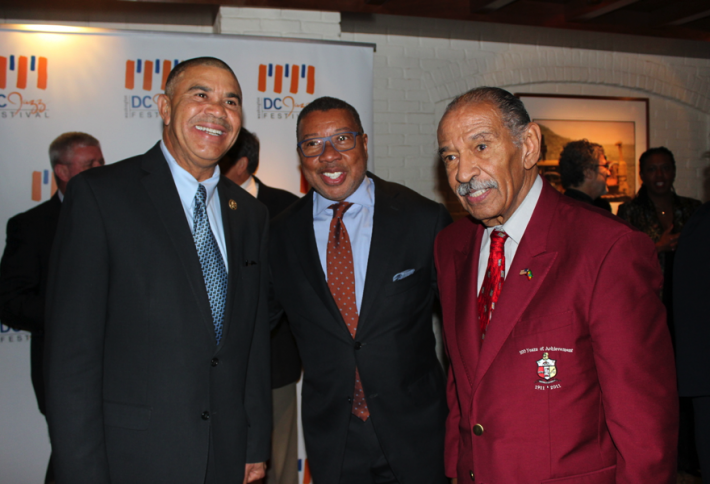
The event raised funds for The DC Jazz Festival, an annual event with more than 100 jazz performances at concert venues and clubs throughout DC. We snapped Rep. William Clay, DC Jazz Fest Chairman Conrad Kenley and Rep. John Conyers Jr., who presented the advocacy award in his name.


Voting is beautiful, be beautiful ~ vote.©

Thursday, September 17, 2015

Conyers to Host Jazz Preservation, Education, and Promulgation in the African Diaspora: Cuba


Honorary host, Rep. John Conyers Jr., in collaboration with the Congressional Black Caucus Foundation, to host:
“Jazz Preservation, Education, and Promulgation in the African Diaspora: Cuba”

WASHINGTON – Honorary host Rep. John Conyers, Jr. (D-MI) and The Congressional Black Caucus Annual Legislative Conference will hold a forum moderated by Cedric Hendricks, Executive Producer of the CBCF ALC Jazz Issue Forum and Concert, that will explore the cultural connections between American and Cuban jazz musicians and the prospect that, in the context of the current diplomatic opening, those relationships can now be made and flower with much less interference. The forum will take place on tomorrow, Thursday, September 17, at 1:30 PM in the Washington Convention Center, Room 143A.
WHO:
Gary Bartz, Jazz Studies Professor, Oberlin Conservatory of Music
James “Plunky” Branch, President, N.A.M.E. Brand Records
James Counts Early, Former Director of Cultural Heritage Policy at Smithsonian’s Center for Folklife Programs and Cultural Studies
Miles Jackson, Founder & Director, CUBA SKATE
Pedrito Martinez, Master Dancer, Percussionist and Vocalist, Afro-Cuban Folkroric Music
Januwa Moja, Founder & CEO, Regality Reality Arts
Yosvany Terry, Founder and Director, Afro-Cuban Roots: Ye dé gbé

WHAT:  Forum to explore the cultural connections between American and Cuban jazz musicians and how those relationships can flourish with less political interference reflective of new diplomatic relations between the two nations.

WHEN:  TOMORROW - Thursday, September 17, 2015 from 1:30–3 p.m.

WHERE:  Washington Convention Center, Room 143A
                        
Media registration is available onsite at the Walter E. Washington Convention Center.
ABOUT THE ALC: The ALC is the leading policy conference on issues impacting African Americans and the global black community. Lawmakers, business and civic leaders, celebrities, and concerned citizens attend the conference to partake in more than 70 public policy forums on health, education, economic empowerment, the environment, civic engagement, and the Exhibit Showcase. Signature events include the National Town Hall, Celebration of Leadership in Fine Arts, Gospel Extravaganza, Black Party, Prayer Breakfast, and the culminating event, the Phoenix Awards Dinner.
 To learn about sponsorship opportunities, contact the CBCF resource development team at 202.263.2800.
 For regular updates about the ALC, visit cbcfinc.org/alc, sign up to receive the e-newsletter, and follow the CBCF on social media.
 
Twitter:twitter.com/CBCFInc #CBCFALC15 #LJFA
Facebook:facebook.com/CBCFInc 
Instagram:instagram.com/cbcfinc 
LinkedIn:linkedin.com/company/congressional-black-caucus-foundation
Google+:google.com/+CBCFIncorg 
YouTube:youtube.com/user/CBCFINC 
Periscope
www.periscope.tv
(follow: CBCFInc)

Views: 4

Voting is beautiful, be beautiful ~ vote.©

Wednesday, April 9, 2014

Smithsonian celebrates April as Jazz Appreciation Month with John Conyers

Smithsonian celebrates April as Jazz Appreciation Month supported by the stalwart leadership of U.S. Representative John Conyers who has introduced a Bill to promote jazz preservation.

Rep. John Conyers, Hugh Masakela, members of the Smithsonian Jazz Masterworks Quintet, and John Haase
Below, is the calendar of events.

Voting is beautiful, be beautiful ~ vote.©

Thursday, April 3, 2014

Pols Party Down at GRAMMYs on the Hill

Then, in true Washington fashion, Pelosi brought everything full circle, singling out Rep. John Conyers Jr., D-Mich., for staying tuned into intellectual property concerns from his perch as ranking member on the House Judiciary Committee...
Voting is beautiful, be beautiful ~ vote.©

Wednesday, March 26, 2014

Conyers Kicks Off Jazz Appreciation Month by Introducing a Bill to Preserve & Promote Jazz


(WASHINGTON) – On March 21st, Congressman John Conyers, Jr. (D-Mich.) reintroduced his jazz appreciation bill, H.R. 4280, the “National Jazz Preservation, Education, and Promulgation Act of 2014.” Tonight, Congressman Conyers will attend the Smithsonian Institution’s Jazz Appreciation Month kickoff concert featuring Ravi Coltranewho donated a saxophone owned by his father, John Coltrane, to the Smithsonian earlier today. This year’s activities commemorate the 50th Anniversary of the classic album A Love Supreme. Prior the event, Congressman Conyers issued the following statement:

U.S. Representative
John Conyers, Jr.
“This legislation builds upon H. Con. Res. 57, the landmark jazz legislation passed in 1987, which recognized ‘jazz as a rare and valuable national treasure.’ Passed on September 23, 1987 - John Coltrane’s birthday - it was an incredibly important moment in the history of this most American of art forms. However, like so many important efforts, its potential has not yet been fully realized,” said Conyers.

“H.R. 4280 seizes upon the three goals stated in H. Con. Res. 57 - preservation, education, and promulgation - and actually creates programs to achieve those ends.

“The first element, preservation, creates in the Smithsonian Institution a Jazz Preservation Program that will secure artifacts from jazz history and work with groups across the country to maintain collections that tell the story of jazz from its inception to its present, and which will provide learning opportunities for jazz enthusiasts nationwide.

“The understanding component is achieved through two different means. It establishes an education program, Jazz Artists in the Schools, which will ensure that children have access to an enriched curriculum that builds jazz performances into the students’ education. And it also reconstitutes international cultural exchanges built around Jazz music, called Ambassadors of Jazz, which the U.S. State Department first initiated in the 1950s.

“Finally, H.R. 4280 adds a promulgation prong that responds to grassroots input. It supports this goal ofpromulgation by creating a National Jazz Appreciation Program at the Smithsonian Institution, in coordination with the National Endowment for the Arts and the National Endowment for the Humanities, which will develop a nationwide series of concerts that showcases the diversity and vitality of jazz.

“H.Con.Res. 57 marked a momentous occasion - the formal recognition of jazz as America’s music and the securing of its place in history. H.R. 4280 fulfills the promise of that recognition, ensuring that our children’s children have access to the music that has influenced so much of our history and so many of our lives.”


Voting is beautiful, be beautiful ~ vote.©

Monday, September 2, 2013

GRAMMY AWARD WINNER TERRI LYNE CARRINGTON, NEA JAZZ MASTER JIMMY HEATH AND ANTONIO HART HEADLINE CBCF JAZZ CONCERT ON SEPTEMBER 20th

Washington, DC – Rep. John Conyers, Jr., of Michigan, Ranking Member of the House Judiciary Committee, and Dean of the Congressional Black Caucus, will once again serve as the Honorary Host of the 28th Annual Congressional Black Caucus Foundation (CBCF) Jazz Issue Forum and Concert. The events will take place during the Foundation’s 43rd Annual Legislative Conference (ALC), September 18-21, 2013, at the Walter E. Washington Convention Center (WEWCC), 801 Mount Vernon Place, NW, Washington, DC 20001.

 The Jazz Issue Forum, entitled, "Jazz Preservation and Education: The Kansas City Connection," will be held on Thursday, September 19th, from 1:30 to 3:30 pm, in Room 145A of the WEWCC. The panel discussion will focus on contemporary jazz preservation and education initiatives in Kansas City, MO and what implications those might have for the proposed National Jazz Preservation and Education Act, H.R. 2823.

The panelists will include Moderator Cedric Hendricks, ALC Jazz Executive Producer; Ms. Anita Dixon, Vice-President, Mutual Musicians Foundation-Kansas City; Gregg Carroll, Chief Executive Officer, American Jazz Museum – Kansas City; Dr. Larry Ridley, Jazz Education Consultant; Dr. James Hardy Patterson, Professor of Music, Clark Atlanta University; and Bobby Watson, Director of Jazz Studies, University of Missouri-Kansas City.

The Issue Forum will also include Josh Kohn, Program Officer for Jazz & Traditional Arts, Mid Atlantic Arts Foundation (MAAF), making a special presentation on the MAAF Project “Jazz.NEXT: Using Technology to Build A Healthy Sustainable Jazz Environment.”.

Cedric Hendricks will set the framework for the Forum with an update on H.R. 2823. Rep. John Conyers will also deliver remarks.

 The Jazz Concert will be held from 8:00 to 10:30 pm, in Ballroom A of the WEWCC. Doors for the concert open at 7:00 pm. Legendary bassist, Dr. Larry Ridley and saxophonist extraordinaire Bobby Watson will be honored and presented in concert. Rep. Conyers will present 2013 CBCF Jazz Legacy Awards to Dr. Ridley and Prof. Watson.INE CBCF JAZZ CONCERT ON SEPTEMBER 20th

 The concert will open with a performance by bassist/composer/bandleader/educator Dr. Larry Ridley and his Jazz Legacy Ensemble. Besides Dr. Ridley, the Jazz Legacy Ensemble consists of Richard Wyands, piano; Doug Harris, saxophone; and Greg Buford, drums.

A special feature of Dr. Ridley’s set will showcase the National Hand Dance Association Dancers demonstrating the profound relationship, but nearly lost art, of social dancing to modern jazz. Hugh Wyatt of the New York Daily News described Dr. Ridley as a “master bassist” and a “musician’s musician.”

He has been one of the most in-demand bassists of the past six decades, performing with over150 artists including Wes Montgomery, Carmen McRae, Freddie Hubbard, Thelonious Monk, David Baker, Dizzy Gillespie, Marvin Gaye, Tammi Terrell, and Alicia Keys. Ridley has also recorded over 50 sessions as a sideman.

His recordings as a leader include Other Voices and Live at Rutgers University (with the Jazz Legacy Ensemble), and Sum of the Parts. Dr. Ridley served as Chairman, Music Department, Livingston College of Rutgers University, 1972-1980; Professor of Music, Rutgers University, 1972-1999, and has served as Professor Emeritus at Rutgers, beginning in 1999. He has served as Artist-in-Residence at a number of colleges, universities and institutions including Southern University, College of the Virgin Islands, University of Natal-Durban and the Schomburg Center/New York Public Library, where he has been in residence since 1993. Dr. Ridley’s numerous honors and awards include the Mid-Atlantic Arts Foundation's Living Legacy Jazz Award (1997), Howard University’s Benny Golson Award (2001) and the Don Redman Society’s Don Redman Heritage Award (2011). He has also been inducted into The International Association of Jazz Educators Hall of Fame (1998); Down Beat Magazine’s Jazz Education Hall of Fame (1999) and received the Rutgers University/Livingston College Legacy Award (2011).

 Headlining the concert will be alto saxophonist/composer/arranger/bandleader/educator Bobby Watson and his quintet, featuring Freddie Hendrix, trumpet; Richard Johnson, piano; Curtis Lundy, bass; and Eric Kennedy, drums. Blessed with sizzling and sinewy sound that Jazz: The Rough Guide described as “a highly individual, extraordinarily fluid style imbued with powerful feeling,”

Watson was born in Lawrence, Kansas, and grew up in Kansas City, Kansas. He started playing piano at ten, the clarinet one year later, took up the saxophone in the eighth grade, played in various concert and R&B bands in high school. He graduated from the University of Miami in 1975, moved to New York City.

Watson joined Art Blakey’s Jazz Messengers, serving as his Musical Director from 1977 to 1981. He has recorded over one hundred recordings as a sideman and has worked with an impressive array of artists including Max Roach, Joe Williams, Dianne Reeves, Betty Carter and Lou Rawls. He was also a co-founder of the 29th Street Saxophone Quartet. Watson formed the group, Horizon in 1980. Horizon’s six recordings include No Question About It, Midwest Shuffle and Post-Motown Bop. Watson’s nearly thirty CD’s as a leader include Appointment in Milano, Round Trip, The Year of the Rabbit and his Kansas City opus, The Gates BBQ Suite. Watson’s compositions, “In Case You Missed It,” “Love Remains,” and “E.T.A,” are considered modern jazz standards. Prof. Watson taught at William Patterson University in the mid-eighties, and at the Manhattan School of Music from 1986 to 1999.

He returned to Kansas City in 2000, where he was selected as the recipient of the first William D. and Mary Grant Missouri Distinguished Professorship in Jazz Studies, the first endowed chair at the University of Missouri-Kansas City Conservatory of Music, where he continues to serve as the Conservatory’s Director of Jazz Studies.

Watson received Howard University’s Benny Golson Award earlier this year. Both the Jazz Issue Forum and the Jazz Concert are free and open to the public. Prospective Jazz Issue Forum and Jazz Concert attendees should register via the conference web site. Registration:

http://cbcfinc.org/registration-2013.html Media Registration: http://www.cbcfinc.org/alc2013-registration.html

Twitter – www.twitter.com/CBCFInc (#CBCFALC13 #Itstartswithyou) 

Facebook – www.facebook.com/CBCFInc For live shots/satellite information, please contact

mcooper@cbcfinc.org.


Learn more: BEVERLY TRAN: GRAMMY AWARD WINNER TERRI LYNE CARRINGTON, NEA JAZZ MASTER JIMMY HEATH AND ANTONIO HART HEADLINE CBCF JAZZ CONCERT ON SEPTEMBER 20th http://beverlytran.blogspot.com/2013/09/grammy-award-winner-terri-lyne.html#ixzz2ejVseKNW
Stop Medicaid Fraud in Child Welfare 
Voting is beautiful, be beautiful ~ vote.©

Monday, September 17, 2012

Conyers hosts CBCF jazz concert, September 20, 2012


GRAMMY AWARD WINNER TERRI LYNE CARRINGTON, NEA JAZZ MASTER JIMMY HEATH AND ANTONIO HART HEADLINE CBCF JAZZ CONCERT ON SEPTEMBER 20th 

Washington, DC – Rep.John Conyers, Jr., of Michigan, ranking member of the House Judiciary Committee, and dean of the Congressional Black Caucus, will once again serve as the Honorary Host of the Congressional Black Caucus Foundation’s (CBCF) Jazz Issue Forum and Concert. The events will take place during the Foundation’s 42nd Annual Legislative Conference, September 19 -22, at the Walter E. Washington Convention Center (WCC), 801 Mount Vernon Place, NW, Washington, DC 20001.
The Jazz Issue Forum, entitled "If You Really Are Concerned: An African-American Agenda For Jazz, " will be held from 2:00 to 4:00 pm, in Room 209-A of the WCC. The panel discussion will focus on African-America’s cultural engagement with jazz.  The panelists will include Dr. James Patterson, Clark-Atlanta University, Willard Jenkins of Open Sky Jazz as well as recording and performing artists Terri Lyne Carrington, Gerald Clayton, Antonio Hart, Jimmy Heath and Lizz Wright. Rep. John Conyers will make remarks. ALC Jazz Executive Producer Cedric Hendricks will provide an update on H.R. 2823, the National Jazz Preservation and Education Act.

The Jazz Concert will be held from 8:00 to 10:30 pm, in Ballroom A of the WCC. Doors for the concert are at 7:00 pm. At 7:30 pm, Willard Jenkins will facilitate a Meet the Artist conversation featuring Terri Lyne Carrington, Gerald Clayton, Jr., and Lizz Wright. M. Carrington’s recent recording date, a re-imagining of the Duke Ellington, Charles Mingus, Max Roach collaboration, Money Jungle, will be the focus of the conversation.
The concert will open with a performance by Grammy nominated saxophonist Antonio Hart and his Quintet. A graduate of Berklee College of Music, Hart first appeared on the jazz scene in the eighties, initially as a member of Roy Hargrove’s band, and then as a leader in his own right. He has appeared on over 80 recordings, including nine as a leader. His latest is All We Need (Chiaroscuro Records). Mr. Hart also studied under Jimmy Heath at Queens College, earning his Master’s Degree. He is currently a full-time Professor at The Aaron Copland School of Music, Queens College. Performing with Hart will be Jeb Patton, piano; John Lee, bass; Lee Pearson, drums; and special guest Jimmy Heath, saxophones.
Headlining the concert will be drummer Terri Lyne Carrington and her Money Jungle Project, featuring: Gerald Clayton, piano; Tia Fuller, saxophones; James Genus, bass; and Lizz Wright, vocals. The Project commemorates the fiftieth anniversary of the recording of the seminal 1962 Duke Ellington LP, Money Jungle. Earlier this year, Carrington was awarded a Grammy for her ground-braking recording, The Mosaic Project, showcasing many of the leading female instrumentalists and vocalists on the scene today.
Carrington has studied, performed and recorded with some of the most important artists in contemporary Jazz, including Geri Allen, Jack DeJohnette, Herbie Hancock, Patrice Rushen, and Wayne Shorter. She was the house drummer for the Arsenio Hall Show, and has released several, critically-acclaimed recordings as a leader, including Real Life StoryJazz is a SpiritStructureMore to Say; Real Life Story and The Mosaic Project.
Rep. John Conyers will present James Edward Heath with the 2012 CBCF ALC Jazz Legacy Award for his six decades of contributions to jazz and world culture. Known worldwide as Jimmy Heath, Mr. Heath is legendary and still active as a tenor and soprano saxophonist, composer and arranger. In 2003, he was presented with the prestigious National Endowment for the Arts (NEA) Jazz Master Award. Jimmy Heath is the recipient of numerous honorary degrees and lifetime achievement awards.
The oldest living member of the Philadelphia-based Heath Brothers jazz family (bassist Percy and drummer Albert), Jimmy Heath rose to prominence during the forties, as a member of the Howard McGhee Big Band. He also played with and composed for Dizzy Gillespie, Miles Davis, Kenny Dorham, Milt Jackson, and Art Blakey. Many of Heath’s compositions have become jazz standards, including “C.T.A.,” and “Gingerbread Boy.” He has minted over twenty critically acclaimed recordings, including Really Big!, Love and UnderstandingNew PictureLittle ManBig Band, and Endurance. Heath first worked as an educator with Jazzmobile, New York City’s premier not-for-profit jazz program. In 1987, he was appointed Professor of Music at the Aaron Copland School of Music at Queens College, City University of New York. Professor Heath created the Jazz Program at Queens College, where he taught and mentored a generation of musicians, before retiring in 2004. In 2010, he co-wrote I Walked With Giants: The Autobiography of Jimmy Heath, with Joseph McLaren (Temple University Press).
Both the Jazz Issue Forum and the Jazz Concert are free and open to the public.
Conference attendees may register at https://show.jspargo.com/cbcf12/reg/


Twitter – www.twitter.com/CBCFInc (#CBCFALC2012)


Voting is beautiful, be beautiful ~ vote.©