Showing posts with label Rosa Parks. Show all posts

Tuesday, February 3, 2015

Rosa Parks papers give insight into the civil rights icon

Rosa Parks papers give insight into the civil rights icon

WASHINGTON – The mother of the modern civil rights movement received a Congressional Gold Medal and the Presidential Medal of Freedom, and was sought out by world leaders, popes and politicians as a symbol of quiet resistance and strength. A statue of her stands in the U.S. Capitol.
But Rosa Parks also had a recipe for featherlight pancakes. She liked to jot prayers that would come to her on slips of paper, or on the back of church bulletins.
For most of her life, she kept a handful of letters from a classmate who moved away when they were girls — the two gossiping in them about boys and their studies.
But there also are notes of her arrest and the important work and shared struggles between fellow icons of the civil rights movement, like Dr. Martin Luther King Jr. And we also learn how much she missed her husband while fighting the good fight.
On Wednesday, the 102nd anniversary of Parks' birth, the Library of Congress will open to researchers a trove of 7,500 manuscripts and 2,500 photos from her personal collection; an archive of handwritten notes, mementos, honors and correspondence that had languished in warehouses in New York and Michigan for nearly a decade since her death in her adopted home of Detroit in 2005.
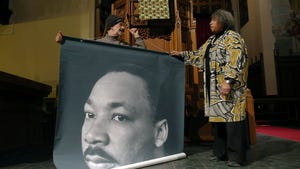
In them, she talks about the Jim Crow laws in the South she grew up under, and sketches notes about the seminal 1955 bus boycott in Montgomery, Ala., she sparked when she was arrested for refusing a bus driver's order to give up her seat to a white passenger.
There are photos of her with Stokely Carmichael and Shirley Chisholm. There is a postcard from Rome from Dr. Martin Luther King Jr.
"We are really in the thick of it now. Rev. King's home was bombed last night while we were at the First Baptist Church mass meeting. His wife and baby were in the house but not hurt," she writes her mother in a letter drafted after the Jan. 30, 1956, attack in Montgomery.
Pope and poll tax
But amid all the witness-to-history artifacts — a note after she's had dinner with future Supreme Court Justice Thurgood Marshall, for instance, or her ID card for the Southern Christian Leadership Conference's 1968 Poor People's Campaign, or a copy of a 1999 letter she sent to Pope John Paul II after meeting him — is the ordinary, the everyday, the mundane.
It is made all the more remarkable for it being hers.
A copy of a 1957 poll tax receipt for $1.50, a remnant of a now-forbidden Jim Crow practice forcing blacks and others to pay their way into the voting booth. A pocket-sized Gideon Bible she carried in her purse. A dues book for her membership in the Order of the Eastern Star, State of Alabama, 1940.
Snapshots of her husband, Raymond Parks, and her childhood home. A long-ago letter from a young niece. Her husband's barber certificate.

"I hope you are all right and that mother is well and you do not miss me too much. I am fine," she wrote to "Parks, my dear husband" in Detroit in October 1957 from Hampton, Va., where she — unable to find work elsewhere — had taken a job as a hostess at an inn for a salary of $308.33 a month.
She was looking for work for him there as a barber so he could join her, she wrote, even enlisting the help of someone who ran an all-white barbershop to let her know if he heard of any positions open.
"I miss you so very much and wish you were here," she continued. "The weather is not cold now but you should be here to warm my feet by the time winter comes."
Life in Detroit
The Parkses moved to Detroit in 1957, unable to work in Alabama, and much of the collection stands as a growing testament not only to their time in Michigan — a program from St. Matthew AME Church on Glendale, a program for a local African History Club and its annual tribute to Paul Robeson in a school auditorium — but to their troubles.
They were so financially strapped, they relied for a time on donations to help pay medical bills.
"I was so glad to get your letter and hope some money has come in, other than the $100. … Ralph Abernathy said the hospital bill was over $500 so I know you are in a bad fix," white civil rights activist Virginia Durr, a friend of Parks in Montgomery, wrote her in 1960, after she had returned from Virginia and was hospitalized with an ulcer.
Her financial troubles would continue until she helped elect John Conyers to Congress in 1964 — asking King for his help in doing so — and Conyers hired her. She worked in his office until 1988.
Loan to library
"I would say personal is the perfect way to describe it," said Margaret McAleer, senior archives specialist for the library. "These are the things she carried with her from home to home to home. And it's amazing it survived."
The collection came to the library late last year on a decade-long loan from the Howard G. Buffett Foundation, which purchased them from the estate for $4.5 million.
A sampling of items from the collection will be on display in glass cases in the library's historic Jefferson Building in Washington from March 2-30. And several items will be included in the library's exhibit on the Civil Rights Act of 1964, which begins March 7 and runs through Sept. 12.
Researchers, meanwhile, will have access to all of the materials, which, taken together, will help inform historians about the civil rights struggle. They also paint a picture of an uncomplaining woman strong enough to weather personal troubles and who had a clear understanding of the oppressive culture she was born into.
She drafted letters and notes describing the times, talking about how blacks could work behind the luncheonette counters but not be served at them, and how white newspaper readers objected to referring to black women as "Miss" or "Mrs."
She spoke of the "lynch-murder of Young Emmett Till of Chicago," saying, "This case could be multiplied many times in the South. ... It is the custom to keep such things covered up."
She describes her feelings leading up to her quiet act of resistance: "I had been pushed around all my life and felt at this moment that I couldn't take it anymore. ...We soothe ourselves with the salve of attempted indifference, accepting the false pattern set up by the horrible restrictions of Jim Crow. ... Let us look at Jim Crow for the criminal he is."
"There is just so much hurt, disappointment and oppression one can take. … the line between reason and madness grows thinner."
Considering her iconic status in the history of civil rights, it is easy to look at such writings and forget she was a woman, too. It is a myth much of the rest of the collection readily dispels.
Her pancake recipe calls for peanut butter. Her childhood friend, named Galatas, wrote saying she was sorry Rosa's new boyfriend — her husband-to-be — wouldn't cut her long hair because he loved it so.
Under the word, "Closing," Rosa Parks wrote on a loose slip of paper: "Oh, man, what doth the Lord request of thee: to do justly — to love mercy and walk humbly with thy God."
Contact Todd Spangler: 703-854-8947 or tspangler@freepress.com. Follow him on Twitter @tsspangler.

ABOUT THE ROSA PARKS COLLECTION
Purchased by the Howard G. Buffett Foundation last summer, the Rosa Parks Collection includes about 7,500 manuscripts and 2,500 photographs kept by the civil rights icon who died in her adopted home of Detroit in 2005. The Library of Congress in Washington, D.C., which will house them on a 10-year-loan, will make them available to researchers for the first time beginning Wednesday, the 102nd anniversary of Parks' birth in Tuskegee, Ala.
A sampling of the items will be on display in glass cases at the library's Jefferson Building from March 2-30. Several items will be included in the library's exhibit, "The Civil Rights Act of 1964: A Long Struggle for Freedom," March 7 to Sept. 12.
Voting is beautiful, be beautiful ~ vote.©

Wednesday, February 27, 2013

Conyers Salutes Rosa Parks as a Civil Rights and Voting Rights Icon


(WASHINGTON) – Today, civil rights icon Rosa Parks was honored by having a statue dedicated in her honor within Statuary Hall inside of the United States Capitol. Following his participation in the ceremony, Congressman John Conyers, Jr. (D-Mich.) issued the following statement:

U.S. Representative
John Conyers, Jr.
“Rosa Parks was a champion of civil rights, an advocate for peace, and a dear friend,” said Conyers.

“While quiet in demeanor, through her steadfast devotion to universal human rights, Mrs. Parks was a powerful voice for racial equality and societal reform through non-violence. She embodied the love of both humanity and freedom, from her decades-long work advancing civil rights, to her time spent in my office serving the Detroit community.

“I find it ironic that on the day we are honoring Mrs. Parks, the Supreme Court is hearing a case challenging the constitutionality of the Voting Rights Act from a county in Alabama. Under these circumstances, we are powerfully reminded that the statue dedicated today stands not only for the dedication and life-work of Mrs. Parks. The statue also reminds us of the unfinished work we have in achieving full equality under the law and in guaranteeing the right to vote of every American everywhere within the country.”


Voting is beautiful, be beautiful ~ vote.©

Friday, February 22, 2013

Day of Courage: Congressman John Conyers

U.S. Representative John Conyers, Jr. introduced by U.S. Representative Gary Peters at the Henry Ford Museum honoring Rosa Parks. Voting is beautiful, be beautiful ~ vote.©

Saturday, January 28, 2012

Michigan's Supreme Court once again insists judge honors Rosa Parks' wishes

Michigan's Supreme Court once again insists judge honors Rosa Parks' wishes

Rosa Parks worked for
U.S. Representative John Conyers, Jr.
The Michigan Supreme Court again has ordered a Wayne County probate judge to put Elaine Steele and Adam Shakoor back in charge of the Rosa Parks estate, in keeping with the late civil rights icon’s wishes.
The high court on Friday gave Judge Freddie Burton Jr. 28 days to reinstate the pair. Steele was Parks’ longtime assistant and caregiver; Shakoor is a retired 36th District Court judge.
Burton had asked the state Supreme Court on Jan. 17 to relent from its Dec. 29 directive ordering him to put Steele and Shakoor back in control, saying, in part, that Steele had previously violated his court orders.
Steele’s attorney, Steven Cohen, denied those charges and urged the Supreme Court a few days later to remove Burton from the case.
Cohen called Friday’s order a significant victory. Even though the high court didn’t remove Burton, he said, it rejected his accusations.
“This reverses three years of Judge Burton’s rulings,” Cohen said Saturday. “We undertook the entire appeal process to ensure that Mrs. Parks’ long-held and deeply felt wishes were going to be carried out.”
Alan May of Troy, who represents the two court-appointed lawyers Burton put in charge of the estate, John Chase Jr. and Melvin Jefferson Jr., said Burton still could give them a role in the estate.
“He could appoint Steele and Shakoor, or he could appoint all four,” May said.
Parks sparked the modern civil rights movement in 1955 by refusing to give up her seat to a white man on a Montgomery, Ala., bus.
She died in 2005, leaving most of her estate to the Rosa and Raymond Parks Institute for Self Development, which she created with Steele.
After she died, Parks’ nieces and nephews challenged her estate plan, and Burton replaced Steele and Shakoor with Chase and Jefferson. The institute, Steele and the relatives eventually settled their differences, but Chase and Jefferson remained in place.
Cohen asked the Supreme Court to intervene in July, saying the two lawyers, with Burton’s approval, had drained the estate of nearly $243,000 and fabricated phony charges that Burton used to order the institute and Steele to forfeit their share of Parks’ vast memorabilia collection, potentially worth $8 million. Burton indicated in court documents that he planned to give the forfeited share to a charity of his choice.
Chase and Jefferson have denied any wrongdoing, and the Michigan Court of Appeals has praised their work on behalf of the estate.
Their lawyer, May, and Cohen agree that the Supreme Court’s Dec. 29 order voids Burton’s forfeiture order. The bulk of the profits from the eventual sale of the memorabilia is expected to go to the institute.

Rosa Parks Estate Court Order January 27, 2012

Voting is beautiful, be beautiful ~ vote.©

Saturday, October 15, 2011

Reigniting The Dream

Reigniting The Dream


By Rep. John Conyers Jr. This post is part of an ACSblog symposium in honor of the unveiling of theMartin Luther King Jr. National Memorial.

U.S. Representative
John Conyers, Jr.
The dedication of the Martin Luther King Jr. National Memorial provides an opportunity to reflect and commit ourselves to Dr. King’s work. The ceremony on Oct. 16 will also serve as a homecoming for people of every nation who heeded Dr. King’s dare to dream and then worked toward the twin goals of justice and equality. In addition we honor the sacrifices of those who marched, sacrificed, and died – including Dr. King – in the struggle for equality and equal justice under law.
Martin Luther King, Jr. Memorial
But what exactly was King’s dream? The easy answer is an America free of racial injustice. But Dr. King understood that at the root of racial injustice lay economic injustice. Poverty went hand-in-hand with segregation. Poverty kept African Americans struggling under the yoke of segregation, and poverty bred the racism and ignorance that made segregation popular amongst their poor white neighbors. Dr. King dreamed to end not just racial injustice, but the poverty that had allowed it to flourish.              
When you examine the levels of poverty and unemployment in the nation today, when juxtaposed against the current levels of defense spending from a decade of war, I believe that Dr. King would determine that the nation had failed to heed his vision of jobs, justice and peace.As families have suffered under the weight of joblessness, low wages and the housing crisis, it is the youngest members of American society who are most affected. The latest “Kids Count” report from the Annie E. Casey Foundation shows that child poverty grew in 38 of 50 U.S. states over the past decade.
In 2009, 20 percent of US children — about 14.7 million — were poor, up from 17 percent in 2000. This means that about 2.5 million more children were living in poverty in 2009 than in 2000. This contrasts to the period from 1994 to 2000, when the child poverty rate fell by nearly 30 percent.
The report found that poverty rates are highest in the South, Southwest and Appalachia. In Mississippi, the worst-affected state, 31 percent of children live in poverty. The highest rates of child poverty were seen among African-Americans (36 percent), American Indian and Alaskan Natives (35 percent), and Hispanics (31 percent). As measured by the impact on the youngest members of our society, we still need to adjust our priorities. The message of Dr. King remains as relevant today as at the time of his death.
Part of the greatness of Dr. King was his ability to convert a mass political movement into an opportunity for an individual awakening by touching our essential humanity. As a young lawyer in Detroit, he inspired me to go south to join the crusade against Jim Crow segregation. It was through this work that I first met Rosa Parks, who ultimately was forced to leave Montgomery after the successful bus boycott to seek better economic opportunity.  Ms. Parks joined my first campaign for Congress, and I was honored when she helped secure an endorsement of me from Dr. King, one of the few he ever made.
Dr. King’s vision of a just America has been the touchstone of my congressional career. For example, I continue to advocate on behalf of H.R. 676, a bill to institute a single payer healthcare system, out of a belief that every American, regardless of their circumstances, deserves access to healthcare coverage. Lack of coverage is one of the largest contributing causes of bankruptcy in this country and we all pay real and social costs when our fellow citizens lack coverage. Dr. King understood that we are not just individuals. And his message that we have a real obligation to help each other, coupled with his commitment in the face of opposition, and strength of character has inspired my work during every day that I have served in Congress.     
When we honor Dr. King, we must remember the greater message of his “I Have a Dream” speech. He fought for jobs, justice and peace for all people. He took on the North’s dehumanizing forms of segregation, and marched with garbage collectors, autoworkers, Teamsters, and other organized labor groups to demand fair pay and dignity for workers of all races. He organized protests to end the era’s bloody wars, and fought for the rights denied to gays and lesbians. Dr. King’s dedication to speaking truth to power on unpopular issues earned him powerful enemies and caused controversy long after his death. 
When I introduced the MLK holiday bill in the days following his assassination, his opponents sought to undermine the effort by pointing to his stance on the Vietnam War and accusing him of being un-American. The power of Dr. King’s message could not be denied, and slowly but surely, support for a federal holiday in his honor grew into the millions. Finally, in 1983, fifteen years after Dr. King’s assassination and twenty years after the March on Washington, Congress passed the legislation with a vote of 338 to 90 in the House on Aug. 3 and a vote of 78 to 22 in the Senate on Oct. 19. That November, President Reagan signed Public Law 98-144 into law. Many of those members of Congress who opposed the bill in at its initial introduction were converted along the way and openly wondered why it took so long to pass. 
I hope that the King Memorial will help ground his legacy in historical fact. The new Memorial should rekindle our nation’s reverence of not just Dr. King’s words, but his works. In this time of political acrimony -- casualties from two wars and millions of Americans out of work -- I hope this celebration will remind our great country of the goals for which Dr. King gave his life and inspire each of us to realize his dreams through our daily actions.


Voting is beautiful, be beautiful ~ vote.©