Showing posts with label Federal Reserve. Show all posts

Thursday, September 21, 2017

CONYERS: CBC Foundation Legislative Conference On Jobs

Jobs, Justice, Peace


Conyers speaks on Martin Luther King, Jr., how Coretta Scott King continued his work in jobs initiatives and how the Federal Reserve needs to create jobs.

Voting is beautiful, be beautiful ~ vote.©

Monday, March 13, 2017

CONYERS, WATERS, SCOTT & WARREN Applaud Appointment Of Raphael Bostic To Atlanta Federal Reserve Bank


Bostic to Become First African-American Fed President

Washington, DC - United States Representatives John Conyers, Jr. (D-MI), Ranking Member on the Judiciary Committee; Maxine Waters (D-CA), Ranking Member on the Financial Services Committee; and David Scott (D-GA), a senior member of the Financial Services Committee; and Senator Elizabeth Warren (D-MA), today released the following statements to recognize the historic appointment of Raphael Bostic to be the President of the Atlanta Federal Reserve Bank. Bostic will become the first African-American President of a Federal Reserve Bank in the Fed's 100 year history. The Members of Congress applauded today's announcement and encouraged the Fed to continue to diversify the leadership of banks across the country.

Dean of the U.S. House
of Representatives
John Conyers, Jr.
In May of 2016, Rep. Conyers and Sen. Warren led a letter to Fed Chair Janet Yellen calling for more diversity in the Federal Reserve’s leadership; the letter was signed by 116 members of the House and 11 senators. In October 2016, Reps. Conyers, Lewis, Waters and Scott sent a letter to the Fed specifically calling for the Atlanta Federal Reserve Bank position to be filled by a diverse candidate.

"The selection of Raphael Bostic to lead the Atlanta Reserve is a historic step on the long road to equality and justice for people of color in the United States," Congressman Conyers said. "I am pleased that Federal Reserve officials have taken this important step to fulfill Congress's call to diversify their leadership, both in terms of race and occupational background. Not only is he the first African-American regional bank president, but he is also a champion for families struggling in today's economy, and does not come from the corporate background that is already overrepresented at the Fed.  I greatly look forward to working with President Bostic to ensure that progress towards the full employment vision, laid out by Dr. King and Coretta Scott King, is fulfilled for all of America's people."

"Mr. Bostic is an outstanding choice," said Congresswoman Waters, Ranking Member of the House Committee on Financial Services. "His wealth of experience and research on wealth disparities and barriers to economic opportunity will play a critical role in shaping the economic policy decisions that affect all American families. Given the disparate economic experiences faced by key demographic groups, it is crucial that a broader cross-section of groups have a seat at the decision-making table. I congratulate Mr. Bostic on his appointment and encourage the Federal Reserve Bank of Richmond, working with the Board of Governors, to build on today's announcement by conducting the genuine and intentional efforts needed to build diversity at the Fed and ensure its senior leaders reflect the interests of America as a whole."

"I could not be more thrilled about today's announcement regarding Raphael Bostic being named the next Atlanta Regional Bank President," said Congressman Scott.  "This marks an historic event for our Federal Reserve System.  In over 100 years of its existence, never has there once been an African American as a Regional President. That all ends today."

"Raphael Bostic is an excellent choice to head the Atlanta Fed. He has extensive experience researching how economic policy affects working families," Senator Warren said. "I am glad to see Raphael's appointment, and I encourage the Fed to further strengthen its leadership by bringing on additional people with diverse backgrounds to serve in key roles."
Congressman Conyers launched the 32-member
 Congressional Full Employment Caucus in February 2014. Full employment is defined as the lowest possible unemployment rate that the economy can reach. Congressman Conyers has introduced several pieces of legislation to further that goal:  H.R. 1000,the Humphrey-Hawkins 21st Century Full Employment and Training Act of 2015, which would tax Wall Street speculation to guarantee a job or training to every American who wants to work; H.R. 3531The Full Employment Federal Reserve Act, which instructs the Federal Reserve bank to target a four percent national unemployment rate – the rate reached in the late 1990s; and H.R.3674The Labor Statistics Improvement Act, which would create a commission to ensure that unemployment statistics accurately reflect the reality on the ground for job seekers. The Congressional Full Employment Caucus serves as a platform and working group for Members of Congress who are dedicated to identifying solutions and advocating for legislative action to reduce unemployment. 

Atlanta Federal Reserve Bank picks Raphael Bostic to succeed Dennis Lockhart as new president and CEO

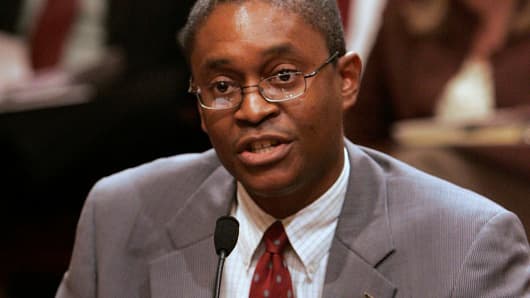
Raphael Bostic
Raphael Bostic, Federal Reserve Bank of Atlanta, President

The Federal Reserve Bank of Atlanta said Monday that Raphael Bostic will succeed Dennis Lockhart as president and CEO.
Bostic, 50, will take on the role after Lockhart retired from the Atlanta Fed on Feb. 28.
"We are very pleased that Raphael will join the Atlanta Fed as its president and chief executive officer," said Thomas Fanning, chairman of the board of the Federal Reserve Bank of Atlanta.
"He is a seasoned and versatile leader, bringing with him a wealth of experience in public policy and academia. Raphael also has significant experience leading complex organizations and managing interdisciplinary teams. He is a perfect bridge between people and policy," he said.
Bostic said in a statement, "The Reserve Banks are vital contributors to our nation's economic and financial success. I'm excited about the opportunity to work with the Bank's well-respected staff in advancing the excellent reputation this organization has built over many years."
Lockhart served in his role since March 1, 2007, and is beyond the 65-year age limit that the Fed sets for reappointment of regional bank presidents to a new 10-year term, Reuters reported. He plans on continuing to pursue his "interests in public policy, civic work and private business," the bank said.
Bostic worked at the Federal Reserve Board of Governors from 1995 to 2001, serving as an economist and then a senior economist in the monetary and financial studies section.
Voting is beautiful, be beautiful ~ vote.©

Thursday, October 6, 2016

CONYERS Leads Effort for Diversity In Federal Reserve Bank Leadership


Washington, DC - Reps.  John Conyers, Jr. (D-MI), Ranking Member on the Judiciary Committee;  John Lewis (D-GA), a senior member of the House Ways & Means Committee; David Scott (D-GA), a senior member of the Financial Services Committee; and Maxine Waters (D-CA), Ranking Member on the Financial Services Committee, urged the Federal Reserve to conduct an inclusive, transparent search for the next President of the Reserve Bank of Atlanta, one that engages candidates from many diverse backgrounds.

Dean of the U.S. House
of Representatives
John Conyers, Jr.
In a letter to Federal Reserve Chair Janet Yellen and Thomas Fanning, Chairman of the Atlanta Fed, the Members emphasized the need for Federal Reserve policymakers to account for our nation’s grave racial disparities in terms of unemployment, wages, and income in the development of monetary policy, especially since the economic downturn severely damaged the already tenuous financial security of traditionally underserved communities.  In the sixth Federal Reserve district, where the new president will serve, unemployment and poverty rates for African-Americans, for example, are about double those for white Americans.

Presidents of the 11 other reserve banks have all worked for major financial firms or at the Federal Reserve before their appointments.  The Members urged the Fed to consider a wider range of backgrounds, including academia, labor, and non-profit institutions, to capture the perspectives of all Americans as they develop economic policy.  Since the appointment of Andrew Brimmer to the Federal Reserve Board of Governors by Lyndon Johnson, there have been only a few minority governors, and no African-American or Latino bank presidents have ever been appointed.  Currently there is one Asian bank president, Neel Kashkari, who heads the Reserve Bank of Minneapolis.

report by the Center for Popular Democracy in February 2016 showed that the overwhelming majority of Reserve Bank directors and presidents are white, and there has never been an African-American or Latino Federal Reserve Bank president in the Fed’s history.  In May, 127 Members of Congress, led by Congressman John Conyers, Jr., signed a letter urging for more diversity and a greater focus on high employment in minority communities at the Fed. 

“Selecting the first African-American or Latino Regional Bank president would be a historic milestone for the Federal Reserve, and I greatly appreciate Chair Yellen’s focus on increasing diversity.  But given the Fed’s long history of prioritizing low inflation over job creation, the candidate also should be truly committed to full employment and possess deep knowledge of labor market disparities that too often leave workers, especially workers of color, behind,” said Rep. John Conyers, Jr., Ranking Member on the House Judiciary Committee and Chair of the Congressional Full Employment Caucus.

“With this search, the Federal Reserve has a unique opportunity to restore confidence in our financial system by including the perspectives and experiences of a wider range of Americans,” Rep. John Lewis said.  “Metro Atlanta was hit hard by the Great Recession, and many people in the South are still mired in poverty due to that downturn.  In light of recent crises, the Federal Reserve should look far and wide to find the best person for this important job, not only within its own network.  The Fed has a responsibility to ensure that the financial needs of the most vulnerable are considered within the policymaking process.”                                      

“The Federal Reserve has an opportunity to do something very significant with the recent retirement announcement of the current President of the Atlanta Federal Bank,” said Rep. David Scott.  “We’ve never had an African American Regional Fed president.  I’m asking the Federal Reserve to take this opportunity to make history.  We have many exceptionally qualified African Americans who can do this.”

In September, Atlanta Federal Reserve President Dennis Lockhart announced his retirement, effective in February 2017.  To find a new president, the Directors of the Federal Reserve Bank of Atlanta will identify and consider candidates, who then must be interviewed and approved by the Federal Reserve Board of Governors.  The Federal Reserve Bank of Atlanta is one of 12 regional Reserve Banks and covers Georgia, Florida, Alabama, eastern Tennessee, southern Mississippi, and southern Louisiana.

Congressman Conyers launched the 32-member Congressional Full Employment Caucus in February 2014. Full employment is defined as the lowest possible unemployment rate that the economy can reach. Congressman Conyers has introduced several pieces of legislation to further that goal:  H.R. 1000, the Humphrey-Hawkins 21st Century Full Employment and Training Act of 2015, which would tax Wall Street speculation to guarantee a job or training to every American who wants to work; H.R. 3531The Full Employment Federal Reserve Act, which instructs the Federal Reserve bank to target a four percent national unemployment rate – the rate reached in the late 1990s; and H.R.3674The Labor Statistics Improvement Act, which would create a commission to ensure that unemployment statistics accurately reflect the reality on the ground for job seekers. The Congressional Full Employment Caucus serves as a platform and working group for Members of Congress who are dedicated to identifying solutions and advocating for legislative action to reduce unemployment. 

Voting is beautiful, be beautiful ~ vote.©

Thursday, June 9, 2016

CONGRESSIONAL FULL EMPLOYMENT CAUCUS STATEMENT ON MAY JOBS REPORT


Washington, D.C. – Congressional Full Employment Caucus Co-Chairs Congressman John Conyers, Jr. (D-MI), Congresswoman Marcy Kaptur (D-OH) and Congresswoman Frederica Wilson (D-FL) released the following statement on May jobs report numbers:

Dean of the U.S. House
of Representatives
John Conyers, Jr.
“We are deeply concerned by the alarming jobs numbers released by the Bureau of Labor Statistics, which show that just 38,000 jobs were created last month—the weakest number in six years.  Jobs figures for the previous two months were revised down, bringing the average for the last three months to just 116,000.   Although the unemployment rate decreased 0.3% to 4.7%, this reflects increased hopelessness rather than new hiring, as the number of Americans looking for work decreased to 62.6%—a level unseen since the late 1970s. The number of Americans working part-time because they were unable to find full time work increased dramatically to 6.4 million people. Communities of color continue to face crisis-level unemployment rates, showing almost no improvement in employment.

“This disappointing jobs report is sending a powerful message:  it is unacceptable for policymakers, including the Federal Reserve, to take any action that harms job and wage growth. This means that raising the interest rate should be off the table, especially considering the impact it would have on communities of color that have yet to share in the economic recovery. As we wrote to Chair Yellen with 124 other House Members and Senators last month, “By fostering genuine full employment, the Federal Reserve can help combat discrimination and dramatically reduce the disproportionate unemployment faced by minority populations.”

“Despite significant progress in recent years, our job market is still too weak to declare victory. Congress must step up to the plate and work with President Obama to expeditiously pass legislation that creates good-paying jobs. President Obama, Congress, and the Federal Reserve must make clear to the American people that job creation remains our top priority.”

The Congressional Full Employment Caucus was launched in February 2014. Members of the Congressional Full Employment Caucus have introduced three bills to address the unemployment crisis and help Americans access good-paying jobs: H.R. 1000, the Humphrey-Hawkins 21st Century Full Employment and Training Act of 2015H.R.3555, the Jobs! Jobs! Jobs! Act of 2015, and H.R.1966, the21st Century Civilian Conservation Corps Act. The Congressional Full Employment Caucus serves as a platform and working group for Members of Congress who are dedicated to identifying solutions and advocating for legislative action to reduce unemployment.
Voting is beautiful, be beautiful ~ vote.©

Friday, May 13, 2016

REP. CONYERS & SEN. WARREN LEAD MORE THAN 125 MEMBERS OF CONGRESS IN CALLING FOR DIVERSITY AT FEDERAL RESERVE BANK

Letter Expresses Concern That Lack of Representation Could Harm Job Creation in Communities of Color

Washington, D.C. - Today, Congressman John Conyers, Jr. (MI-13), the Dean of the Congress and Senator Elizabeth Warren (D-MA) sent a letter signed by 127 Members of the U.S. House and U.S. Senate, urging the Federal Reserve to prioritize diversity in its leadership and to focus its attention on the high rates of unemployment in communities of color across the country.

Addressed to Federal Reserve Chair Janet Yellen, the letter calls attention to the lack of diversity across the Federal Reserve system. The letter is the latest effort by Rep. Conyers and his Full Employment Caucus to focus attention on the impact of the Federal Reserve’s policies on communities of color. Last September, Rep. Conyers and the Full Employment Caucus introduced H.R. 3541, the Full Employment Federal Reserve Act, which instructs the Federal Reserve to target a 4 percent unemployment rate nationally. 

Dean of the U.S. House
of Representatives
John Conyers, Jr.
“Far too often, the voices of minorities are silenced because they aren’t sitting at the table,” said Congressman Conyers. “The Federal Reserve needs leadership that models the diversity that exists in this Nation. Detroit and cities across the country with high minority populations have some of the highest unemployment rates and will be harmed if the Federal Reserve does not consider our needs when they make key policy decisions. Increasing diversity at the Federal Reserve will help ensure that the needs of people of color, women, labor, and consumers are part of the crucial conversations at our nation’s central bank.”

Currently, 11 of the 12 regional Federal Reserve Bank presidents are white and 10 of the 12 are men. Not a single regional Bank president is African American or Latino and no African-American has ever served as president of a regional Bank in the history of the Federal Reserve System. This year, all voting members of the interest rate-setting Federal Open Market Committee (FOMC) are white.

recent study found that just 53 percent of Detroiters ages 16-64 are employed, well below the national average of 75 percent. When the Federal Reserve raises interest rates to slow inflation, it necessarily slows job creation and wage growth, which some argue is problematic for communities of color that have not yet fully received the benefits of the economic recovery.

In 2010, Federal Reserve meeting minutes show no discussion of the African-American unemployment rate, even as it reached 15.5 percent that year. In their letter, the Members wrote, “When the voices of women, African-Americans, Latinos, and representatives of consumers and labor are excluded from key discussions, their interests are too often neglected.”

Noting the current African-American unemployment rate of 8.8 percent, which is more than double the rate for Whites, the Members continued, “By fostering genuine full employment, the Federal Reserve can help combat discrimination and dramatically reduce the disproportionate unemployment faced by minority populations…employment discrimination against women and minorities decreases as our economy approaches full employment. The data is unambiguous: even when comparing workers with the same levels of education, African-American workers face higher unemployment rates and are paid less than their white counterparts, women make less than their male counterparts, and women of color are particularly disadvantaged.”

The letter is signed by 116 Members of the U.S. House, including Members of the Congressional Full Employment Caucus, which Rep. Conyers founded and jointly chairs with Rep. Marcy Kaptur (D-OH) and Frederica Wilson (D-FL); as well as nearly every member of the Congressional Black Caucus and Congressional Hispanic Caucus. The letter is also signed by 11 U.S. Senators.
Voting is beautiful, be beautiful ~ vote.©

Tuesday, December 15, 2015

CONYERS: The Federal Reserve Should Let Jobs and Wages Grow

By John Conyers, Jr.

Dean of the U.S. House
of Representatives
John Conyers, Jr.
The Federal Reserve is widely expected to raise the federal funds interest rate from the near-zero levels in force since December 2008. With the headline unemployment rate at 5 percent, many Fed officials are declaring that we are near full employment, and will therefore act to slow the economy for the first time in 7 years. 

This would be a mistake. Our jobs recovery remains incomplete. 

In 1977, Congress tasked the Federal Reserve with the "dual mandate" of pursuing "maximum" employment and low inflation. But fighting potential inflation--the top priority of inflation hawks at the Fed--comes at the expense of jobs and wages. Raising interest rates dampens economic demand with the goal of impairing the job market and undermining workers' ability to seek higher pay or better benefits (what Wall Street executives refer to as "wage inflation"). If the Fed raises interest rates for the first time since the Great Recession, they will effectively be declaring "mission accomplished" on jobs and wages.

But there is a major issue: The data simply does not support a rate hike. Inflation remains well below the Fed's target of 2 percent (a target that many leading economists already say is too low). Meanwhile, tens of millions of workers are struggling to find good jobs. Over 6 million Americans are working part-time because they can't find a full-time gig. Arguably the most important indicator, the prime-age employment-to-population ratio (the share of adults ages 25 to 54 who have a job) has recovered less than half of its drop from the Great Recession. This means that over 4 million would-be workers have given up looking for work, and are not even counted as unemployed. And one figure that Fed Chair Janet Yellen is known to watch carefully--the quits rate, or the percentage of workers willing to leave their job, has remained essentially unchanged all year. At year's end, the quits rate is still 9.2 percent lower than it was before the recession, indicating that many workers are stuck in jobs that they would leave if they could. This makes sense, because with 1.5 unemployed workers for every job opening, one-third of those currently unemployed will not be able to find a job no matter how hard they search. 

Wage growth has been sluggish, with workers unable to earn their share of what was lost in the recession, and November's jobs report showed that it slowed to a crawl for many workers. With a minimum wage that is lower in real terms than it was in 1968, and millions of Americans still seeking work, the Fed should not slow job creation and wage growth absent clear evidence of inflation. 

Workers of color have the most to lose from a premature rate increase. The African-American unemployment rate is more than double the rate for whites, with many urban pockets--such as my hometown of Detroit--faring even worse. But letting the economy reach full employment holds some answers: For every 1 percent reduction in the national unemployment rate, African-Americans see a nearly 2 percent reduction. When the unemployment rate dropped to 4 percent in the late 1990s, the black unemployment rate fell to 7.6 percent, the lowest rate on record and the closest it has ever been to the white rate during an economic expansion. An unsubstantiated rate increase will again raise questions about the Fed's commitment to ensuring that our disadvantaged populations can experience the American Dream of earning a living.

If the Fed does rush to raise rates, it would not be the first time that our central bank valued Wall Street's inflation jitters over the livelihoods of American workers. Since 1980, the economy of the United States has operated below full employment 70 percent of the time, according to the Congressional Budget Office's official estimate of full employment. This is perhaps unsurprising, considering that Fed policymakers almost exclusively come from the financial industry and tend to be far more concerned about inflation than working Americans. 

To correct this imbalance, I introduced H.R. 3541, "The Full Employment Federal Reserve Act," which instructs the Fed to target a 4 percent unemployment rate. Even if it is not immediately passed by Congress, Fed officials should follow the lessons from the late 1990s that inspired my bill. At the time, then-Fed Chair Alan Greenspan was facing the same pressure from banks and inflation hawks to raise rates that Yellen is facing today. Greenspan, however, refused to go along, and the unemployment rate dropped all the way down to 4 percent as a year-round average for 2000. This meant that millions of Americans were able to get jobs and wage increases a rate increase would have denied them.

Despite causing the Great Recession, Wall Street got bailed out. Congress then failed to enact meaningful job creation legislation (such as my New Deal-style jobs bill, H.R. 1000) to bail out working Americans. Will the Fed now heed our workers and allow jobs and wages to grow? Will they look at the reams of data showing that the job market remains damaged from the recession? Or will they pull the rug out from under the recovery, setting a troubling precedent by slowing the economy before it's ready? We find out on Wednesday.

Voting is beautiful, be beautiful ~ vote.©

Monday, September 21, 2015

Senior Democrat Has A New Plan To Trim Unemployment

Rep. John Conyers wants to force the Federal Reserve to focus more on job growth.

<span class='image-component__caption' itemprop="caption">Rep. John Conyers (D-Mich.), accompanied by demonstrators with the umbrella group Fed Up, speaks outside of the Federal Reserve in Washington, Thursday, Sept. 17, 2015. Conyers introduced legislation on Thursday require the Fed to target lower unemployment. (AP Photo/Jacquelyn Martin)</span>
Rep. John Conyers (D-Mich.), accompanied by demonstrators with the umbrella group Fed Up, speaks outside of the Federal Reserve in Washington, Thursday, Sept. 17, 2015. Conyers introduced legislation on Thursday require the Fed;to target lower unemployment
 
The Federal Reserve may not have raised its benchmark interest rate on Thursday, but advocates of full employment still worry it could do so before the economy is ready.


Rep. John Conyers (D-Mich.), a senior House progressive, introduced a bill that same day that would make a future rate increase dependent on much lower unemployment than the U.S. is likely to achieve anytime soon.

Conyers’ proposed Full Employment Federal Reserve Act would obligate the Fed to define full employment as a maximum unemployment rate of 4 percent and “a labor market in which median wages are rising with worker productivity, job seekers can find work, and involuntary part-time work is at a minimum.” Short of meeting those criteria, the Fed would be unable to raise its influential interest rates.

“It is unacceptable for any branch of our government to take any action to slow our economy before all Americans have the opportunity to experience the jobs recovery and see meaningful wage growth,” Conyers said in a statement.

Conyers’ bill has six original co-sponsors -- all members of the Full Employment Caucus, a group of House members devoted to full employment policies. It has the backing of the Economic Policy Institute and the Center for Economic and Policy Research, two Washington-based liberal think tanks.

Unemployment now is officially 5.1 percent, a level that falls within the Fed’s full employment target. The central bank is prepared to raise interest rates with this level of joblessness, but did not on Thursday because of concerns that an economic slowdown in China and a drop in oil prices will depress inflation. 

The Fed has a dual mandate to enact monetary policy that promotes both full employment and stable prices. The two-pronged mission, established by Congress in 1977, does not specify how the central bank should define those goals.

Critics of the Fed, mostly liberal, have said top Fed officials have used this discretion in recent decades to prioritize concerns about excessive inflation over maximizing employment. The choice is essentially zero sumWhen the Fed increases interest rates to limit inflation, it does so by deliberately reducing economic demand, which reduces potential job growth. 

Long before the financial market volatility that began in late August, these economists and activists opposed an interest rate hike, saying the official unemployment rate fails to account for people working part time involuntarily, or those who have given up looking for work.

Progressive pressure on the Fed to prioritize full employment has escalated in the past year with the launch of the Fed Up campaign, a coalition of groups led by the Center for Popular Democracy. Fed Up has mobilized low-income workers and people of color to lobby Fed officials against an interest rate hike and to make the central bank more accountable to the broader public. 

Conyers joined Fed Up activists demonstrating on Thursday outside of the downtown Washington offices where Fed Chair Janet Yellen later held a press conference on the decision to maintain current interest rates.


Voting is beautiful, be beautiful ~ vote.©

Thursday, September 17, 2015

Conyers and Full Employment Caucus Members Introduce Legislation to Strengthen Federal Reserve System’s Jobs Mandate


WASHINGTON–Today, Representative John Conyers, Jr. (MI-13), with support from 6 members of his Congressional Full Employment Caucus, introduced the “Full Employment Federal Reserve Act of 2015.” The bill instructs the Federal Reserve System to target a 4 percent unemployment rate and other indicators of a strong labor market before acting to slow the economy by raising interest rates.

Sean of the U.S House
of Representatives
John Conyers, Jr.
“My new legislation will help to ensure that Federal Reserve policymakers prioritize job creation and wage growth for workers above Wall Street jitters about possible inflation. It is unacceptable for any branch of our government to take any action to slow our economy before all Americans have the opportunity to experience the jobs recovery and see meaningful wage growth,” said Rep. Conyers.

Congress amended The Federal Reserve Act in 1977 to mandate that the Federal Reserve System promote the goals of “maximum employment” and “stable prices,” which became known as the “dual mandate.” As a result, Federal Reserve board members seek to determine what is the lowest unemployment rate consistent with stable inflation (known as the “nonaccelerating inflation rate of unemployment,” or NAIRU).

Rep. Conyers’ new legislation amends the Federal Reserve’s mandate to define “maximum employment” as “as an economy with an unemployment rate of not more than 4 percent,” in addition to “a labor market in which median wages are rising with worker productivity, job seekers can find work, and involuntary part-time work is at a minimum.”

The bill also replaces “stable prices” with “a stable rate of inflation,” to comport with the consensus among economists that some level of inflation is necessary and healthy.

"The Fed acted admirably to stem the damage done by the Great Recession and to spur recovery until now. But the job is far from finished—the economy remains far from genuine full-employment and this means that the Fed's mandate remains unfulfilled,” said economist Josh Bivens, Director of Research and Policy at the Economic Policy Institute.

While the headline unemployment rate has lowered to 5.1 percent, other indicators suggest a weaker job market. 6.5 million Americans are forced to work part-time because they can’t find full time work, a figure that is higher than at any time since the early 1990s. Another 3.5 million “missing workers” have given up searching for work due to poor job opportunities, and as a result are not included in the unemployment rate. Nominal wage growth, arguably the most important indicator of a strong labor market, remains stagnant.

"Congress gave the Fed a dual mandate to pursue full employment and price stability,” said economist Dean Baker, Co-Director of the Center for Economic and Policy Research. “In the last thirty five years it has not paid sufficient attention to the full employment part of this mandate. Specifying a 4.0 percent unemployment rate as a target, the same rate the economy sustained as a year-long average in 2000, should act to clarify the Fed's mission.”

Since the Great Recession, the American economy has consistently had an unemployment rate higher than the Federal Reserve’s NAIRU and an inflation rate below the Federal Reserve’s target. Overall, since 1980, the American economy has been operating at an unnecessarily high rate of unemployment70 percent of the time, according to estimates of the NAIRU by the Congressional Budget Office.

Conyers announced the legislation earlier today at a press conference hosted by the Fed Up Coalition, which urged the Federal Reserve not to prematurely raise interest rates, a view that has been echoed by former top economists for Presidents Clinton and Obama, Lawrence Summers and Gene Sperling, Nobel Prize winning economists Joe Stiglitz and Paul Krugman, the NY Times Editorial Board, thechief economist of the World Bank, and many others.

Original co-sponsors of the measure include Full Employment Caucus Co-Chairs Frederica S. Wilson (D-FL) and Marcy Kaptur (D-OH), as well as Full Employment Caucus Members Keith Ellison (D-MN), Sheila Jackson Lee (D-TX), Henry C. "Hank" Johnson, Jr. (D-GA), and Donald Payne, Jr. (D-NJ).

Voting is beautiful, be beautiful ~ vote.©

Sunday, March 16, 2014

Conyers & Wilson Lead Congressional Letter to New Federal Reserve Chair Janet Yellen Urging Focus on Full Employment


(WASHINGTON) – Today, in response to the ongoing jobs crisis in America, Representatives John Conyers, Jr. (D-Mich.), Frederica Wilson (D-Fla.), and 19 of their Congressional colleagues sent a letter to new Federal Reserve Chairwoman Janet Yellen urging her to focus on the Federal Reserve’s mandate to promote maximum employment. The Federal Reserve’s jobs mandate has a long history, with origins in the Employment Act of 1946, and further affirmations in both the Federal Reserve Reform Act of 1977 and the Humphrey-Hawkins Full Employment and Balanced Growth Act of 1978.  For much of the last century, our political leaders were in agreement: government has a responsibility to strive toward the attainment of full employment. Today, monetary policy remains an essential vehicle for reducing unemployment. The letter encourages Chairwoman Yellen to explore options beyond the current quantitative easing programs to boost the economy as directly as possible. After the letter was sent to Chairwoman Janet Yellen, the leaders of the letter, Representatives Conyers and Wilson issued the following statement:

U.S. Representative
John Conyers, Jr.
Congressman John Conyers, Jr. (D-Mich.):  “While Wall Street is booming, tens of millions of Americans continue to suffer unemployment or underemployment.   Our entire government - including Congress and the Federal Reserve - must work towards a comprehensive agenda to pursue full employment. Chairwoman Yellen has a powerful arsenal of policy tools to combat unemployment and a long history of standing up for working Americans. We know that her policy priorities align with those of the Congressional Full Employment Caucus, and that she will guide Federal Reserve’s policymaking with the plight of the unemployed in mind. In our letter, we encourage the Federal Reserve to search for options beyond quantitative easing to boost the economy directly and efficiently.”

Congresswoman Frederica Wilson (D-Fla.): “I came to Congress to fight for jobs. With the Republican House leadership inexcusably unwilling to act on any meaningful jobs legislation, we must make use of all the economic tools at the government’s disposal. That’s why we’re calling on the Federal Reserve to commit to strong job-creation policies. We have faith in Dr. Yellen, who is not only a historic figure as the first female Fed Chair, but also a champion for low-income Americans.”


Voting is beautiful, be beautiful ~ vote.©